Read · · 6 min read
The market's most-owned stocks spent nineteen months going sideways while every benchmark ran. We built a daily board to read whether that is ending — here is how it works, and why.

The companion read to the Mag Pulse board, which launches today. The board answers one question daily; this piece explains why the question is worth asking at all.
The discount, stated plainly
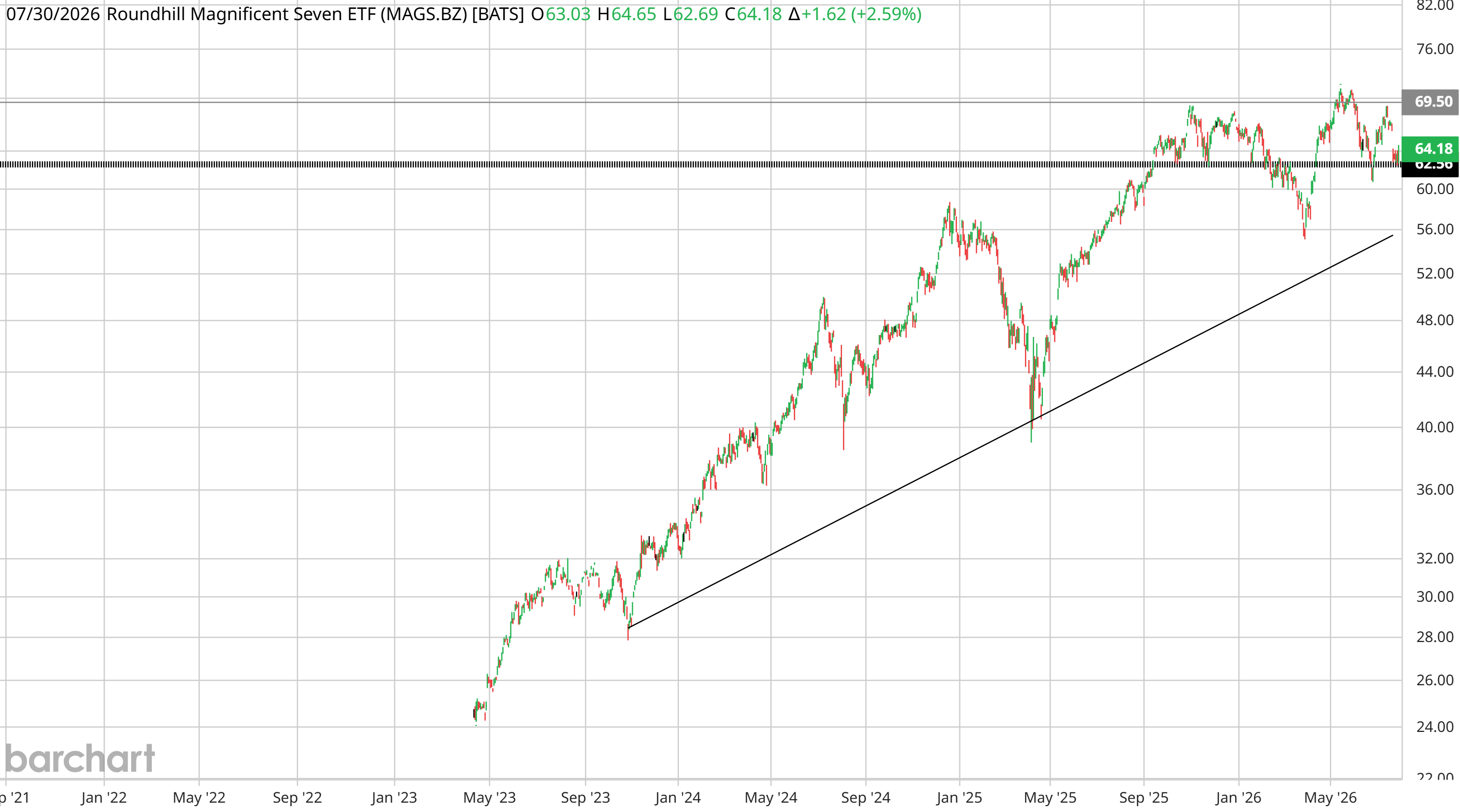
For roughly nineteen months, the market's most-owned companies have gone nowhere. The Roundhill Magnificent Seven ETF — MAGS, the popular instrument for the trade — returned +12.9% over the year to July 30. Over the same window the Nasdaq-100 returned +21.6%, the S&P 500 +18.2%, the technology sector fund +35.2%, and the semiconductor index +109.8%. The only benchmark the Mag complex beat was software — which spent the year in its own bear market. On a price basis, MAGS closed that window just 2.6% above its December 17, 2024 top of 62.56. A year and a half of the biggest earnings machine in market history, and the price of owning it moved a few percent.
That is not a growth problem. Through those same nineteen months the cohort compounded earnings, and the largest members grew cloud revenue at rates most companies never see at any size. The market did not stop believing in the businesses. It stopped paying for them — specifically, it stopped paying for their spending. The discount has a name: capex fear. The market looked at hundreds of billions of dollars of data-center construction and asked whether free cash flow would ever come back. While that question hung, the multiple compressed to absorb every earnings beat, and the complex went sideways while its own suppliers — the semiconductor index up triple digits — collected the very dollars the Mags were spending.
Where the discount concentrated — and what just hit it
Inside the complex, the discount was not evenly spread. Over the year to July 30, Microsoft returned −11% and Meta −24%; Amazon was flat at +1.4%. Alphabet (+74%) and Apple (+57%) were paid. Sort those names by how directly their story depends on AI capex producing revenue, and the pattern is exact: the discount sat deepest precisely where the cloud proof would have to land.
Then it landed. In the last week of July, Microsoft printed Azure growth of 43% with a $678 billion contracted backlog and was paid over fifteen percent in a day — after a year of sold beats. Amazon printed AWS re-acceleration to 37% and delivered the largest one-day print reaction in its recorded history, parking directly beneath its all-time-high line. The two hardest-discounted names in the complex produced booked-demand evidence against the exact fear that had discounted them — and the market paid it, immediately and at size. Our launch piece walks through that week print by print; the print records keep the per-name history.
One week does not close a nineteen-month discount. But it converts the question from a thesis into something measurable: is the hyperscaler cohort re-rating? That is a question you answer with a daily instrument, not an annual opinion. Hence the board.
The architecture: three cohorts and a torque row
The board divides six names into cohorts that fail for different reasons — because a composite of things that fail differently tells you nothing when it moves.
Hyperscalers — Microsoft, Amazon, Alphabet. The thesis longs. These are the names whose discount is a direct bet on cloud economics, and whose re-rating would be the discount closing. Alphabet straddles — cloud yes, but search disruption is already visible, and an AI answer monetizes less well than a search page — which is why it needs cohort-mates rather than a solo read.
Consumer-AI — Meta, Apple. Different in kind, deliberately separated. Meta is excellent at AI-for-advertising, but that is not the generative build-out the capex cycle funds — and the market charged it hardest for spending without a booked-demand anchor. Apple is waiting to monetize its reach, with the tail risk that a new AI interface takes the reach away from mobile. Neither belongs in a hyperscaler read; both belong on the board as its control group.
Supplier — Nvidia. The anchor between build-out and deployment: both cohorts pay it either way. It sits on the board as the boundary condition, priced on workloads rather than orders.
The Torque — Oracle, visually separated. The most weakly positioned name in the complex: down nearly half over the year, roughly 60% below its September 2025 high, a hyperscaler-since-recently that was a legacy database company before. That weakness is the point. If the hyperscaler thesis holds, the biggest percentage move lives in the most discounted seat — and if the thesis fails, the same seat falls furthest. The torque row is the thesis amplifier, in both directions, and it carries the highest realized volatility at the table.
Tesla is excluded by methodology. Its price is set by autonomy and robotics narratives, not by cloud economics. Including it would add noise to precisely the signal this board exists to isolate. The exclusion is stated once, here, and enforced permanently.
The instrument: what the board computes
Everything on the board reduces to standard windows — one day, one week, one month, one year, all in trading days on adjusted closes — computed three ways:
1. The regime-turn line. The headline read: the hyperscaler cohort composite divided by the consumer-AI composite, equal-weight within each cohort, indexed over one year. Rising means the market is paying the build-out cohort over the consumer-AI cohort — which is what "the discount is closing" looks like in price, isolated from everything the two cohorts share (rates, index flows, the general tech bid). A durable turn in this line is the single thing the board exists to detect.
2. Benchmark relatives. Every name and cohort against six instruments: the Nasdaq-100, the S&P 500, semiconductors, the tech sector, software — and MAGS itself, the popular instrument, as the foil. The relatives are what separate "the Mags are rallying" (everything is rallying) from "the Mags are re-rating" (the gap is closing).
3. The MAGS map. A standing price frame, not a computed one: the 69.50 supply shelf (two rejections, October 2025 and May–June 2026), the 62.56 pivot (the December 2024 top on price), and the multi-year trendline near 56, drawn from the October 2023 low through the April 2025 low and updated by hand monthly. Ten months of compression: flat top, rising floor. The resolution levels are published in advance — 69.50 up, the trendline down — in the same convention this desk used for the semiconductor band: levels first, story second.
Data plumbing, for the record: equities from the Closelook data lake, benchmark ETFs from EODHD, refreshed nightly after the US close. No new infrastructure was built for this board — it composes sources the site already runs, which is why it can update every trading day without a human in the loop.
What would confirm the turn
The board will not call a regime turn on one good week — the launch week is the hypothesis, not the verdict. Confirmation, by this desk's standards, needs several things to print together: the regime-turn line making higher highs across weeks, not days; MAGS resolving its compression upward through 69.50 rather than failing at it a third time; the hyperscaler cohort's relative line against the Nasdaq-100 turning positive on the one-year window; and the next round of cloud prints — roughly ninety days out — confirming that the July acceleration was a trend and not a quarter. The AI Handoff Board reads the same transition from the supplier side; if the hyperscalers re-rate while the handoff ratios keep migrating toward the operating layer, the two boards are telling one story.
And the failure case is published with the same precision: a regime-turn line that rolls back over, a third rejection at the shelf, a break of the trendline near 56. If the discount is real and permanent — if the market has decided hyperscaler capex is structurally value-destructive — this board will show it faster than any opinion will.
The board is a diary entry on our process, updated daily at /lab/mag-pulse/. Closelook publishes research, not investment advice.