Read · · 16 min read

Samsung, the inverted conglomerate discount, and the case for the broadest AI trade of the build-out

Part II of the series that opened with The Verification Tax: which layers of the AI build-out survive the capex→opex handoff as strategic positions — and which are only the cycle. Part I graded a duopoly that owns one layer completely. This part grades the opposite construction: a company that owns a piece of nearly every layer.
The print Seoul paid
On 30 July, Samsung Electronics reported the largest quarter in its history: revenue of ₩171.5 trillion, operating profit of ₩89.5 trillion — roughly eighteen times the year-ago figure. The Device Solutions division, which houses memory and foundry, produced ₩127.5 trillion of sales and ₩89.2 trillion of the operating profit. Read that pair of numbers again: the semiconductor business is currently almost the entire company's earnings, and everything else — phones, displays, appliances — nets out to roughly zero.
The market's response is the interesting part. Seoul paid the print roughly +7% — in the same session it sold SK Hynix a further 6%, in a week when the index had crashed through two circuit-breaker days and the memory trade was the epicentre. One day earlier, Hynix had printed its own record quarter and been punished for missing consensus and declining to raise capex. Samsung's record cleared its bar; the market held the two apart.
That is the discrimination regime we have been tracking all week, and it sets this piece's question. If the market can now tell two memory companies apart, what exactly is it pricing when it prices Samsung? The prevailing answer — a leveraged memory-cycle trade — is the conglomerate discount at work. The argument here is that the discount has the sign wrong.
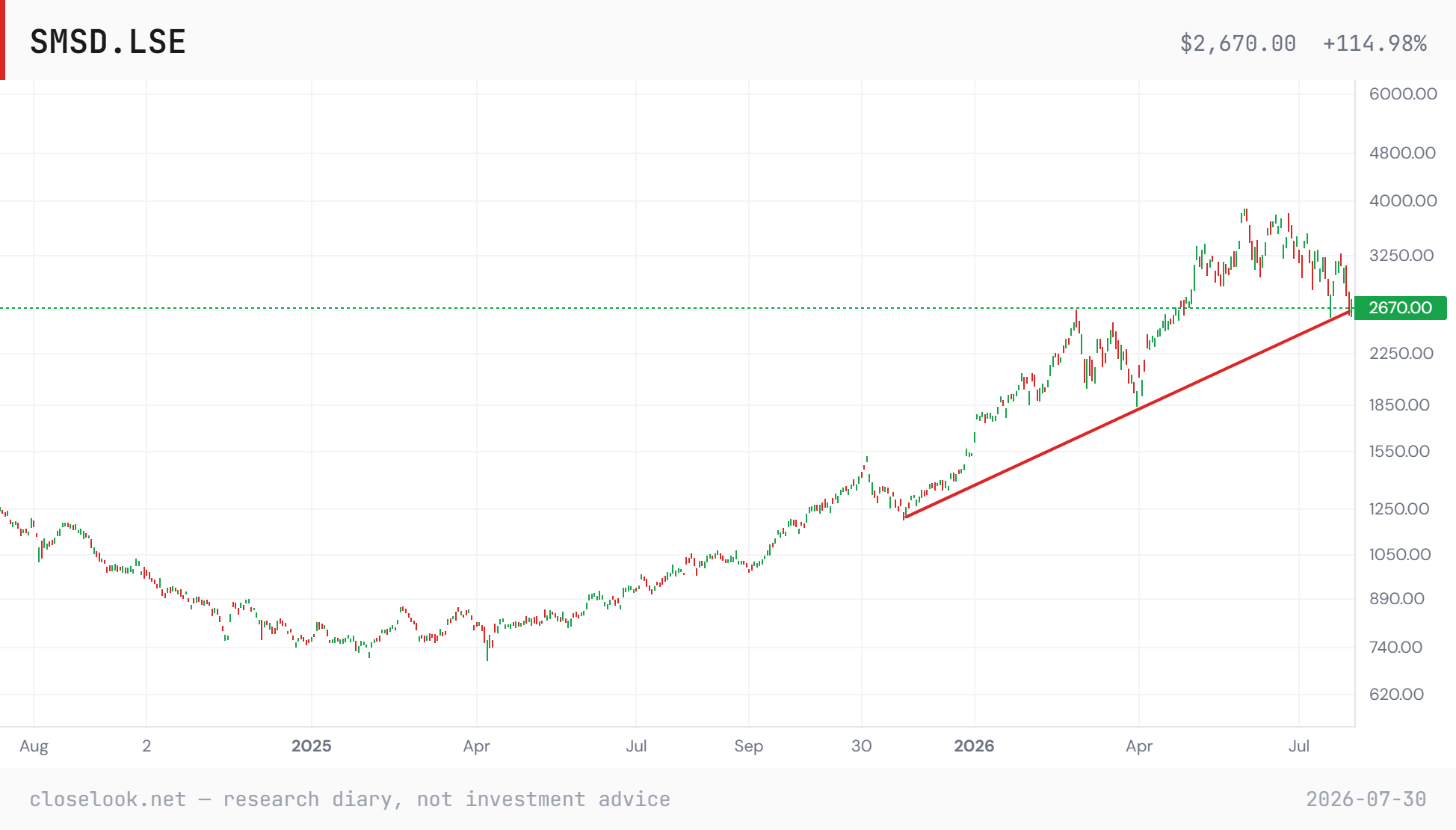
Most AI winners are exposed to one layer of the build-out. Nvidia is the architecture. The testing duopoly of Part I is verification. Vertiv is power, Corning is optics, the memory pure-plays are memory. Samsung is the one large-capitalisation name that spans almost the entire stack — high-bandwidth memory, server DRAM, NAND and enterprise storage, a leading-edge logic foundry, advanced packaging, image sensors, displays, batteries through its affiliate, the devices where inference will land, and now robotics placed directly under CEO oversight. It is a barbell inside a single company: high-performance infrastructure on one side, mass-market edge devices on the other.
Inside this study
The full piece — free with the C account — works through:
- The three-layer map — AI infrastructure, AI at the edge, physical AI: where Samsung actually sits in each, and which exposures are real today versus optionality.
- The competition, front by front — the part the short version of this thesis skips: Hynix and Micron in HBM, TSMC in foundry, Apple and the silicon merchants at the edge, the robotics field. Breadth means fighting on every front at once; each front gets its own honest scoreboard.
- The base-die opening — why HBM4's logic base die, the largest contested front in Part I's testing analysis, is also Samsung's single clearest path from cyclical rider to structural position: it is the only company with leading-edge memory, leading-edge logic and advanced packaging under one roof.
- The internal tension as information — the mobile division's margin squeeze is not a flaw in the breadth thesis; it is the breadth thesis operating. One side of the barbell pays the other's bill.
- The rubric, applied line by line — the series' four questions asked of each business separately. Samsung is not a four-for-four constraint player, and the piece does not pretend otherwise. What it is instead may matter more by 2030.
- The steelman — the HBM execution gap, the foundry gap to TSMC, the China commodity attack, governance, and why the conglomerate discount exists for reasons.
- How we hold it — classification, sizing discipline, and the seven indicators we watch from here.
Headline numbers: ₩171.5 trillion revenue and ₩89.5 trillion operating profit — a record on both lines, ~18× the year-ago profit — with ₩89.2 trillion of it from semiconductors; paid +7% in a tape that sold the other record memory print of the week.