Read · · 41 min read
Situational Awareness ran the Rubin map with 4x leverage. The thesis held. The fund died anyway. An autopsy in fourteen parts — and a defense nobody else will write.

Numbers at a glance
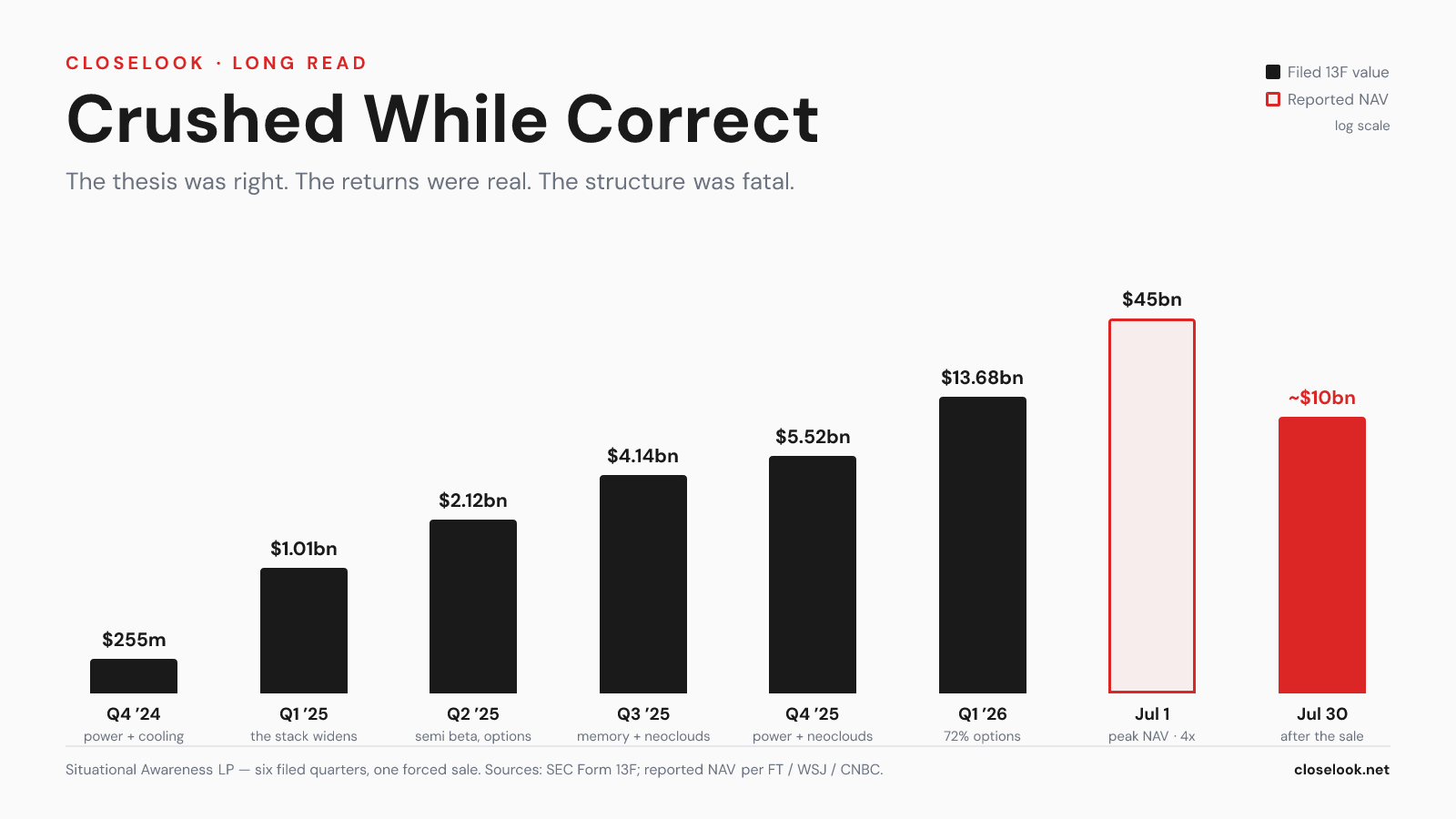
- Launched September 2024 with ~$225m; first 13F filed at $255m; peak NAV reported at $45bn in early July 2026
- Cumulative net return reported in the July 24 investor letter: +1,551% since inception; +439% net in H1 2026 alone
- Reported leverage: approximately 4x
- Q1 2026 13F: $13.68bn reference value; only ~$3.86bn in ordinary shares — ~72% options
- July 2026: SOX −28.6% from its June 22 peak; MS Momentum TMT −53.5%; core holdings −35% to −47%
- Estimated July loss: ~−67%; fund reportedly still +80% for 2026 after the crash
- July 30: public book sold to Citadel under margin calls from Goldman Sachs, JPMorgan, Bank of America; NAV $45bn → ~$10bn
- July 30, the day of the sale: SanDisk +26%, Micron +18% — still +20% and +11% off the low at Friday's close. The rebound arrived without them
- Korea: record ₩38.6tn margin debt; Samsung + SK Hynix = ₩9.1tn of it; 1.2m accounts margin-called, 360,000 liquidated
- Retained: the private Anthropic stake (~$5bn) — the one position without a daily price
- Post-crash annualized return since inception: an estimated ~140–150% per year
I. The Premise
In late 2024, a 22-year-old former OpenAI researcher — FTX's Future Fund before that, research seats both — raised a hedge fund on a thesis he had already published as a 165-page manifesto: scaling AI would require a massive physical build-out — semiconductors, compute, memory, energy — and the market was systematically underpricing the physical layer. His first 13F held six positions. Custom silicon, power, thermal management, electricity.
Readers of the Rubin Build-Out 100 will recognise this immediately. It is the constraint chain. Not the model layer, not the application layer — the physical bottlenecks underneath. Situational Awareness and the Rubin framework were, from inception, reading the same map.
What makes the fund's two-year arc worth a full autopsy is not that the map was wrong. It is that the map was verifiably right the whole way through — validated in sector data, validated in four-digit returns, validated even by the rebound that began the very day of the fund's forced liquidation — and the fund still ceased to exist as a public-market investor on July 30, 2026.
Correct and dead. That combination is precisely the scenario the house maxim — price is the only truth — exists to prepare for. This piece reconstructs the full record, maps it against the Generation Rotation Framework, identifies the three analytical gaps that the correct thesis contained, walks through the mechanics that killed it, and closes with the defense: an honest accounting of what those returns actually were, against the industry now writing the obituaries.
A note on evidence. Every claim in this piece carries one of four confidence levels, and the distinction matters more here than in most market writing, because the dramatic July narrative rests substantially on anonymous-source reporting while the quarterly record is formally documented:
- Filed — SEC Form 13F, formally documented
- Reported — FT, WSJ, CNBC, Bloomberg and others citing people familiar with the fund or investor letters they have reviewed
- Inferred — interpretation of changes between quarterly filings, or reconstruction from price action
- Unknown — ordinary shorts, swaps, precise leverage terms, intra-quarter trading
One caveat governs everything below: 13F values for options represent the value of the referenced securities, not the premium paid or the capital at risk. A $2bn put reference value is not $2bn of exposure and must never be equated with AUM. Where this piece cites option figures, it cites reference values and says so.