Read · · 13 min read

The interconnect gate: optics demand is certain, the toll-keeper is not — why the lasers and the package survive the handoff and the module does not

Part V of the series that opened with The Verification Tax and continued with The Breadth Discount: which layers of the AI build-out survive the capex→opex handoff as strategic positions — and which are only the cycle. Part I graded a duopoly that owns one layer completely. Part II graded a conglomerate that owns a piece of every layer. This part grades a layer where the profit pool is enormous, growing, and physically guaranteed — and where almost nobody who collects it today gets to keep it.
The week the chain repriced twice
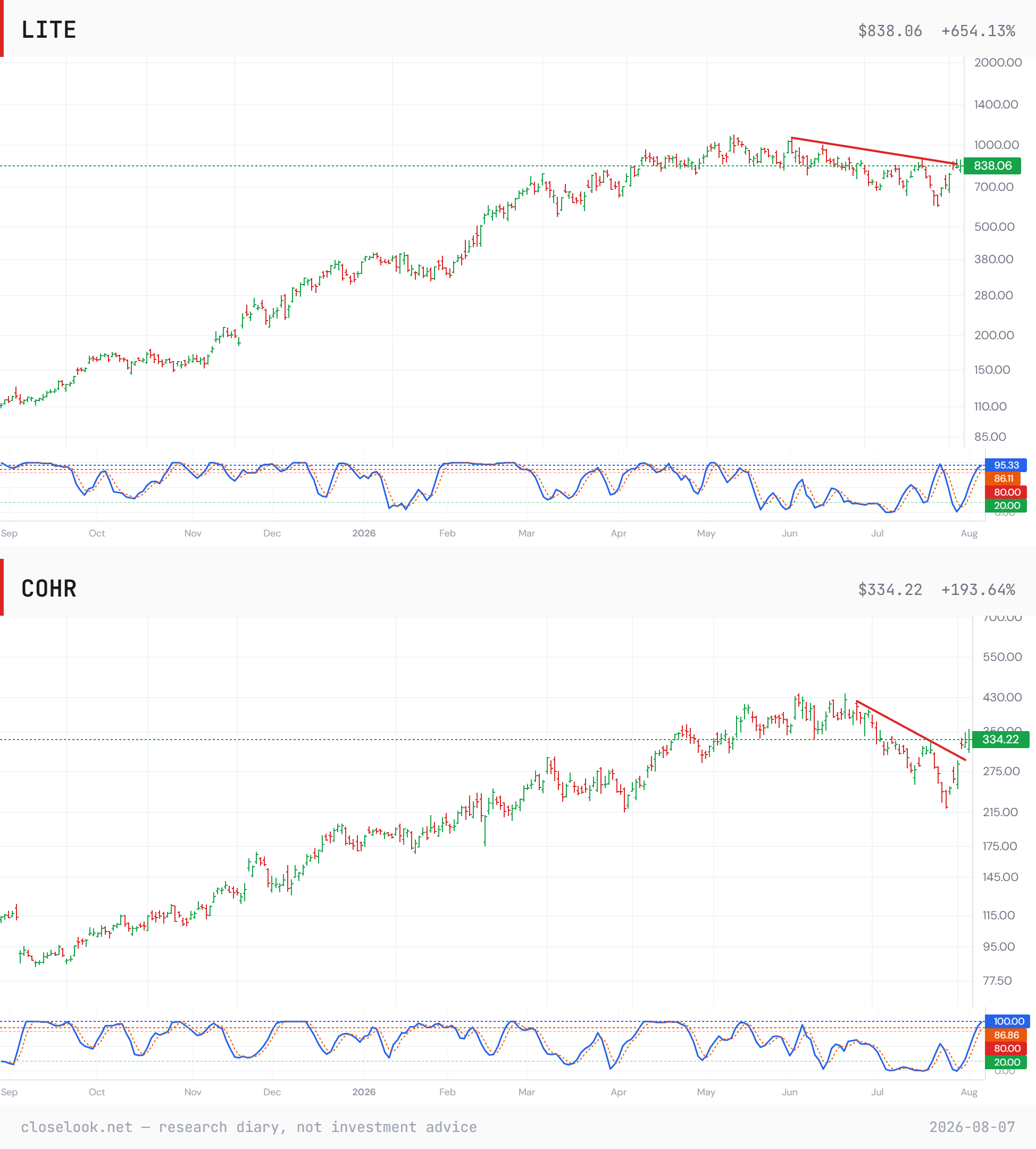
In the space of four sessions, the optical interconnect chain was sold as a broken trade and bought as the strongest demand story on the docket — by the same market, on the same facts.
On Friday, Coherent fell 11.8% through its 50-day average on no numbers at all. On Monday, Lumentum followed with −8.6%. Then Lumentum reported: revenue of $1.006 billion — the first billion-dollar quarter in the company's history, up 109% year over year — non-GAAP EPS of $3.23 against $2.97 expected, its eleventh consecutive EPS beat, gross margin up more than twelve points to 50.4%, and a first-quarter revenue guide with a midpoint of $1.25 billion, reaching its target model more than a quarter ahead of schedule. The market paid it +13.6% on day one.
Twenty-four hours later Coherent delivered the same story one octave lower: $2.05 billion of revenue, up 34% year over year, non-GAAP EPS of $1.74 against roughly $1.62 — its own eleventh straight EPS beat — and management language that its transceiver capacity is effectively sold out through 2028, with some contracts running to 2030. The stock, which had rallied 8.2% into the print, was marked down about 5% after hours.
Same chain, same week, same quality of print — one paid, one faded. Fabrinet, which reports Monday, rose 8.7% in sympathy without printing anything. The market is not confused about optics demand; nobody who read either release could be. What the market cannot decide is the only question that matters past the cycle: who keeps the toll.
That is this part's subject. The interconnect gate on the Feynman list is the strangest of the seven: the constraint is physically certain, the spending is contractually visible — and the position of toll-keeper has changed hands in every optics generation so far. Demand certain, toll-keeper not.
Inside this study
- The physics that writes the toll — why bandwidth × distance guarantees the spend regardless of who wins anything.
- The toll booth's three floors — module, DSP silicon, light source: where the margin actually sits, with the August prints as evidence.
- The competition, front by front — the indium-phosphide supply squeeze, the DSP toll with a clock on it, the module floor that pays rent, and the package the whole toll is migrating into.
- The rubric, applied line by line — the four series questions asked of each claimant class.
- The steelman — the capacity-glut precedent, the CPO timeline risk, and what Tuesday's sell-the-beat tape might already know.
- What survives the handoff, and how we hold it — the series verdict, the watch indicators, and where this lives inside our own surfaces.