Daily Pulse · · 08:50 CET · 7 min read · market · QQQM

In this edition
Pattern alerts
- QQQM nasdaq-100-gap-two-thirds-closed-decision-line-249-63 WARNING
- QQQ largest-opening-jump-since-2000-7-4-percent NEUTRAL
- EWY kospi-closed-under-pre-rally-level-low-held WARNING
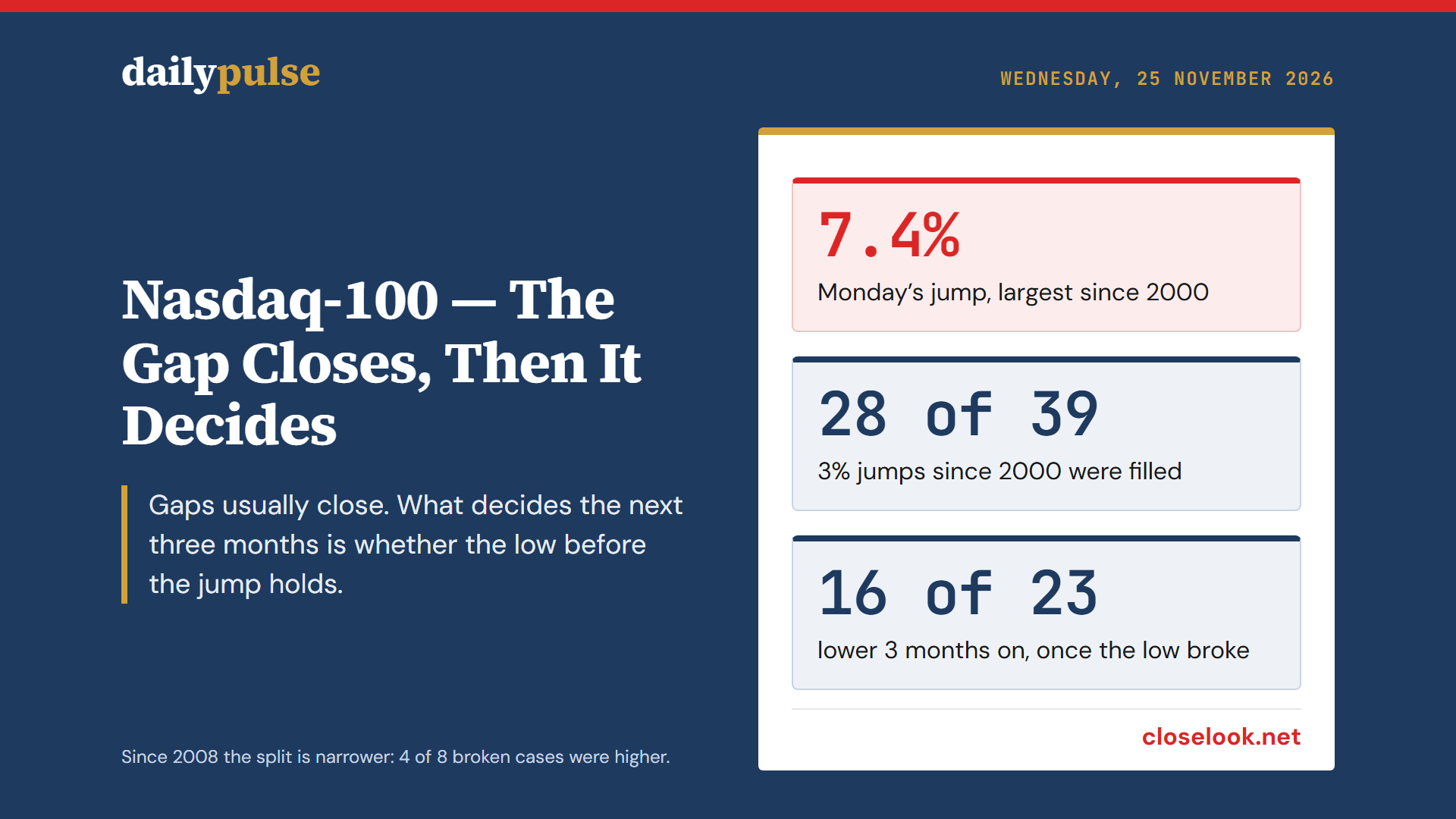
On Monday the Nasdaq-100 opened 7.43% above Friday’s close, at 26,889.29 against 25,028.98, after Nvidia brought back Jensen Huang as chief executive. In the opening prices available since 2000, no jump at the open was larger. Two sessions later the gap is closing: the index fell 1.99% on Tuesday to 26,214.17, and futures this morning put it about 2.7% above Friday’s close, roughly two-thirds of the way back. Thomas’s read: “markets are closing the breakaway gap from Monday. Then it is decision time.” History agrees on the first half. Of the 39 times since 2000 that the Nasdaq-100 opened 3% or more above its previous close, 28 gaps were filled within 60 sessions. What came after split on one line, the low of the day before the jump, and that line now sits at 24,910.48 for the index and 249.63 for QQQM, the Nasdaq-100 fund on Thomas’s chart.
Gaps usually close
A gap is the empty space a chart leaves when a market opens far above the previous close. Traders call it a breakaway gap when it starts a new move; a gap that is closed again within days is just a jump. To see which one Monday was likely to be, we took every session since 2000 on which the Nasdaq-100 opened 3% or more above the previous close. There are 39 before Monday. 28 of them were filled, meaning the index traded back down to the close before the jump within 60 sessions: seven on the gap day itself, 11 more within five sessions, the other ten later. Only 11 were never filled. Monday’s 7.43% is the largest of the 40; the next largest were 6.05% on 11 April 2001, 5.93% on 5 April 2001, 5.77% on 13 March 2020 and 5.65% on 19 October 2000.
Big opening jumps belong to falling, nervous markets. 21 of the 39 came between October 2000 and October 2002, during the collapse of the dot-com stocks; three came in the autumn of 2008 and five in 2020. Monday fits the pattern: it came after the Nasdaq-100 had fallen 19.8% from its 6 October record close of 31,224.47 to Friday’s 25,028.98, with the AI names at the centre of the fall, and it came on one company’s news. A jump of that kind is a vote on one headline. Whether it starts something is decided in the days after, when the market comes back to test where the jump started.
C — free account
The free C account unlocks the full Daily Pulse — every section of this read.
One tap with Google or one email — no password, no card. You are signed in until you sign out, on this browser, from then on.
Join the Look — freeAlready joined on this browser? The full edition shows automatically — if it doesn't, sign in again here. Looking for the archive, portfolios and realtime? That is C+.
One more block on our desk — tomorrow's levels and what we're watching into the next session. Join the Look — it’s free.