Taiwan +2.5%, Kospi Holds Its Line as Korea Hikes Rates
AI Trade — Taiwan +2.5%, Kospi Holds Its Pre-Rally Close as Korea Hikes; Wall Street Shut for Thanksgiving
Asia passed the first test after Monday’s gap closed: Taiwan stayed far above Wednesday’s low and Korea closed 2.67 points above its pre-rally level. But the rallies faded from their highs; the Kospi had been up 2.6%. S&P put Nvidia’s AA rating on watch for a downgrade; US futures edge higher.
In this edition
The Morning 10 Thu, Nov 26, 2026 ~90 seconds 08:40 CET
The ten points
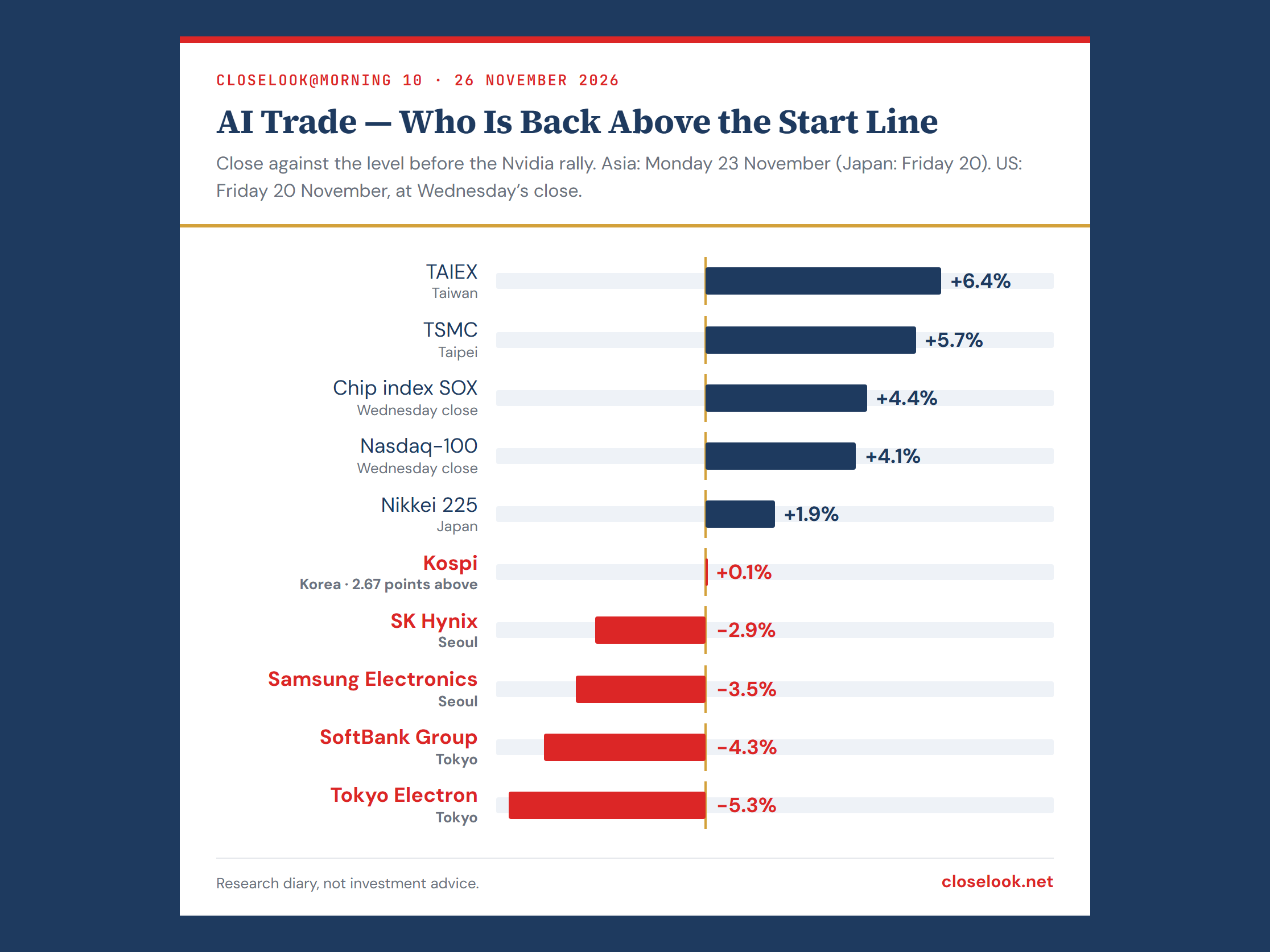
Asia passed the first test this morning. Taiwan’s TAIEX rose 2.50% to 39,151.81; its low of the day was its opening level, 4.8% above Wednesday’s intraday low of 36,681.90. Korea’s Kospi rose as much as 2.56% but closed only 0.29% higher at 4,711.21, 2.67 points above Monday’s close of 4,708.54, the level before the Nvidia news reached Asia, and 124 points above Monday’s low. Japan’s Nikkei gained 0.86% after a 2.18% high. The Bank of Korea raised its policy rate by a quarter point to 3.25%, its third rise since July. SoftBank Group rose 7.3%, Kioxia 12.6% and Advantest 4.6%; SK Hynix gained 2.2% and Samsung Electronics 0.4%.
On Wall Street on Wednesday the Nasdaq-100 fell as much as 4.74%, back under Friday’s close and so filling Monday’s gap, stopped 60 points above Friday’s low of 24,910.48 and closed 0.64% lower at 26,046.90. The chip index SOX was 8.0% lower at its low and closed 0.65% lower. October’s PCE inflation came in at 3.8%, core at 3.3%, a tenth above forecast, and Treasury yields still fell, the 10-year to 4.85%. Nvidia lost 3.9% to $149.30, and S&P Global Ratings placed its AA credit rating on watch for a possible downgrade, citing its management and board (Reuters). US markets are closed today for Thanksgiving and close early on Friday; Nasdaq-100 futures are 0.5% higher.
Thomas’s read on Wednesday: markets are closing Monday’s breakaway gap, and then it is decision time. The first decisions went to the buyers: the Nasdaq-100 held Friday’s low, Taiwan held its Wednesday low, Korea its pre-rally close. But each bounce was sold from its high. The Kospi gave back nine-tenths of its intraday gain; Tokyo Electron rose 6.6% and closed 0.6% higher. Taiwan, TSMC and the US chip index are back above their pre-rally levels; Korea’s memory makers, SoftBank and Tokyo Electron are still under theirs.
- AI Trade in Asia — Taiwan +2.5%, far above Wednesday’s low; Kospi +0.3% after a +2.6% high, just above its pre-rally close; Nikkei +0.9%
- Asia’s AI Bellwethers — SoftBank +7.3%, Kioxia +12.6%, Advantest +4.6%; SK Hynix +2.2%, Samsung +0.4%; Tokyo Electron +0.6% after +6.6%; TSMC −0.2%
- China and the Rest of Asia — Hong Kong +1.7% a day after its lowest close in a year; Shanghai flat; India +0.3%, up 12% in November; Australia +0.8% on record capex
- Europe — Stoxx 600 −1.1% on Wednesday, closed before the US turn; ASM International −7.8%, Infineon −6.5%, ASML −5.8%, Prysmian −5.4%
- Wall Street on Wednesday — Nasdaq-100 −0.6% after a −4.7% low, chip index −0.7% after −8.0%; Dow +0.3%, Russell 2000 +0.7%; Nvidia −3.9%, Oracle −5.1%, Meta +3.4%
- Breadth and the Gap — filled, with Friday’s low held by 60 points; equal-weight S&P 500 +0.8%, low-volatility beat momentum; VIX 35 at the low, 28.3 at the close
- Rates — inflation 3.8%, core 3.3%, growth revised to 4.3%; 10-year yield −6 basis points to 4.85%, long bonds back above 81.50; Korea hikes to 3.25%
- Gold, Bitcoin, Oil and the Dollar — gold futures near $3,600, gold fund −8.0% in November; Bitcoin back above $60,000; oil funds +3% on a refinery attack claim; dollar index 103.8
- Our AI Indices and Earnings Record — Rubin −2.7%, 0.7% above its March high; AI Users +1.3%, HALO +1.1%; Zoom 5 cents under its paid line, Autodesk under its sold line
- Today and Friday — US closed for Thanksgiving; German consumer confidence and ECB minutes today; Friday’s US session ends at 18:00 UTC; French and Spanish inflation

-
AI Trade in Asia — Taiwan +2.5%, far above Wednesday’s low; Kospi +0.3% after a +2.6% high, just above its pre-rally close; Nikkei +0.9%
StructureEWYEWTEWJ
- What
- Taiwan’s TAIEX opened 0.63% higher at 38,435.99, which was also its low of the day, rose as much as 3.31% to 39,459.95 and closed 2.50% higher at 39,151.81, 6.7% above Wednesday’s intraday low of 36,681.90. Korea’s Kospi opened 1.01% higher at 4,745.10, rose as much as 2.56% to 4,817.77, then gave back most of the gain and closed 0.29% higher at 4,711.21. Its low of 4,704.65 dipped just under Monday’s close of 4,708.54, the level before the Nvidia news reached Asia; the close was 2.67 points above it. The Kosdaq rose 0.78%. Japan’s Nikkei 225 opened at 57,429.54, rose as much as 2.18% to 58,251.93 and closed 0.86% higher at 57,499.16. The Bank of Korea raised its policy rate by a quarter point to 3.25%, its third rise since July, with two board members voting against; it expects inflation to stay above target for a prolonged period and forecast growth of 4.1% for 2027, driven by chip exports (investingLive).
- If
- Taiwan holds above Wednesday’s low of 36,681.90 and the Kospi above Monday’s low of 4,586.80 into next week. Then the first decision after the closed gap stands; a Kospi close back under Wednesday’s 4,697.51 would put Korea under its pre-rally level again.
- Why
- Korea, Taiwan and Japan hold most of the companies that make, test and package AI chips, which makes them the cleanest overnight read on the AI trade. Yesterday’s question was whether their lines would hold, and they did. But the Kospi gave back about nine-tenths of its intraday gain and the Nikkei about three-fifths: sellers met the bounce.
- Then
- Taiwan is 21.4% under its record close of 49,822.55 from 6 October, 6.0% under its 200-day average of 41,664 and down 13.4% in November. Korea is 48.3% under its record close of 9,114.55 from 22 June, 27.7% under its 200-day average of 6,517 and down 17.8% in November. The Nikkei is 20.5% under its record close of 72,366.34 from 25 June and down 9.2% in November.
-
Asia’s AI Bellwethers — SoftBank +7.3%, Kioxia +12.6%, Advantest +4.6%; SK Hynix +2.2%, Samsung +0.4%; Tokyo Electron +0.6% after +6.6%; TSMC −0.2%
StructureTSMSMH
- What
- In Tokyo SoftBank Group rose 7.32% to ¥2,894 after a high of ¥3,029, the memory maker Kioxia 12.57% to ¥7,762 and the chip-test maker Advantest 4.57% to ¥24,830, after rising as much as 11.5% to ¥26,480; Lasertec gained 4.18% and Disco 3.97%. Tokyo Electron rose as much as 6.6% to ¥8,343 and closed only 0.59% higher at ¥7,871. In Seoul SK Hynix rose as much as 6.6% to ₩1,098,000 and closed 2.23% higher at ₩1,053,000; Samsung Electronics rose as much as 3.5% to ₩176,700 and closed 0.35% higher at ₩171,300, its low of the day equal to Wednesday’s close of ₩170,700. In Taipei TSMC slipped 0.23% to NT$2,145, while the server assemblers rose: Hon Hai 4.84%, ASE 4.71%; MediaTek gained 1.65%.
- If
- SoftBank holds above Wednesday’s ¥2,696.50, its lowest close since July 2025, and the memory makers get back above their pre-rally closes of ₩177,500 for Samsung and ₩1,085,000 for SK Hynix. Then the rebound reaches the names that fell hardest; until then it is led by Taiwan’s assemblers and Japan’s testers.
- Why
- These are the names where the AI build-out shows up first: memory (Samsung, SK Hynix, Kioxia), chip testing and tools (Advantest, Tokyo Electron, Lasertec, Disco) and the money behind AI (SoftBank). Today’s split: Kioxia, SoftBank and Taiwan’s assemblers kept most of their gains; Korea’s two memory makers and Tokyo Electron gave back most of theirs.
- Then
- SoftBank is 66.5% under its June peak close of ¥8,632 and down 35.4% in November; SK Hynix is 63.9% under its June peak of ₩2,919,000, Samsung 52.7% under its ₩362,500. In November Advantest is down 28.8%, Tokyo Electron 17.3% and TSMC 9.5%.
-
- ETF Dispersion Which themes move together and which have decoupled — dispersion across the ETF complex, nightly. See the dispersion →
-
China and the Rest of Asia — Hong Kong +1.7% a day after its lowest close in a year; Shanghai flat; India +0.3%, up 12% in November; Australia +0.8% on record capex
StructureFXIINDAMCHI
- What
- Hong Kong’s Hang Seng rose as much as 2.63% to 22,543.75 and traded 1.6% higher at about 22,310 shortly before its 08:00 UTC close, after Wednesday’s 21,966.01, its lowest close in a year; Tencent gained 1.6%, Alibaba 2.1% and the chip maker SMIC 1.8%. The Shanghai Composite ended flat at 3,476.88 and Shenzhen’s index slipped 0.02%. China’s central bank set its daily dollar reference rate at 6.7096 yuan, weaker than the 6.6655 analysts expected (investingLive). India’s Nifty 50 traded 0.3% higher at about 25,890, 1.7% under its January record and up 12.3% in November. Australia’s ASX 200 rose 0.82% after third-quarter business investment jumped 12.2% against a forecast of 4.4%, with spending on equipment at a record (investingLive).
- If
- Hong Kong holds above Wednesday’s 21,966.01 and India stays within reach of its January record of 26,328.55. Then the money that left Asia’s chip markets in November has stayed in the region’s other markets rather than leaving Asia.
- Why
- Asia outside the AI supply chain has moved on its own clock this month: India is up 12.3% while Korea is down 17.8% and Taiwan 13.4%. That gap says the November selling is about AI, not about Asia.
- Then
- Hong Kong is 20.2% under its high close of 27,968.09 from 29 January and 10.8% under its 200-day average. The US tariff proposals for 14 trading partners, among them China, Japan, South Korea, Taiwan and India, would not add to July’s tariffs and are unlikely to take effect before February or March (Reuters, via Investing.com).
C — free account
The free C account unlocks points 4 through 10 — the full morning read.
One tap with Google or one email — no password, no card. You are signed in until you sign out, on this browser, from then on.
Join the Look — freeAlready joined on this browser? The full edition shows automatically — if it doesn't, sign in again here. Looking for the archive, portfolios and realtime? That is C+.
C · point 11 · members
The privileged, actionable read — what we do, and at which level — is in point 11, for members only.
Join the Look — it’s freeFree members account · one click · the ten points stay free, always.
Further reading on Closelooknet
A daily overview, not advice — an investment diary. Published every trading morning at 08:00 CET. See the Daily Pulse and today’s check-in.