Rotation
Enterprise Software — The Agent Is Not the Product. The Orchestrator Is.
Legacy enterprise software is moving from seat-based applications to agentic execution — and every incumbent is racing for the same seat: the control plane that assigns, permissions and meters the work. There are fewer seats than claimants.


The transition from traditional enterprise software to agentic software is often described as adding AI agents to existing applications. That understates the change. The decisive question is not which company can build the smartest individual agent — models and basic agents are becoming widely available and increasingly interchangeable. The real contest is over orchestration: which platform decides what agents should do, gives them the necessary context, coordinates them across applications, controls their permissions, and verifies the result.
This is why SAP, Salesforce, Microsoft, ServiceNow, Oracle and Workday are all racing toward remarkably similar architectures — and why the same claim was made twice in a single print week in July 2026: ServiceNow framing itself as the orchestrator of AI in the enterprise on Wednesday's call, SAP pitching the Autonomous Enterprise around Joule Studio, n8n and its Knowledge Graph on Thursday's. The category is forming in public. This piece maps it: why orchestration decides the transition, who holds which position, how the alliances form and break, and what the diary watches to score the knockout.
From selling seats to executing work
Traditional enterprise software monetizes human activity. One employee gets one seat; the employee opens the application, retrieves information, moves the process forward; the vendor charges per user, per month. Agentic software changes the unit of value. Fewer people interact directly with the application while agents perform thousands of tasks in the background.
That weakens the logic of seat-based pricing — but it does not necessarily weaken the incumbents. It offers them a trade: replace seat revenue with consumption-, workflow- or outcome-based revenue. The winning platform charges for cases resolved, invoices processed, orders completed, service requests handled, agent actions executed. But to capture that revenue, the vendor must own more than an application interface. It must become the orchestration layer of the enterprise — because the platform that assigns and verifies the work is the platform that gets to meter it.
Why orchestration matters
A useful enterprise agent cannot merely generate an intelligent answer. It must act. Consider an agent asked to resolve a delayed customer order. It may need to identify the customer and the contractual commitments in the CRM; check the order and inventory position in the ERP; review supplier and logistics data; calculate the financial consequences; obtain approval for an exception; update the customer through the service system; and record every decision for audit. No individual agent performs that reliably without access to data, workflows, permissions and business rules across multiple systems.
The critical platform therefore needs five things at once:
- Trusted enterprise data — not copies, the authoritative record;
- Deep knowledge of business processes — the rules and relationships between the data, not just the data;
- Permission to initiate transactions — the authority to do, not only to draft;
- Identity, governance and auditability — who acted, under whose authority, verified how;
- Coordination of proprietary and third-party agents — the estate will never be single-vendor.
That makes agentic software a battle for the enterprise control plane.
Centrality beats intelligence
Being attached to an enterprise workflow is not enough — the vendor must sit close to the operational core. A peripheral application may hold valuable data, but it usually lacks the authority and context to orchestrate the whole process. An agent that drafts a message is useful; an agent that identifies a problem, accesses the relevant systems, applies company policy, obtains approval and completes the transaction is a different economic object. This creates a hierarchy of strategic positions:
- Systems of record own authoritative data.
- Systems of action control transactions and workflows.
- Systems of orchestration coordinate agents, applications, people and decisions.
The strongest incumbents are attempting to occupy all three layers at once. The weakest own none of them and are discovering it in their net-retention lines.
The field: who holds which position
Microsoft — the broadest horizontal position
Microsoft has perhaps the widest potential reach because it sits across employee identity, productivity, communications, development, analytics and business applications. Microsoft 365, Teams, Entra, Azure, GitHub, Power Platform, Dynamics and the Graph collectively give it the daily working environment of a large part of the enterprise; Copilot Studio provides the layer for building and coordinating agents. Its ambition is to make Copilot the universal interface through which employees initiate work — even when another vendor completes the transaction. Its weakness: Microsoft does not always own the underlying transactional system. It may know what the employee is doing without owning the definitive financial, supply-chain or customer record. That makes it a necessary partner for almost everyone — and, ultimately, a potential threat to everyone.
SAP — the deepest operational position
SAP may hold the strongest position where agents must understand how a company actually operates. Its systems contain finance, procurement, production, inventory, logistics, supplier and workforce data — and, more importantly, encode the relationships between those data and the processes that govern them. SAP positions Joule Assistants as coordinators of specialized Joule Agents, grounded in Business Data Cloud, the Knowledge Graph and decades of embedded process rules; the Agent Hub is meant to govern SAP-built, custom and third-party agents from one place; n8n's low-code automation, embedded into Joule Studio, extends orchestration across SAP and external systems. The architecture is not AI inside ERP — it is an attempt to turn the ERP core into the orchestration layer. The weakness is the user-facing layer: exceptionally central to transactions, less central to communication, collaboration and unstructured knowledge. Its optimal strategy is not to beat Microsoft at the interface; it is to make every agent — Microsoft's included — pass through SAP's semantic, transactional and permission layers whenever it touches a core process.
ServiceNow — the natural workflow orchestrator
ServiceNow is the structurally interesting one, because orchestration is close to its original function: routing tasks, managing approvals and coordinating activity between otherwise disconnected systems across IT, employees, customer service, security and operations. Its Workflow Data Fabric aims to give workflows and agents access to data residing elsewhere — which matters, because the winning orchestrator may not need to own every system of record if it controls how work moves between them. Its AI Control Tower is a bid for the governance seat: discovering agents, assigning permissions, monitoring behavior. The neutrality is valuable — an enterprise wary of handing Microsoft or SAP total control has an alternative — but neutrality is hard to keep: as ServiceNow's own agents expand into HR, customer service, finance and operations, it increasingly competes with the vendors whose agents it promises to govern. The cleanest pure-play bet on enterprise orchestration, with the burden of proving its workflow centrality extends beyond IT and service management.
Oracle — the integrated-suite challenger
Oracle combines database infrastructure, cloud compute and the Fusion application suite across finance, HR, supply chain and customer processes. Its Fusion Agentic Applications are built as coordinated teams of agents operating inside Oracle's own transactional and security framework — native access to data, workflows, approval hierarchies and permissions, not bolted on from outside — described as systems that reason and execute against business outcomes rather than assist users. Inside an Oracle-centric estate, that is a structural advantage comparable to SAP's. The limitation is the fortress logic itself: most large enterprises are heterogeneous, and a platform optimized for its own estate is a harder sell as the neutral layer across SAP, Salesforce, Microsoft and Workday environments.
Salesforce — strongest around the customer
Salesforce owns some of the most valuable workflows in the enterprise: acquiring customers, closing sales, providing service, retaining accounts. Agentforce provides the agent layer; Data 360 the unified customer context; MuleSoft the connections into external applications; Slack the human-and-agent interface. That is a credible orchestration stack, not a collection of CRM agents — and customer-facing workflows are numerous, measurable and economically dense, so agent activity maps directly to leads, conversions, service cost and retention. The limitation is equally clear: CRM is central to the customer relationship but rarely authoritative for finance, production, inventory or the supply chain. Salesforce must reach that operational data through MuleSoft and partnerships — which is exactly what its deepening Google alliance is for. Salesforce may dominate customer-domain orchestration without becoming the orchestrator of the whole enterprise.
Workday — a powerful but narrower control point
Workday owns critical workforce, payroll and financial data, and its strategic idea is genuinely clever: the Agent System of Record — registering, governing, measuring and controlling first- and third-party agents, with identity, permissions, lifecycle management and observability. If agents become workers, Workday wants to manage them alongside the human ones, and its Agent Gateway could become a real control point for the digital workforce. But its process footprint remains narrower than SAP's, Oracle's or Microsoft's. The realistic prize is dominance in governing agents across HR and finance — a domain win, not the enterprise-wide seat, unless the registry becomes genuinely vendor-neutral infrastructure.
The knockout: many applications, few orchestrators
The traditional software market supported many vendors because each application served a defined department. Agentic software breaks the boundaries — a useful agent does not stop at the edge of one application. The customer therefore faces a choice: let every vendor deploy its own agent layer, or select a small number of strategic platforms to coordinate the entire agent estate. Most large enterprises will choose the second, because every additional orchestration layer creates duplication, conflicting instructions, security risk and another incomplete view of the company.
Orchestration also has winner-takes-most economics. The layer becomes more valuable as it gains access to more data, applications, agents, identities, processes and outcomes — the platform with the broadest context coordinates best, which attracts more workflows, which deepens the context. The reverse is brutal: a platform that fails to become an orchestrator is demoted to a data source or execution endpoint controlled by somebody else. The application survives; the strategic position and the pricing power do not. The likely end-state inside one large enterprise is a hierarchy: one employee-facing orchestration layer, one core transactional layer, possibly one cross-system workflow-and-governance layer — two or three strategic control planes, not one per incumbent. Six credible claimants, at most three seats.
How it plays out: three phases
Phase 1 — everyone becomes friends. The current phase. Vendors need data and workflows they do not own, so they integrate: Joule reachable from Microsoft 365 Copilot, Salesforce agents on Google models and BigQuery, ServiceNow's Control Tower governing Microsoft agents, Workday registering everyone's agents. Interoperability accelerates adoption and everyone benefits — while every partnership quietly reveals who owns which layer.
Phase 2 — enterprises select their control planes. Agent sprawl arrives: conflicting permissions, multiple identity systems, duplicated data access, inconsistent audit trails, unclear responsibility when agents fail, several vendors charging for the same workflow. CIOs consolidate. A large enterprise picks, say, Microsoft for employee interaction and identity, SAP for finance and supply-chain execution, ServiceNow for governance and cross-system workflow — and every other vendor's agents operate under one of those planes. Cooperation becomes hierarchy.
Phase 3 — the platforms exclude one another. Once orchestration consolidates, the leaders make their own agents easier to deploy, better integrated, cheaper to run, better permissioned and better measured than third-party alternatives. Technically open, economically closed: the external agent is still permitted — it just gets worse data access, higher latency and worse pricing than the native one. That is how an open ecosystem still produces winner-takes-most outcomes.
The alliances — and their fault lines
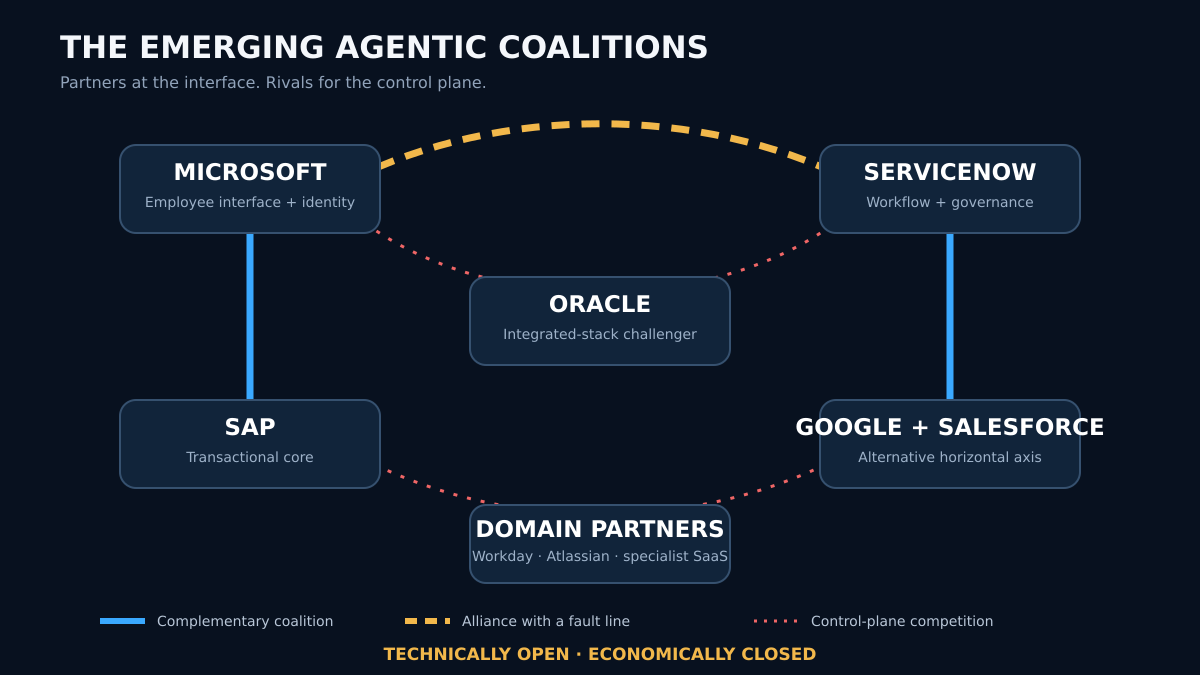
Microsoft + SAP is the natural pairing: the employee, identity and productivity layer meets the operational and transactional core — a default architecture for much of corporate Europe and global manufacturing. It holds until Microsoft pushes deeper into process orchestration or SAP tries to make Joule the primary employee interface.
Microsoft + ServiceNow is the strongest architecture for a heterogeneous enterprise that does not want one ERP vendor controlling everything — identity and distribution from one side, workflow intelligence and governance from the other, usage even metered across both. It is also inherently unstable: both ultimately want to be the control tower.
Google + Salesforce is the clearest anti-Microsoft coalition — models, cloud, Workspace and BigQuery meeting customer data, MuleSoft integration and Slack. Separately each has a gap; together they are the credible alternative horizontal stack. The open question is whether it becomes a genuinely unified platform or stays a collection of integrations between two commercial interests.
The vulnerable
Atlassian holds useful context across developers, projects and organizational knowledge, and Rovo can be a strong specialist layer — but Atlassian rarely owns the authoritative financial, customer or workforce transaction. A successful specialist, supplying agents and context to a larger orchestrator, more than a control-plane winner.
The long tail of specialized SaaS carries the greatest structural risk in the entire transition. If a Microsoft, SAP or ServiceNow agent can reach a narrow application through an API, the user may never open that application again — or know which software completed the task. That erodes seat expansion, engagement, brand visibility, cross-selling and pricing power at once. Some will survive on uniquely valuable data or transaction capabilities; some will be acquired; many will lose the direct customer relationship and become invisible tools called by somebody else's orchestrator. This is the extinction layer — peripheral, single-point-of-excellence software — and the market began repricing it weeks before the vendors finished their orchestration slideware.
The final battlefield: four control points
| Control point | Best-positioned players |
|---|---|
| Employee interface | Microsoft; Google–Salesforce |
| Transactional truth | SAP; Oracle |
| Cross-system workflow | ServiceNow; Microsoft |
| Identity and governance | Microsoft; ServiceNow; Workday |
The probable outcome is not one winner but a three-layer structure: Microsoft winning the employee and identity layer; SAP or Oracle controlling the transactional core; ServiceNow governing cross-system workflows and heterogeneous agents — with Salesforce powerful in the customer domain and capable of breaking into the top group if the Google alliance becomes a real platform, and Workday strategically relevant as the governance registry for the digital workforce.
The decisive test
The winner will not be the vendor with the most agents or the best demonstrations. It will be the platform enterprises trust to decide which agent receives a task, which data it may access, which applications it may control, which decisions it may make autonomously, when a human must approve, how the result is verified and audited — and which vendor gets paid for the work performed. Once one platform controls those decisions, competing orchestration layers become unnecessary. The diary's six-question scorecard for every name in the field:
- Does the company own authoritative enterprise data?
- Does it understand the underlying business process?
- Can its agents execute transactions, not merely recommend actions?
- Can it coordinate agents across third-party systems?
- Does it control identity, permissions, approvals and audit trails?
- Can it replace declining seat economics with usage or outcome economics — before the old line erodes?
On this framework, SAP and Oracle hold the deepest transactional advantages, Microsoft the broadest horizontal reach, ServiceNow the most natural cross-application position, Salesforce the strongest customer-domain opportunity, Workday a credible governance niche. Each has a real claim. Not all claims can succeed — the market currently prices agentic AI as a growth opportunity available to every incumbent, and it is more likely to function as a selection mechanism. Friends today, hierarchy tomorrow: the winners own orchestration, the survivors own indispensable data or transactions, the losers become tools inside someone else's agent workflow.
The transition, compressed to one line: from applications that help employees perform work, to orchestration platforms that perform, coordinate and govern the work themselves. The decisive question is no longer who has an agent. It is whose agent is allowed to control the others.
Research diary, not investment advice. The Control-Plane cohort inside Agentic Winners is how this contest is expressed in the diary's own indices; the scoring happens print by print, on the record.
Closelooknet publishes a market diary, not investment advice. The strategies described here are educational. Tax, suitability, and risk depend on personal circumstances — consult a licensed advisor before acting.