Read · · 9 min read
Agent Cloud — The Landlords Build It, Others Bill It
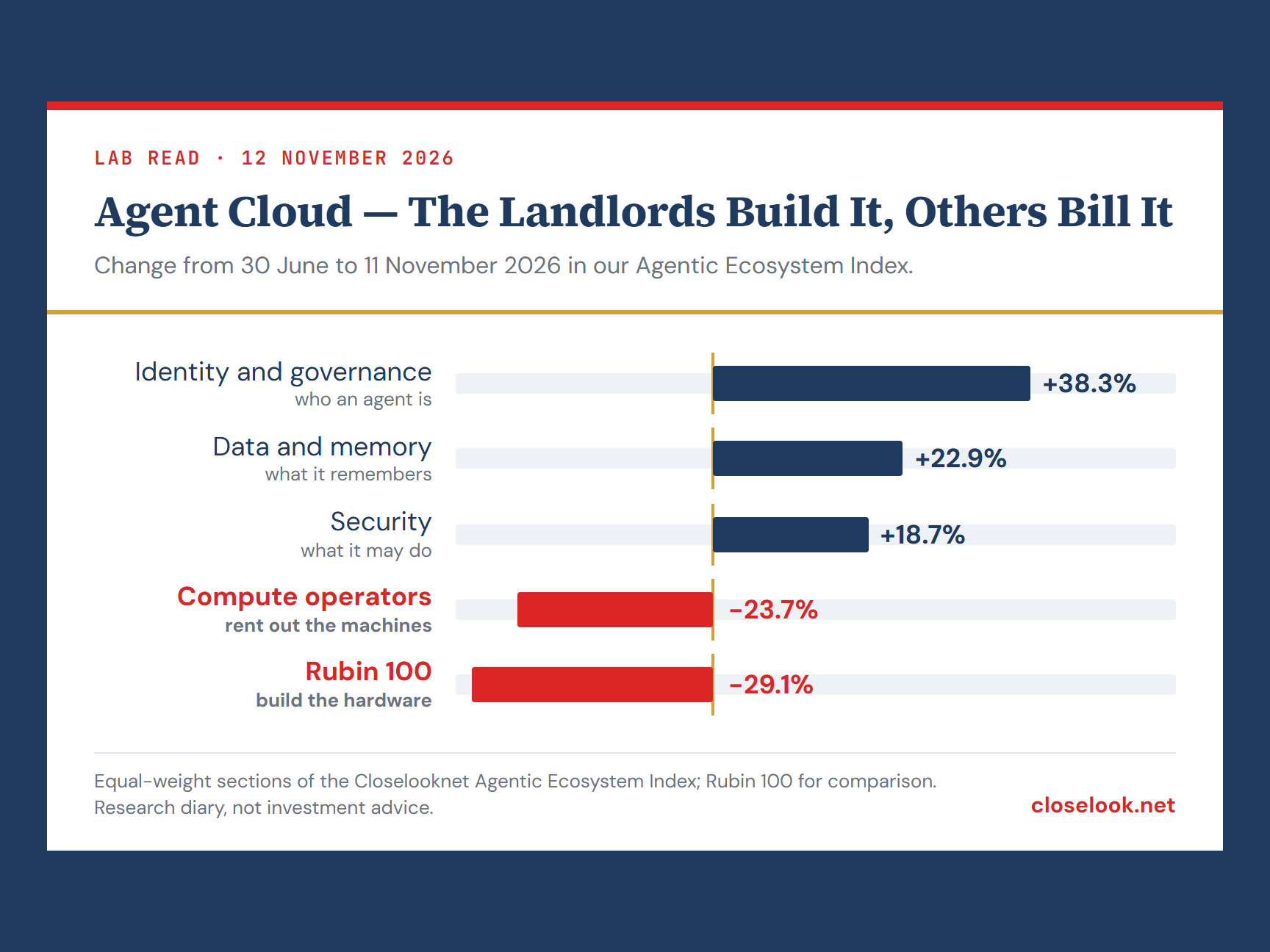
AI agents need a cloud of their own: an isolated machine for every task, memory that lasts, a meter on every call. Since 30 June the companies that own the machines have fallen 24% to 29% in our indices, while the ones that store, identify and secure have risen 19% to 38%.

A Lab Read on a map that is not ours and a reading that is. The map of the “agent cloud” comes from Jamin Ball’s Clouded Judgement of 6 November 2026. Who pays for it and who gets paid is our own reading, tested against the Closelooknet indices at the close of 11 November. Diary framing throughout: this is how we read it and what we watch, not what anyone should do with it.
What the agent cloud is
The cloud of the past fifteen years was built so that one application could serve millions of people around the clock. Around 2012 the large providers sold it as a bundle of four parts: virtual servers, file storage, a database and a load balancer. It was tuned to push as much traffic as possible through shared machines.
AI agents turn that around. An agent is software that carries out a task on its own: it writes code, runs it, calls other programs and checks the result. Ball describes millions of agents, each running a small application for seconds or for days, each on its own isolated machine, in bursts nobody can plan. Much of the code was written by a model moments earlier.
The new cloud, he writes, has “the same core primitives, but rebuilt for agents”, and many more units of each. What counts is no longer traffic per machine. It is how well tasks are kept apart, how much they remember and how fast a machine starts. He expects this cloud to end up far larger than the classic one and to grow sharply within twelve months; he gives no figures.
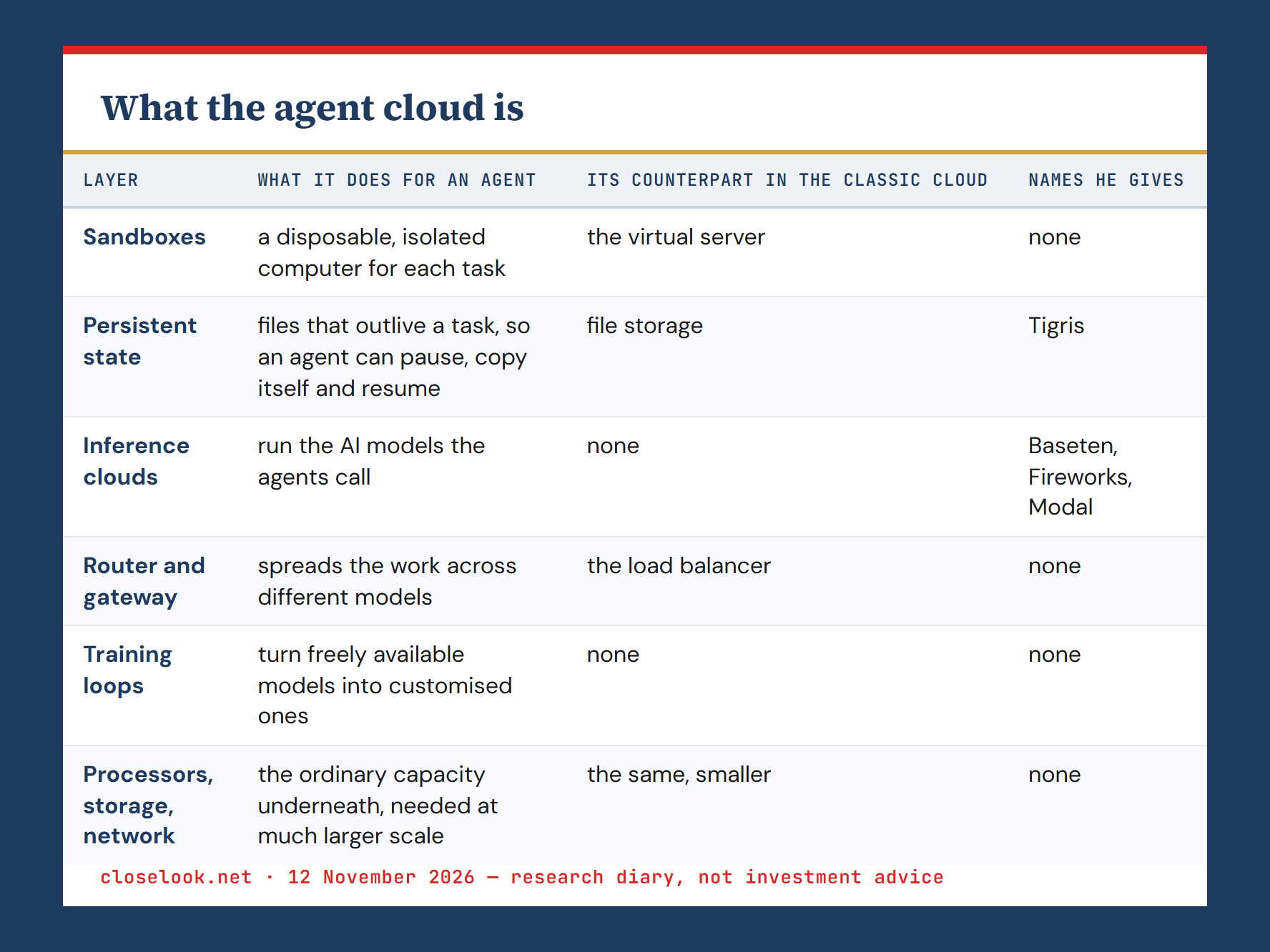
Table as text
| Layer | What it does for an agent | Its counterpart in the classic cloud | Names he gives |
|---|---|---|---|
| Sandboxes | a disposable, isolated computer for each task | the virtual server | none |
| Persistent state | files that outlive a task, so an agent can pause, copy itself and resume | file storage | Tigris |
| Inference clouds | run the AI models the agents call | none | Baseten, Fireworks, Modal |
| Router and gateway | spreads the work across different models | the load balancer | none |
| Training loops | turn freely available models into customised ones | none | none |
| Processors, storage, network | the ordinary capacity underneath, needed at much larger scale | the same, smaller | none |
Around these six he lists a second ring: tools that keep long tasks running, browsers for agents, machines for building and testing code, code storage, identity and payment for agents, monitoring and memory. Two deals he mentions show who is buying. Dropbox bought the storage company Tigris in the week of his post, and OpenAI bought Pierre Computer Company, which stores code.
What he does not say matters for this report. He makes no claim about prices, margins or who keeps the profit. That part is ours.
Inside this study
- Where it sits in our indices — his layers against the sections of the Agentic Ecosystem Index.
- The landlords build it — who owns the machines and what it costs them.
- Others bill it — the companies that charge by use, and what the market paid them.
- Where the compute goes when states say no — Texas, the edge and orbit.
- Where this breaks — the arguments against our reading.
- What we watch next.
Where it sits in our indices
Our Agentic Ecosystem Index holds 34 listed companies that are paid each time an AI agent runs. It is equal weighted, based at 1,000 on 30 December 2025 and split into nine sections. Set next to Ball’s map, the sections line up closely. The matching is ours.
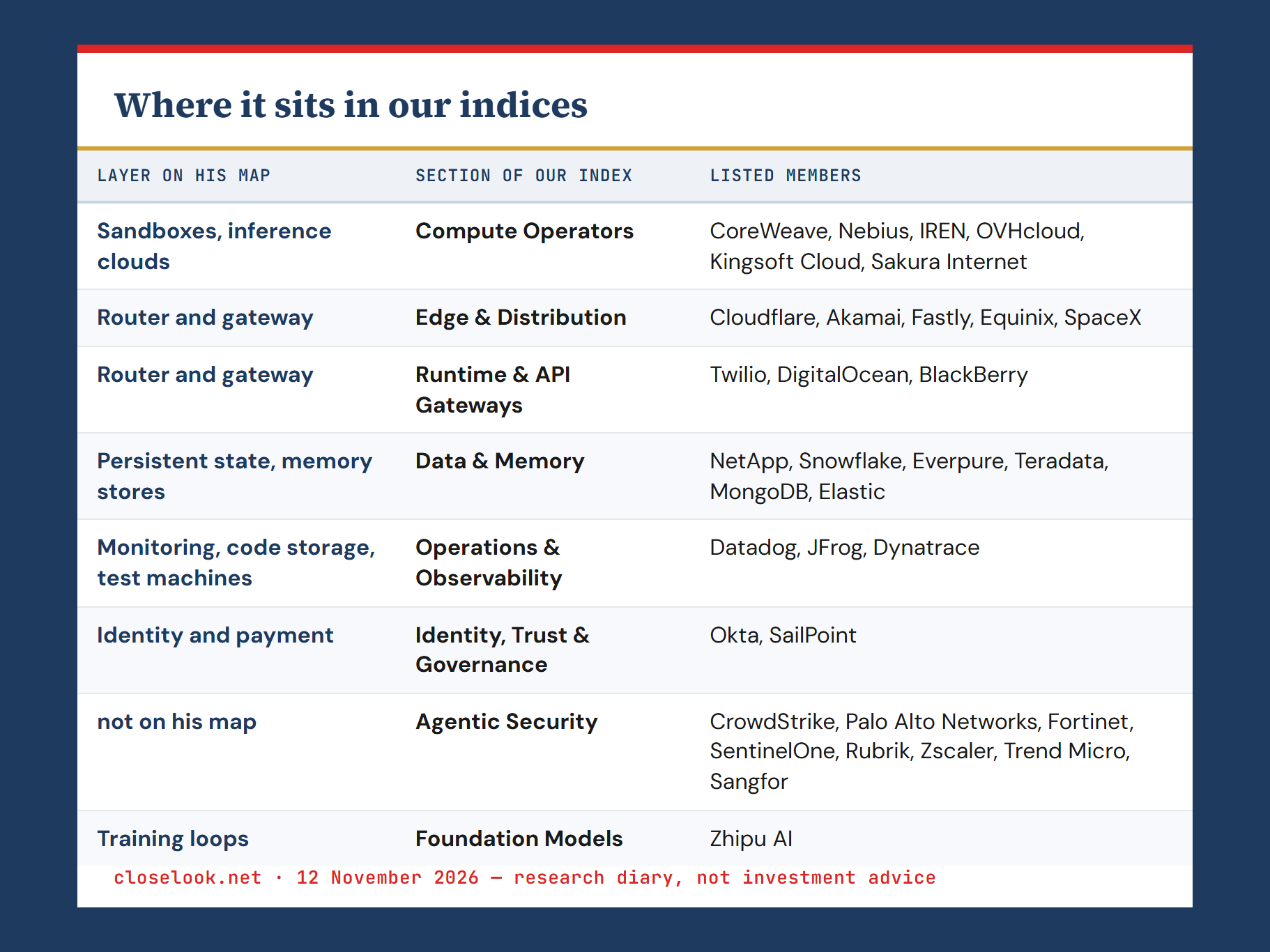
Table as text
| Layer on his map | Section of our index | Listed members |
|---|---|---|
| Sandboxes, inference clouds | Compute Operators | CoreWeave, Nebius, IREN, OVHcloud, Kingsoft Cloud, Sakura Internet |
| Router and gateway | Edge & Distribution | Cloudflare, Akamai, Fastly, Equinix, SpaceX |
| Router and gateway | Runtime & API Gateways | Twilio, DigitalOcean, BlackBerry |
| Persistent state, memory stores | Data & Memory | NetApp, Snowflake, Everpure, Teradata, MongoDB, Elastic |
| Monitoring, code storage, test machines | Operations & Observability | Datadog, JFrog, Dynatrace |
| Identity and payment | Identity, Trust & Governance | Okta, SailPoint |
| not on his map | Agentic Security | CrowdStrike, Palo Alto Networks, Fortinet, SentinelOne, Rubrik, Zscaler, Trend Micro, Sangfor |
| Training loops | Foundation Models | Zhipu AI |
Two limits. Most of the companies Ball names are private, so no index of listed stocks holds the purest cases. And the chips, the power and the buildings underneath are not in this index at all. They are in Rubin 100, our index of 130 companies that build AI hardware.
The landlords build it
Somebody has to own the machines. Two groups do. The large cloud companies build their own data centres. The specialised renters of AI capacity, which we called landlords on 26 October, borrow money, buy chips and rent the computing power out.
The bills are large. Morgan Stanley puts the AI capital spending of big tech near $805 billion this year and above $1 trillion next year. Alphabet’s spending more than doubled in a year to $51.4 billion in the third quarter, and its free cash flow, the cash left after operations and investment, was negative $9.1 billion, the second negative quarter in a row.
The market graded that. In our earnings record a report counts as sold when the stock stands more than 3% lower three sessions later. Alphabet was sold, −14.1%, in a quarter in which its cloud revenue grew 103%. Microsoft was sold too, −4.5%; Amazon ended flat at +2.8%.
The renters carry the same weight with less room. CoreWeave had net borrowings of about $29.5 billion at mid-year. Its order backlog rose to $132.5 billion in the third quarter from $104 billion in June, and it guided to interest costs of $860 million to $940 million for one quarter. On 25 October Elon Musk predicted that most of the more than 200 such companies face failure or consolidation, because lenders have closed the door on operators with no other revenue.
Ball’s map adds to the landlords’ bill. Agents need AI chips, and they also need what he calls the boring parts: ordinary processors, storage and network, at a much larger scale than the classic cloud.
Our indices show what owning the machines has been worth lately. Rubin 100 is 29.1% lower than on 30 June and 32.6% under its high of 22 June. The Compute Operators inside the Agentic Ecosystem Index, the six listed renters, are 23.7% lower than on 30 June.
Others bill it
Above the machines sit the meters: companies that charge per request, per stored unit, per monitored system or per checked identity. They own no data centres. Their revenue rises with the number of units, and units are what agents multiply.
The first piece of evidence is a week of reports. Five members that charge by use reported between 3 and 5 November, and all five beat estimates on earnings and revenue.
Five reports in three days
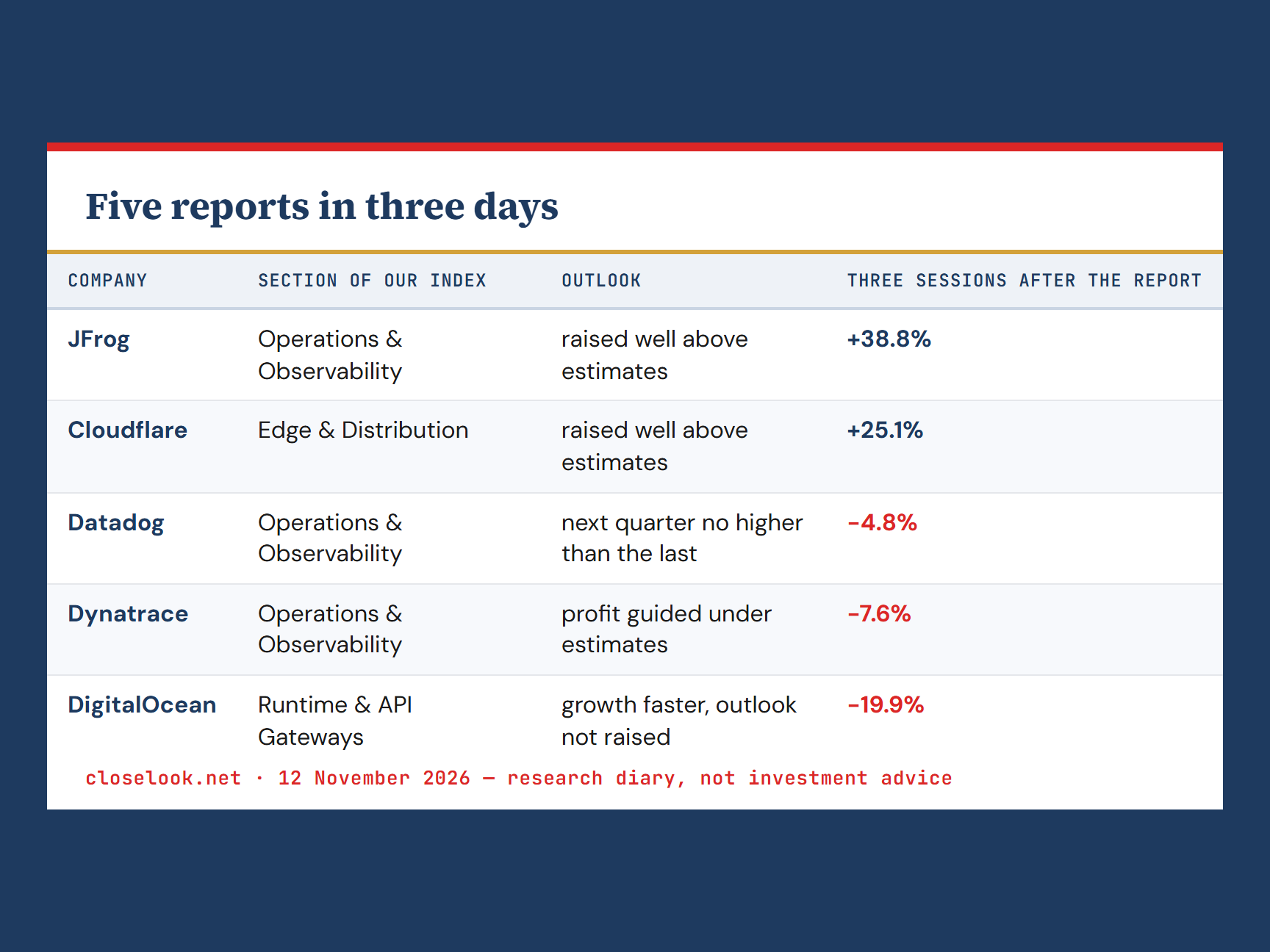
Table as text
| Company | Section of our index | Outlook | Three sessions after the report |
|---|---|---|---|
| JFrog | Operations & Observability | raised well above estimates | +38.8% |
| Cloudflare | Edge & Distribution | raised well above estimates | +25.1% |
| Datadog | Operations & Observability | next quarter no higher than the last | −4.8% |
| Dynatrace | Operations & Observability | profit guided under estimates | −7.6% |
| DigitalOcean | Runtime & API Gateways | growth faster, outlook not raised | −19.9% |
Cloudflare guided fourth-quarter revenue to $845 million to $846 million against $798 million expected. JFrog raised its outlook for the year to $680 million to $682 million against $651.9 million. Both were paid. The three whose outlooks did not rise were sold. Charging by use is not enough; the meter has to be seen running faster.
The second piece of evidence is the sections of the index since the middle of the year.
The sections since 30 June
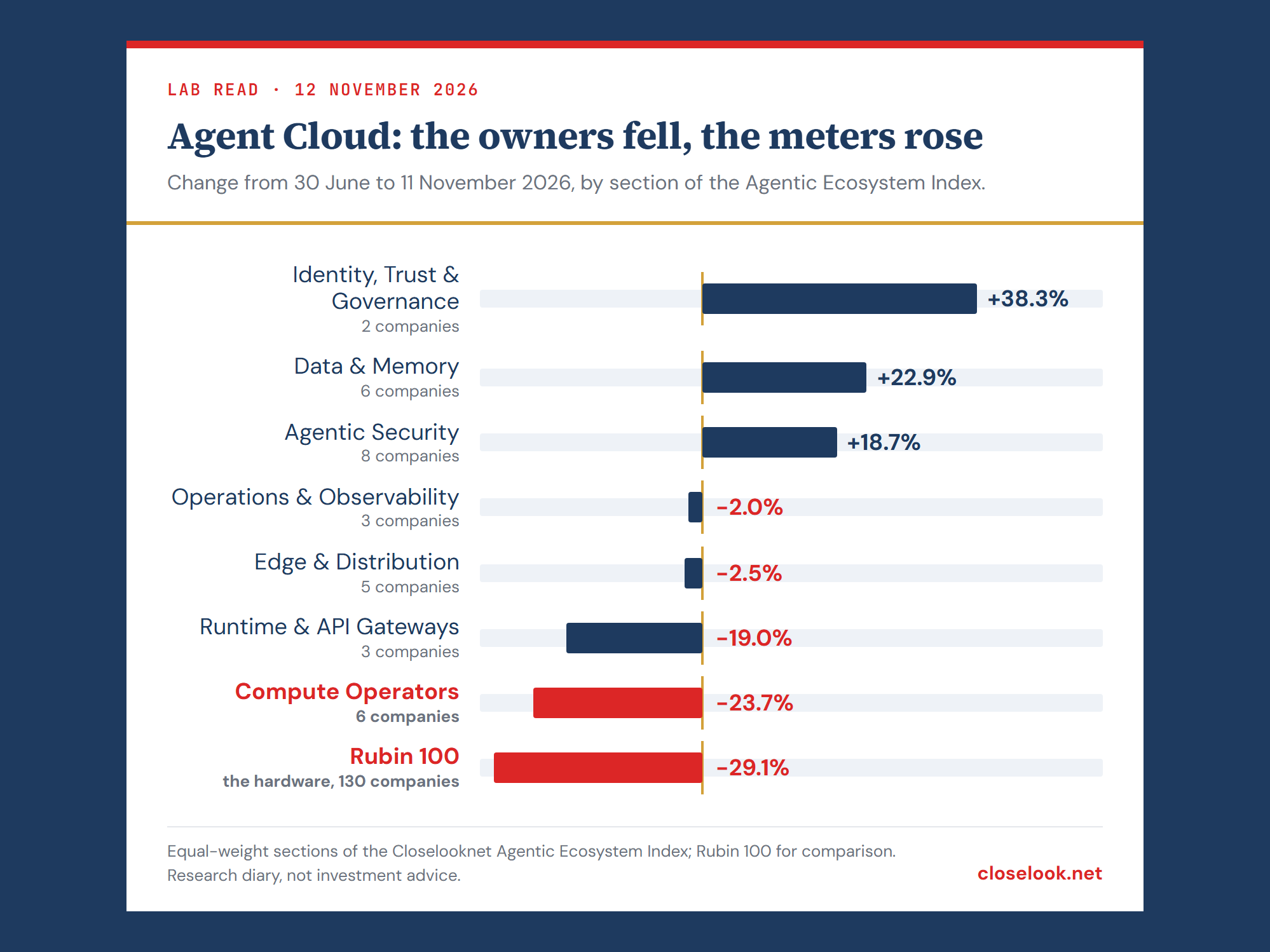
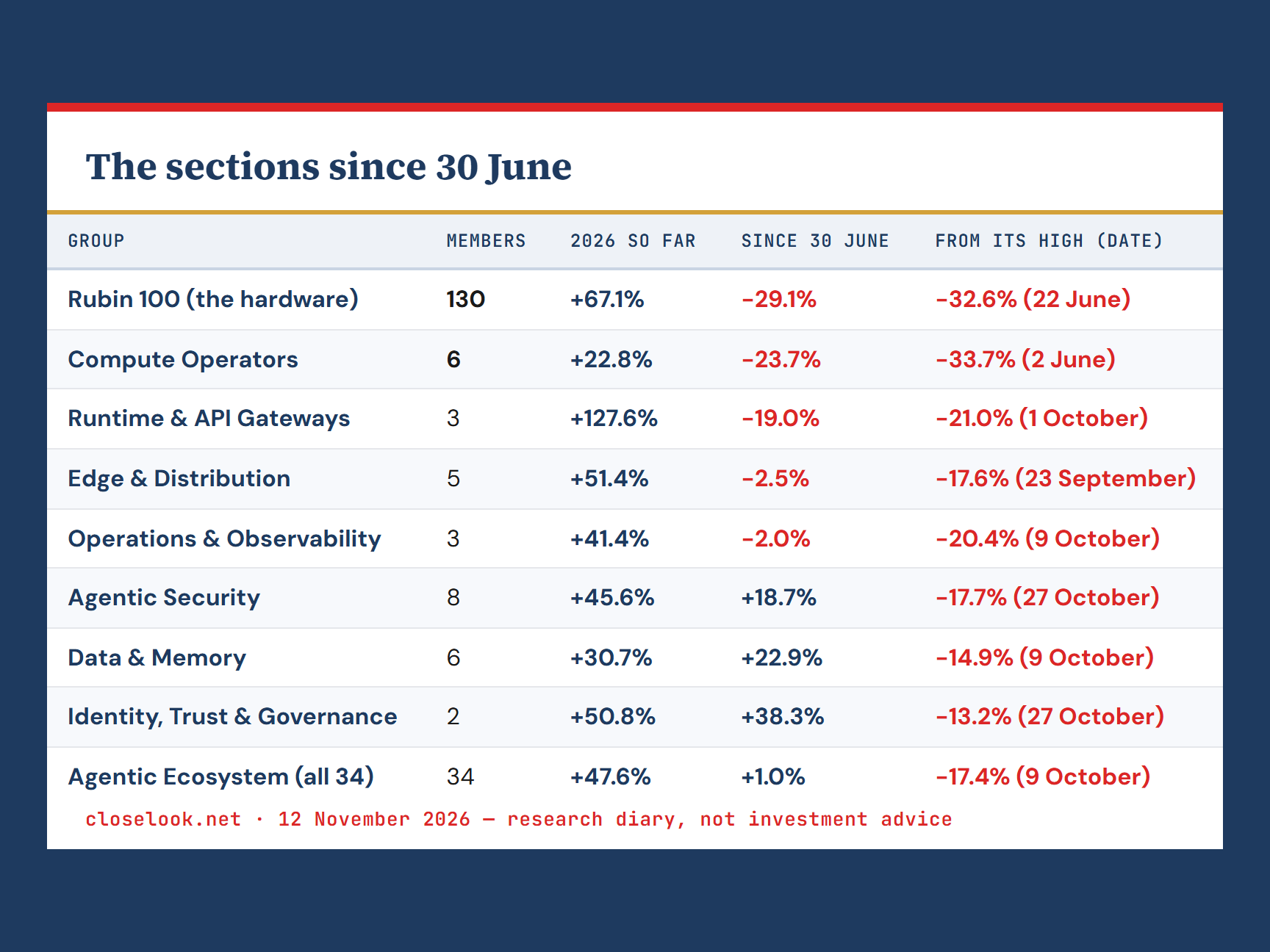
Table as text
| Group | Members | 2026 so far | Since 30 June | From its high (date) |
|---|---|---|---|---|
| Rubin 100 (the hardware) | 130 | +67.1% | −29.1% | −32.6% (22 June) |
| Compute Operators | 6 | +22.8% | −23.7% | −33.7% (2 June) |
| Runtime & API Gateways | 3 | +127.6% | −19.0% | −21.0% (1 October) |
| Edge & Distribution | 5 | +51.4% | −2.5% | −17.6% (23 September) |
| Operations & Observability | 3 | +41.4% | −2.0% | −20.4% (9 October) |
| Agentic Security | 8 | +45.6% | +18.7% | −17.7% (27 October) |
| Data & Memory | 6 | +30.7% | +22.9% | −14.9% (9 October) |
| Identity, Trust & Governance | 2 | +50.8% | +38.3% | −13.2% (27 October) |
| Agentic Ecosystem (all 34) | 34 | +47.6% | +1.0% | −17.4% (9 October) |
Since 30 June the sections that store, identify and secure have risen: Identity, Trust & Governance 38.3%, Data & Memory 22.9%, Agentic Security 18.7%. The sections that own capacity have fallen: Compute Operators 23.7%, and the hardware in Rubin 100 29.1%.
The middle is mixed. Edge & Distribution and Operations & Observability are a little lower. Runtime & API Gateways lost 19.0%; it has three members, and DigitalOcean, the largest mover among them, trades with the build-out more than with software.
The highs tell the same story in time. Compute Operators peaked on 2 June and Rubin 100 on 22 June. Edge followed on 23 September, Runtime on 1 October, Data and Operations on 9 October, Identity and Security on 27 October. The peak walked up the layers, from the machines to the controls.
Our reading: since the middle of the year the market has paid less for owning capacity and more for metering, storing and controlling what runs on it. That is what the title means. It is a reading of eight groups over four and a half months, not a rule.
Where the compute goes when states say no
The landlords have a second problem: where to build. In the midterm elections on 3 November voters decided 41 local measures on new data centres, and at least 10 communities approved bans or limits (CNBC). Texas elected Gina Hinojosa governor; she wants a moratorium on new data centres. Texas holds more than a quarter of the data-centre capacity planned in the US by 2030, and a report tied a $5 billion gap in Microsoft’s spending to delays at a Texas site.
Capacity that cannot be built in one place goes to another. We see three directions. The first is other states and other countries. The second is the edge: networks of many small sites that already exist, which is the business of the Edge & Distribution section. The third is orbit. Musk says the first data centre in orbit could launch in late 2027; SpaceX’s own filing says deployment starts as early as 2028.
For our reading this cuts one way for each side. Scarce sites raise the value of capacity that already stands and the cost of adding more. They do not change who runs the meter.
Where this breaks
The reading is ours, and readers of Ball’s post raise the opposite case. One points out that the classic cloud earned its margins by packing many applications onto shared machines, and that one isolated machine per task works against that. Another notes that more agent activity does not by itself mean pricing power, because the cost per finished task keeps falling.
Landlords can bill too. The large cloud companies sold the classic bundle themselves, and nothing stops them from selling every layer of the agent cloud as their own service.
The order looks different over the whole year. In 2026 so far Runtime & API Gateways is up 127.6% and Rubin 100 67.1%, against 30.7% for Data & Memory. The machines were paid first and most; what changed since June is the direction.
The groups are small. Identity has two members and Runtime three. The Agentic Ecosystem Index as a whole is 17.4% under its high of 9 October, so the upper layers have fallen as well, only later and by less.
And the purest agent-cloud companies are private. What we measure is how listed neighbours trade, not the layer itself.
What we watch next
First, the next reports from the meters. Snowflake is listed to report on 2 December and MongoDB on 7 December; both sit in Data & Memory, the section that has held up best.
Second, the landlords. Nvidia reports on 17 November with its board still deciding on its chief executive, and CoreWeave trades with that news.
Third, the gap itself: whether Compute Operators keep falling while the upper sections hold, or whether the fall reaches the top of the stack.
Fourth, deals. Dropbox and OpenAI bought pieces of the agent cloud within days. If more application companies buy their own layers, the meters have a new kind of competitor.
This diary describes what it sees and what it watches; none of it is a recommendation.