C+

Daily Pulse · · 10:00 CET · market · IBM

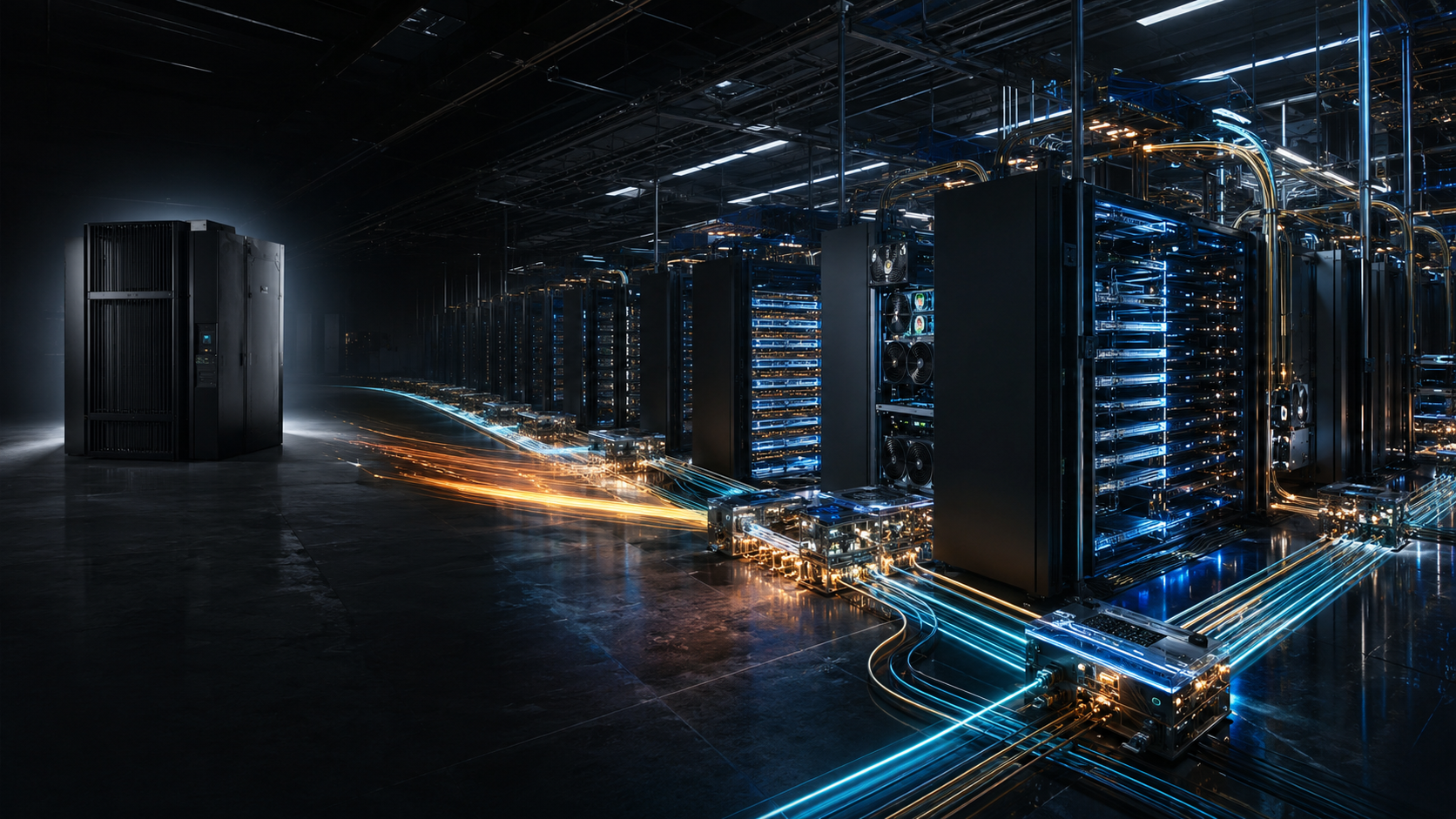
A lone mainframe cabinet in the dark on the left, streams of glowing fiber flowing across the floor into a bright wall of dense server racks — the data center's center of gravity moving from the box to the cluster and the network.

The Data Center Isn't Shrinking — Its Center of Gravity Is Moving

A structure read for full-add Thursday — companion to this morning's Morning 10, which has the verdict-night settles and today's calendar. This is the pattern underneath them.

One income statement, both directions

The most revealing number of the four-print night was not Alphabet's capex guide. It was a pair of numbers inside IBM's release that point in opposite directions. Z mainframe revenue fell 42%, dragging the company to a revenue miss and a trimmed 2026 growth outlook of 4–5%. In the same quarter, IBM's distributed infrastructure business — Power servers and storage — grew 37%, its strongest result on record. IBM's own explanation ties the two together: customers redirected capex toward servers, storage and memory to secure supply-constrained AI infrastructure. The same budget, the same buyer, a different machine.

One qualification belongs up front, because the 42% invites over-reading. The decline is exaggerated by IBM's product cycle — a hard comparison against the strong z17 launch year. IBM says the z17 program still runs at roughly 130% of its predecessor and sees no material migration off the platform. Banks are not abandoning mainframes. The systems of record stay. What is moving is the incremental dollar — and that is the trend worth mapping, because it showed up in three unrelated income statements within twenty-four hours.

What is changing inside the data center

Traditional mainframe infrastructureEmerging AI infrastructure
Centralized, scale-up computingDistributed, scale-out computing
CPUs and proprietary systemsGPUs/TPUs, accelerators and dense servers
Transaction processingModel training, inference and data processing
Compute concentrated in one machineThousands of servers operating as one system
Networking relatively secondaryOptical and IP networking becomes critical
Long, episodic replacement cyclesContinuous capacity additions
One-vendor proprietary stackNvidia and custom silicon plus a broad supplier ecosystem

The other side of the wire

Alphabet's allocation fits the right-hand column precisely. Of the $44.9 billion it spent last quarter — and the $195–205 billion it now guides to for 2026 — roughly 60% of infrastructure capex goes to servers, with the remaining 40% to data centers and networking. "Servers" here principally means accelerated computing: TPUs, GPUs, CPUs, memory and the storage attached to them — not traditional big iron. The largest builder in the market is voting with six of every ten dollars for the cluster.

Nokia is collecting on the other side of the same architecture. Its sales to AI and cloud customers rose 105% in this morning's print, with Optical Networks up 20% and IP Networks up 16%. The reason is structural: AI clusters create enormous east-west traffic — between accelerators, between racks, and increasingly between separate data centers operating as one training run. The network is becoming part of the compute system rather than merely the connection to it. When thousands of servers have to behave like one machine, the wire is no longer plumbing; it is part of the processor.

The path of the AI dollar

Put the three reports together and the route the money takes becomes legible: out of mainframes and conventional enterprise infrastructure → into distributed servers, memory and storage → through optical and IP networking → and on into power and cooling. That single chain explains all of last night at once. IBM's mainframes fell 42% because spending was deferred or redirected away from traditional transaction infrastructure. IBM's distributed business grew 37% because customers bought servers, storage and memory instead. Nokia's AI-and-cloud sales doubled because scale-out servers require vastly more connectivity. And Alphabet's capex guide rose because Google is building the accelerated, networked capacity that creates all of that demand in the first place.

Alphabet weekly chart with the 340 level marked and the rising trend channel from the 2025 low.

The tape graded the chain overnight exactly as the chain predicts. The funder was sold — Alphabet settled 3.3% lower after hours, back onto the 340 area it has been arguing with since June, its first negative-free-cash-flow quarter since the IPO weighing more than its 82% cloud growth lifted. The vendors were paid — the semiconductor complex holds its breakout and Nokia beat. And the one software name that got bought, ServiceNow, got bought for claiming the one seat in the new architecture that resembles the old mainframe's privilege: the orchestration layer, the place where the enterprise's work actually runs. Mainframes remain systems of record. The incremental data-center dollar is going into factories of intelligence. The data center is not shrinking — its center of gravity is moving, from the mainframe to the cluster, and from the box to the network.

One more block on our desk — tomorrow's levels and what we're watching into the next session. Join the Look — it’s free.

Weekly SignalOne signal to define the week — scored in the open, Sundays at 21:00 CET.Read the Weekly Signal →
The signals behind thisEach line links to the tool it comes from