Kospi +4.3%, Kosdaq +8.1% as Asia’s Rally Holds
AI Trade — Kospi +4.3%, Kosdaq +8.1% as Asia’s Rally Holds to the Close; Nasdaq Futures +2.5%
On Thursday Asia’s bounces were sold from their highs. Today Korea, Japan and the memory makers closed at or near them, and Beijing promised to support its stock market. Wall Street reopens for a short session that ends at 18:00 UTC, with S&P 500 futures at the line where Monday’s rally stalled.
In this edition
The Morning 10 Fri, Nov 27, 2026 ~90 seconds 08:45 CET
The ten points
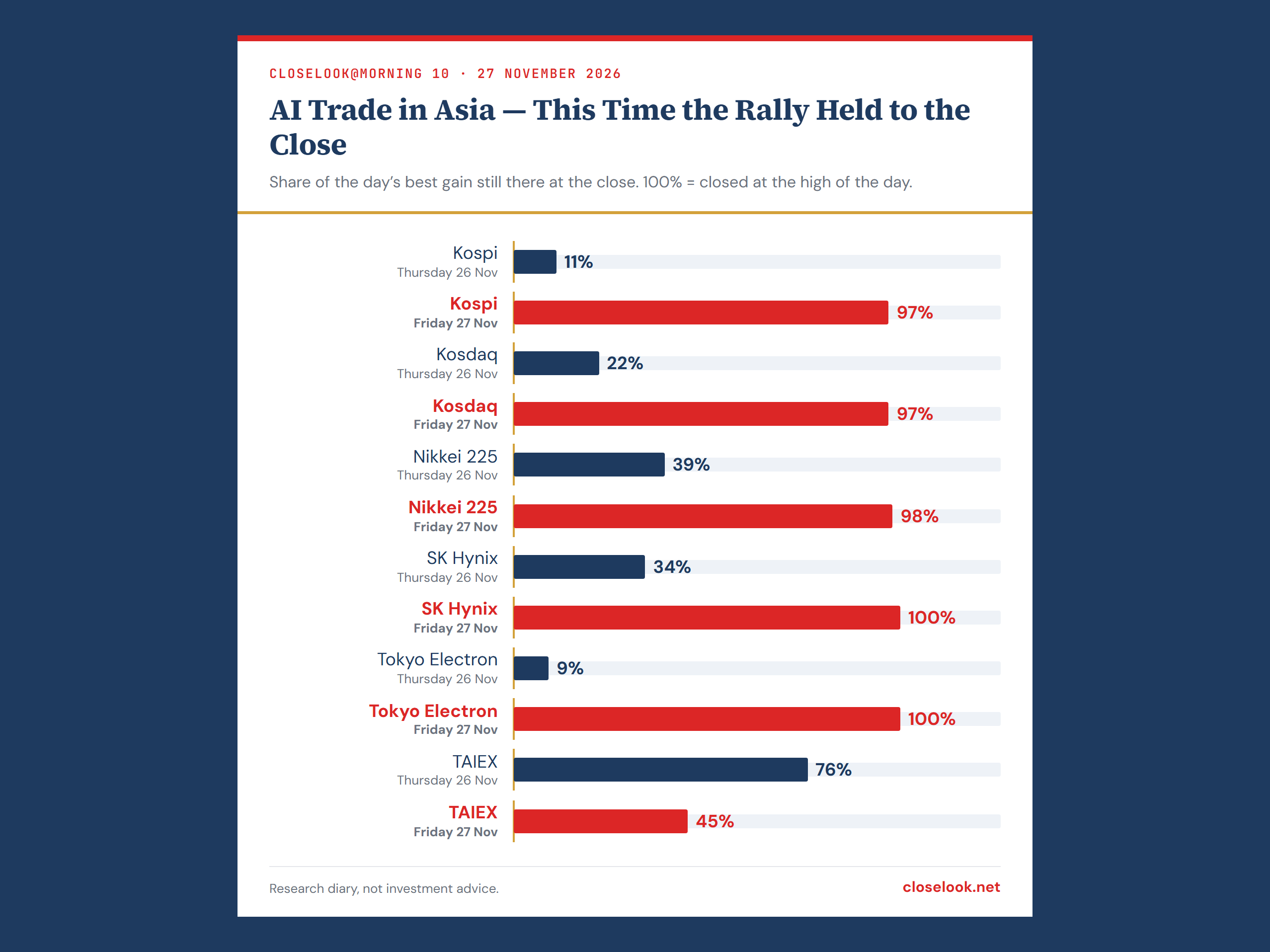
This time Asia’s rally held to the close. Korea’s Kospi rose 4.34% to 4,915.68, 7 points under its high of the day, and the Kosdaq, Korea’s market for smaller and younger companies, jumped 8.13% to 708.99. Japan’s Nikkei 225 gained 2.11% to 58,711.11, 27 points under its high. On Thursday the same markets had kept only a fraction of their gains: the Kospi 11% of its best level of the day, the Kosdaq 22%, the Nikkei 39%. SK Hynix rose 5.41% and closed at its high, Tokyo Electron rose 4.43% and closed one yen under it; Lasertec gained 9.98%, Kioxia 8.86% and Advantest 7.07%. Taiwan was the exception: the TAIEX rose 0.40% after a 0.88% high.
China added to it during the afternoon. In a rare midday statement the cabinet promised new capital-market policies, a bigger role for the state-backed buyers known as the national team and more dividends and buybacks, without saying how much or when (Bloomberg, investingLive). Shanghai’s composite index rose 3.73% to 3,606.49, most of it after the lunch break; in Hong Kong the chip maker SMIC rose about 17% and Alibaba about 7%. In Seoul foreign investors and domestic institutions bought, on hopes that the authorities widen a market stabilisation fund (Edaily). US Nasdaq-100 futures, 0.5% higher on Thursday evening, are now 2.46% higher at 26,743.25, S&P 500 futures 1.68% at 7,316.50. Gold futures are up 4.2% at $3,685 an ounce.
Thomas’s read on Wednesday: markets are closing Monday’s breakaway gap, and then it is decision time. Wednesday and Thursday gave the lines to the buyers and the highs to the sellers. Today the buyers kept the highs too, in Korea and Japan. Futures put the Nasdaq-100 at about 26,690, close to Monday’s close of 26,746.10, and the S&P 500 fund SPY at about 729, on the 727 line of Thomas’s chart where Monday’s high stalled. Wall Street reopens for a short session that ends at 18:00 UTC; our earnings record grades four reports at that close: Zoom, Hewlett Packard Enterprise, CrowdStrike and Zscaler.
- AI Trade in Asia — Kospi +4.3% and Kosdaq +8.1%, both within 0.3% of their highs; Nikkei +2.1% at its high; Taiwan +0.4%, the laggard
- Asia’s AI Bellwethers — Lasertec +10.0%, Kioxia +8.9%, Advantest +7.1%; SK Hynix +5.4% at its high, Samsung +4.6%, Tokyo Electron +4.4%; TSMC +1.6%
- China and the Rest of Asia — Beijing pledges market support at midday: Shanghai +3.7% back above 3,600, SMIC +17% and Alibaba +7% in Hong Kong; India −0.8%
- Europe — Stoxx 600 +1.8% on Thursday, back above its 200-day average; chip makers +3–4.5%: STMicro +4.5%, Infineon +3.6%, ASML +3.2%
- US Futures — Nasdaq-100 +2.5%, back near Monday’s close; S&P 500 +1.7%, Russell 2000 +1.2%, Dow +1.0%; tech leads again after Wednesday’s rotation
- The Gap and Thomas’s Lines — filled on Wednesday, held 60 points above Friday’s low; futures put SPY at the 727 line where Monday’s high stalled
- Rates — Treasury futures lower: yields point higher from Wednesday’s 4.85%; a December Fed hike still priced; China pledges support, Korea hiked on Thursday
- Gold, Bitcoin and the Dollar — gold futures +4.2% to $3,685; Bitcoin +2.1% to $61,756; dollar index flat at 103.7, won +0.5%, yen 159.3
- Our AI Indices and Earnings Record — Rubin +1.4% on Thursday from its non-US members, 2.0% above its March high; four reports graded at today’s close
- Today and Next Week — US session ends at 18:00 UTC; French and Spanish inflation; Rubrik on Monday, Marvell and Okta on Tuesday

-
AI Trade in Asia — Kospi +4.3% and Kosdaq +8.1%, both within 0.3% of their highs; Nikkei +2.1% at its high; Taiwan +0.4%, the laggard
StructureEWYEWTEWJ
- What
- Korea’s Kospi opened 0.37% higher at 4,728.80, dipped to 4,682.43 in the first minutes — 0.61% under Thursday’s close — and then rose almost without a pause to close 4.34% higher at 4,915.68, against a high of 4,922.94. That is 4.4% above Monday’s close of 4,708.54, the level before the Nvidia news reached Asia, and 1.8% under Tuesday’s close of 5,006.03. The Kosdaq rose 8.13% to 708.99, its highest close since 4 November, on net purchases of ₩303 billion by foreign investors and ₩586.6 billion by domestic institutions; Edaily put it down to AI stocks and to expectations that the financial authorities widen and use the Securities Market Stabilisation Fund. Japan’s Nikkei 225 opened at 57,669.79, slipped to 57,447.16 and closed 2.11% higher at 58,711.11, 27 points under its high of 58,738.02. Taiwan’s TAIEX rose as much as 0.88% to 39,495.41 and closed 0.40% higher at 39,308.08; it closed at 05:30 UTC, before most of the afternoon rally in China.
- If
- The Kospi holds above 4,708.54, its pre-rally close, and Taiwan above Wednesday’s low of 36,681.90 into next week. Then the decision after the closed gap has gone to the buyers twice in a row, and the Korean rally has a floor under it; a Kospi close back under 4,708.54 would undo it.
- Why
- Korea, Taiwan and Japan hold most of the companies that make, test and package AI chips, which makes them the cleanest overnight read on the AI trade. A rally that closes at its high says the buyers were still buying in the last hour; on Thursday the sellers used every bounce, and today they did not. Thomas’s read waits for exactly this kind of decision after a closed gap.
- Then
- The Kospi is 46.1% under its record close of 9,114.55 from 22 June and 24.6% under its 200-day average of 6,517; the Kosdaq is 42.2% under its 27 April high. Taiwan is 21.1% under its record close of 49,822.55 from 6 October, the Nikkei 18.9% under its record of 72,366.34 from 25 June. Over five sessions the Kospi is 0.9% higher, the Kosdaq 9.8% and Taiwan 9.1%; the Nikkei is 1.2% lower.
-
Asia’s AI Bellwethers — Lasertec +10.0%, Kioxia +8.9%, Advantest +7.1%; SK Hynix +5.4% at its high, Samsung +4.6%, Tokyo Electron +4.4%; TSMC +1.6%
StructureTSMSMH
- What
- In Tokyo the chip-inspection maker Lasertec rose 9.98% to ¥33,600, the memory maker Kioxia 8.86% to ¥8,450, the chip-test maker Advantest 7.07% to ¥26,585, the wafer-dicing maker Disco 4.93% to ¥44,280, Tokyo Electron 4.43% to ¥8,220 and SoftBank Group 3.13% to ¥2,984.50. Several started the day lower: Tokyo Electron was 3.47% down at its low, SoftBank 3.77%. In Seoul SK Hynix opened 1.23% lower, fell as much as 2.94% to ₩1,022,000 and closed 5.41% higher at ₩1,110,000, its high of the day; Samsung Electronics rose 4.55% to ₩179,100 after a 1.34% fall at the open. In Taipei TSMC rose 1.63% to NT$2,180, also its high, while MediaTek fell 0.67% and Foxconn rose 1.15%. On Thursday Tokyo Electron had been up 6.62% and closed up 0.59%, SK Hynix up 6.60% and closed up 2.23%.
- If
- The memory makers hold today’s closes next week. Then SK Hynix and Samsung, the two names that closed under their Monday lows on Wednesday, are back inside the rally; Samsung at ₩179,100 is still under its Tuesday close of ₩189,400, the high point of the rally in Seoul, which is the next test.
- Why
- The memory makers fell furthest after the June peak of the AI trade — SK Hynix, Samsung and Kioxia are each half or more under their June highs — so they are the part of Asia that most needs to show buyers. Today they did: reversals from a lower open to a close at the high are the pattern of buyers who were waiting, not of a short squeeze that fades.
- Then
- SK Hynix is 62.0% under its record close of ₩2,919,000 from 22 June and 27.6% under its 200-day average; Samsung is 50.6% under its record of ₩362,500. SoftBank is 65.4% under its June high and lost 15.6% over five sessions. TSMC is 2.6% under its 200-day average of NT$2,238 and 15.7% under its 6 October record.
-
- Trade the Look AI Cycle 2030 — capex, opex, applications: the three-phase AI cycle, run as a wikifolio. See the wikifolio →
-
China and the Rest of Asia — Beijing pledges market support at midday: Shanghai +3.7% back above 3,600, SMIC +17% and Alibaba +7% in Hong Kong; India −0.8%
StructureFXIMCHIKWEB
- What
- China’s State Council published a statement on market support during the lunch break, which Bloomberg called rare: new capital-market policies, a larger role for the state-backed funds known as the national team, more dividends and buybacks, with Central Huijin to act more openly as a stabilisation fund; it gave no size or timing (investingLive, Reuters). Shanghai’s composite index, flat at 3,486.76 before the break, closed 3.73% higher at 3,606.49, its highest close since 13 November. The STAR 50 index of Shanghai’s technology board, where China’s chip makers list, rose more than 12% to 1,346.25 (rallies.ai). In Hong Kong, shortly before the 08:00 UTC close, the Hang Seng was 1.9% higher at about 22,655, SMIC 17.0% higher at HK$53.70, Alibaba 6.9% at HK$88.20 and Tencent 2.9% at HK$351. India’s Nifty 50 was 0.77% lower at 25,685.80 at midday; Australia’s ASX 200 rose 0.80% to 8,833.60.
- If
- Beijing follows the statement with numbers — an amount for the national team or a buyback programme — next week. Then Shanghai can hold 3,600; without them, the move rests on a statement alone.
- Why
- A support pledge from China’s cabinet changes what investors are willing to pay for Chinese chip and internet stocks, and it spills over into Korea and Hong Kong, which sell into China. It came after Shanghai fell to 16-month lows, as Reuters put it.
- Then
- Shanghai is still 15.0% under its 13 May high of 4,242.57 and 8.6% under its 200-day average of 3,947. The Hang Seng is 19.0% under its January high and 9.5% under its 200-day average. Alibaba is 52% under its October 2025 peak close; SMIC traded at its highest level since 14 October.
C — free account
The free C account unlocks points 4 through 10 — the full morning read.
One tap with Google or one email — no password, no card. You are signed in until you sign out, on this browser, from then on.
Join the Look — freeAlready joined on this browser? The full edition shows automatically — if it doesn't, sign in again here. Looking for the archive, portfolios and realtime? That is C+.
C · point 11 · members
The privileged, actionable read — what we do, and at which level — is in point 11, for members only.
Join the Look — it’s freeFree members account · one click · the ten points stay free, always.
Further reading on Closelooknet
A daily overview, not advice — an investment diary. Published every trading morning at 08:00 CET. See the Daily Pulse and today’s check-in.