Heresy · 09:00 CET
AI Bottlenecks — The Constraint Relay · Closelooknet Heresy IX
Why the company solving today's bottleneck is almost never the one to hold through tomorrow — and why a handful of them are the exception that proves it.

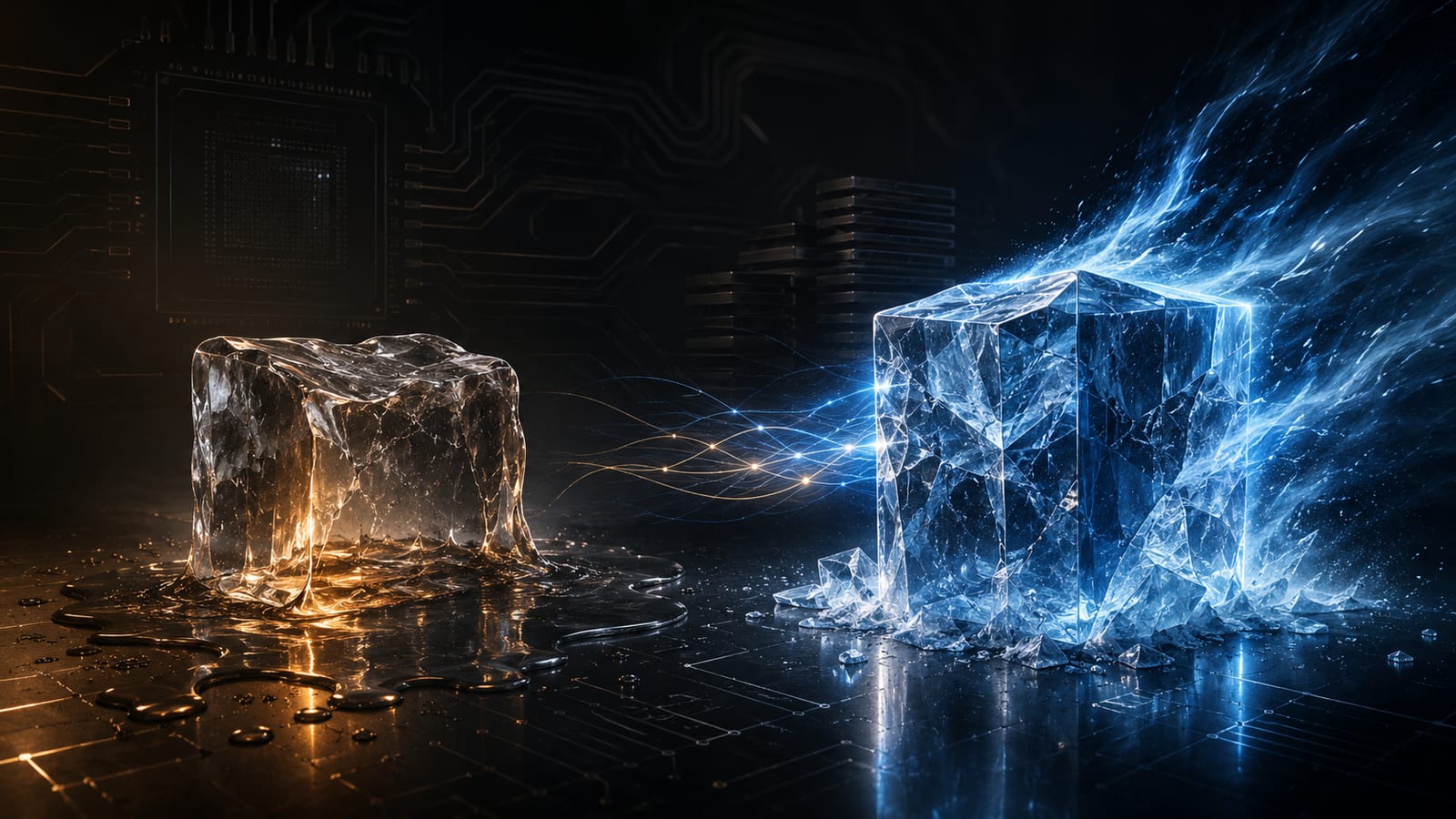
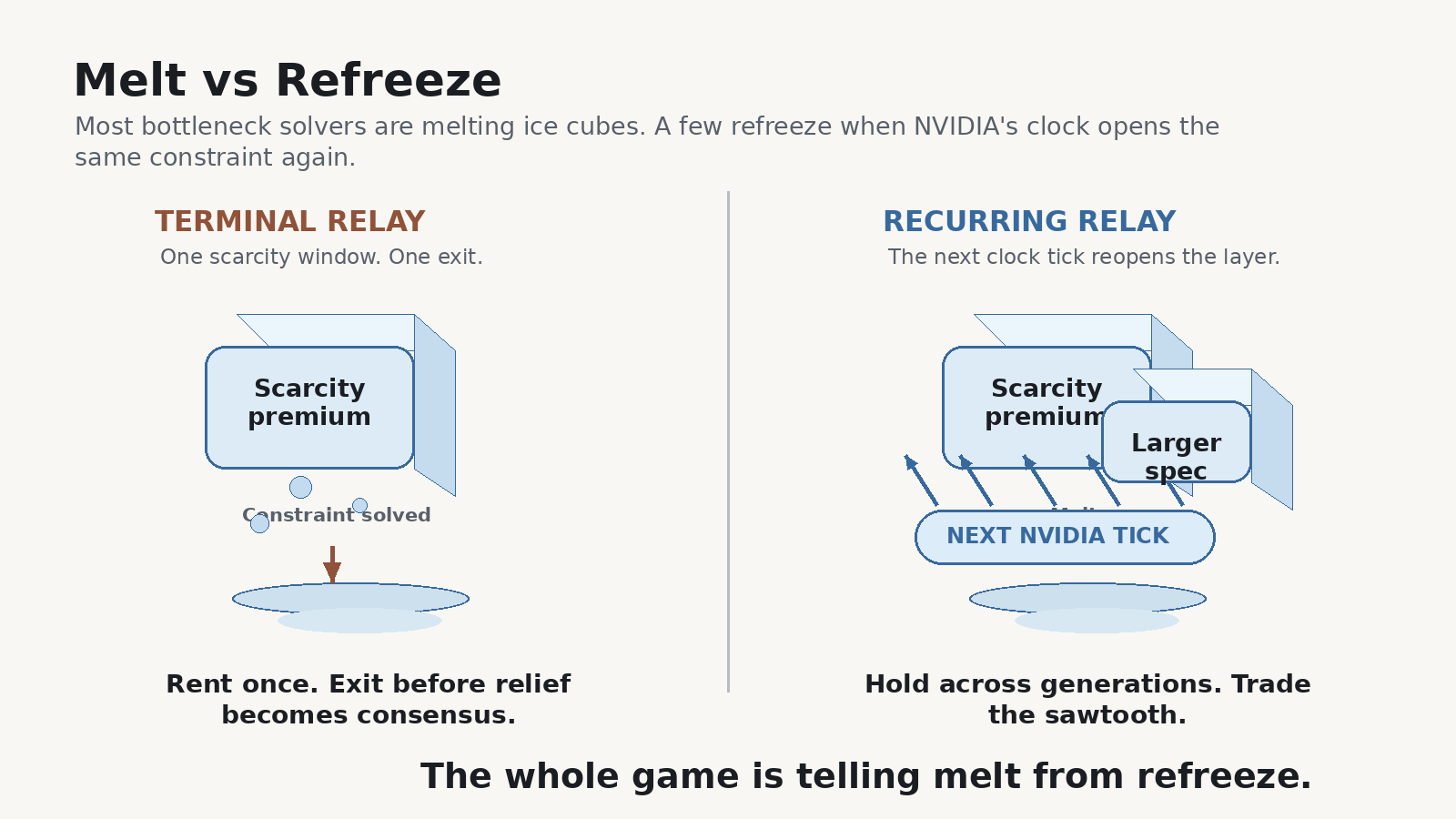
Most picks-and-shovels in the AI build-out are melting ice cubes — the better they solve their bottleneck, the faster they erase the reason to own them. But a handful refreeze on NVIDIA's clock, every generation. The whole game is telling the two apart.
The heresy: A bottleneck is not automatically a moat. It is a scarcity — and someone is paid, urgently and at scale, to make it disappear. The market was never paying for the company; it was paying for the scarcity. But a few scarcities are re-opened by NVIDIA's own cadence every generation, and those compound instead of decaying. Owning the build-out is one discipline: trade the refreeze, rent the melt, respect the wall.
I. The inversion
Here is the advice you have heard a hundred times. Don't try to pick the winner of the AI race — focus on the picks and shovels. Own the bottleneck. Own the company everyone has to go through.
It sounds like discipline. Applied carelessly, it is a slow way to lose.
A bottleneck is not automatically a moat. Often it is a scarcity — and a scarcity has a property a moat does not: someone is paid, urgently and at scale, to make it disappear. The company that relieves the bottleneck captures an extraordinary premium while the constraint binds, and then, by relieving it, liquidates the very scarcity the premium was paying for. The better it executes, the faster it can kill its own franchise. The market was never paying for the company. It was paying for the scarcity — and scarcities, once solved, move on.
That is the melting ice cube: solve the bottleneck, and you erase the reason to own you.
II. But the constraint comes back
Most scarcities, once solved, stay solved. A few do not — and that difference is the entire thesis.
A relieved constraint can recur with every new NVIDIA generation. Hopper opened a memory constraint; the scaling phase solved it; the premium compressed. Blackwell did not inherit a solved memory problem — it re-opened it at a higher spec. Rubin re-opens it again at HBM4. Feynman will re-open it once more. The same layer, the same solver, handed a fresh scarcity each time the clock ticks. The bottleneck does not vanish. It rhymes.
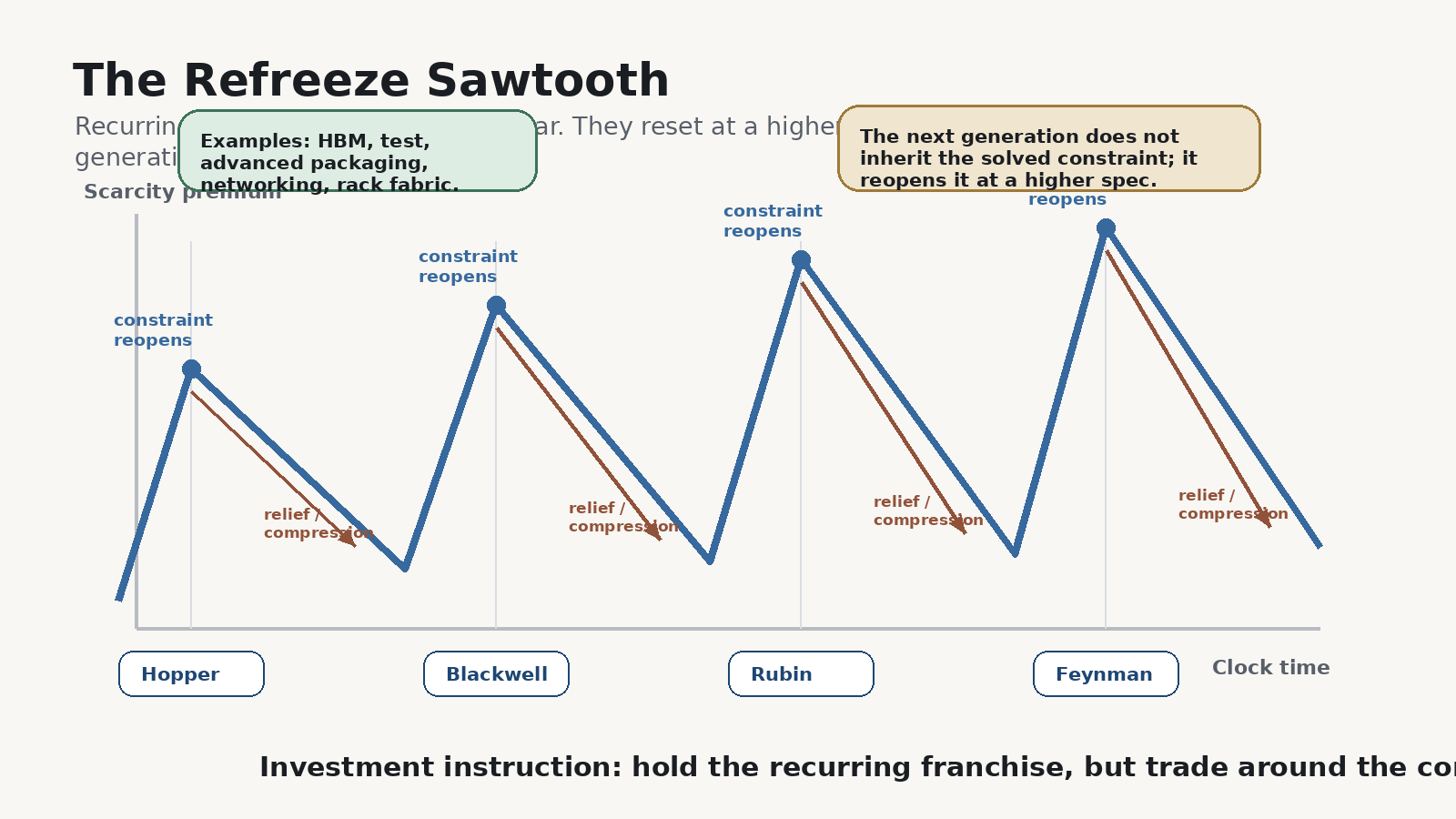
So the right picture is not a single melt. It is melt-and-refreeze. A solver sitting on a constraint that the cadence keeps re-opening runs a sawtooth premium: it builds into each generation's binding phase, compresses as that generation's version of the constraint is solved, then rebuilds as the next chip re-opens it at a higher spec.
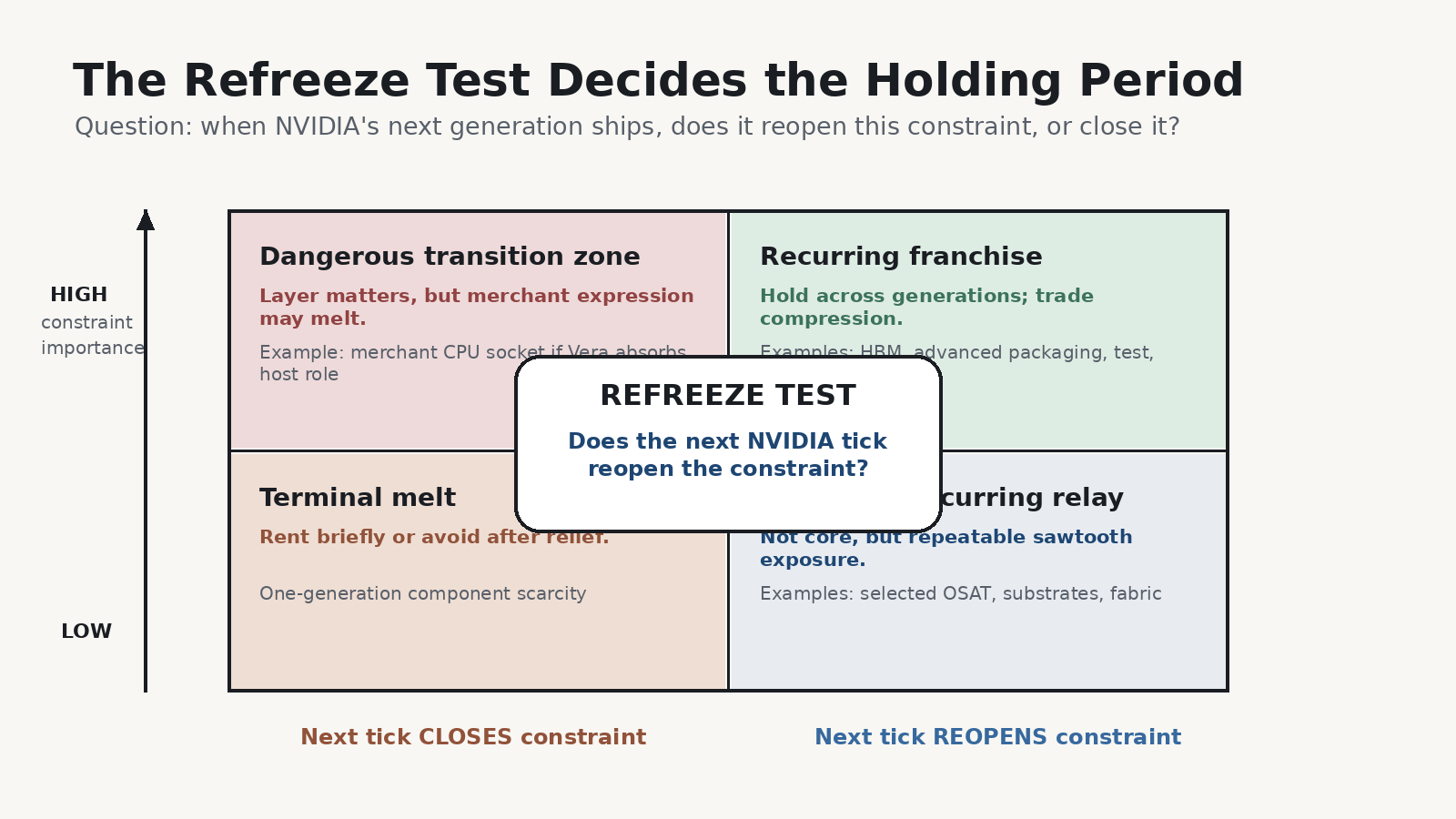
That splits every bottleneck solver into two different animals, and one question separates them:
When NVIDIA's next generation ships, does it re-open this constraint — or close it?
Re-open, and the solver refreezes: a recurring franchise, held across generations, traded around the sawtooth. Close — designed out, integrated onto the die, commoditized — and the solver is a terminal melt: rent it once, into the binding phase, and exit before the relief. That test is the investable content of the relay. The rest is applying it down the stack.
III. The structure: a threshold, not a pedestal
Most AI hardware maps are thirty names and a logo wall. The relay imposes a harsher rule: a company earns a place only if it sets the cadence, sits above the line that co-determines what the system can economically do, or solves a structurally recurring bottleneck.
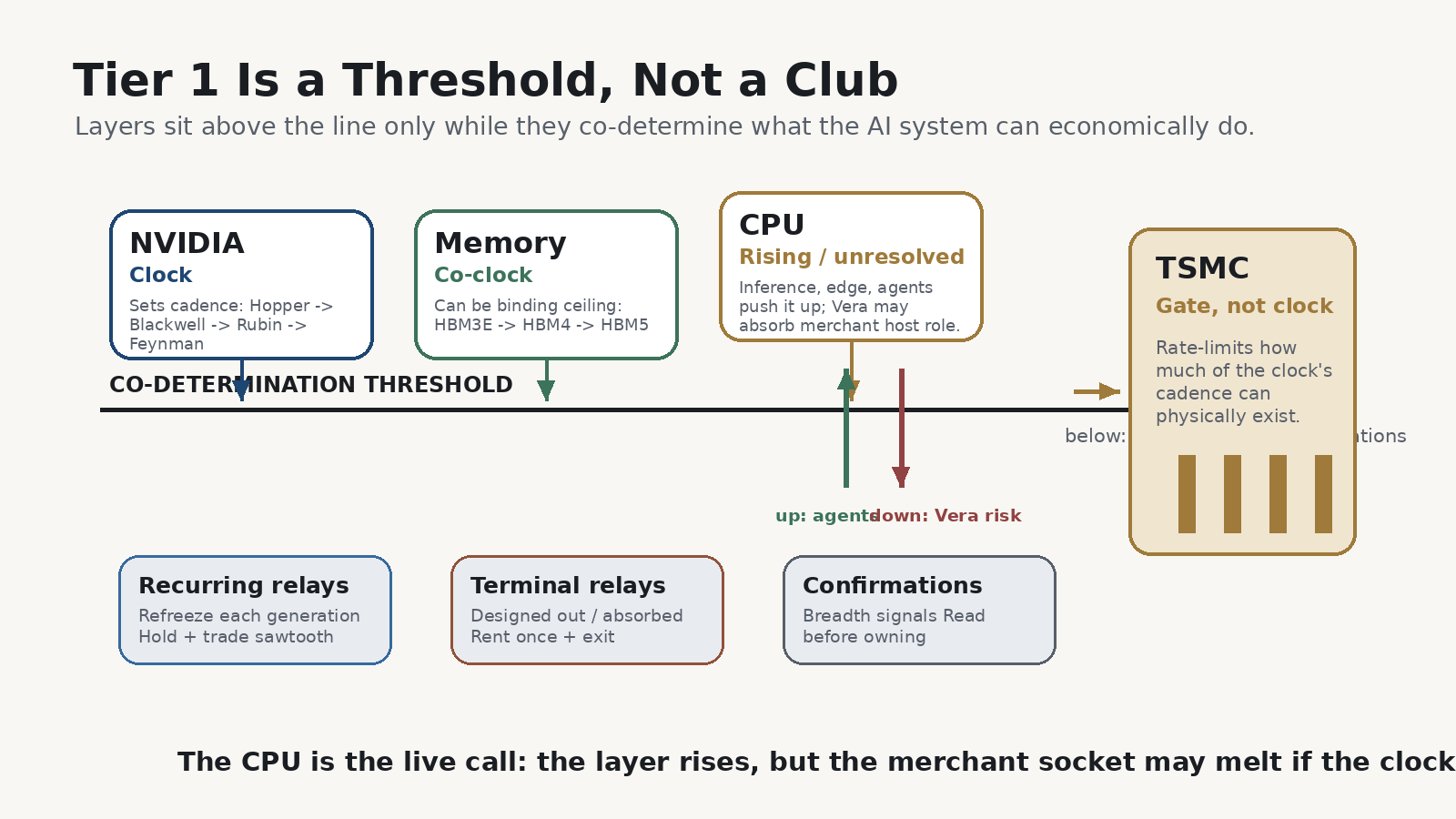
And the top tier is a threshold, not a permanent club. A layer belongs there for as long as it sits above the line of co-determining what the system can do — an importance that is neither uniform across the build-out nor eternal. It breathes with the phase: layers cross the threshold upward as the phase turns toward them, and fall back when the clock absorbs them.
Tier 1 — above the co-determination threshold
NVIDIA — the clock. The only unambiguous cadence-setter: Hopper → Blackwell → Rubin → [Feynman]. Every other layer reacts to its tick. Held through the build-out, always subject to price — a clock bought at the wrong number is still a bad hold. Watch what it is doing to the layer below: with Grace and Vera it is pulling the CPU host function inside the clock. (Cadence past Rubin: Roadmap. Feynman timing is reported, not confirmed.)
The memory layer — the co-clock. Memory is not a relay beneath the clock; it is co-equal to it. A Rubin rack is a GPU-and-memory system where either layer can be the binding ceiling — the memory constraint refreezes every generation and compounds pricing power, which is why it behaves like a platform rather than a commodity (the case made in full in the companion piece on memory). SK Hynix holds the product lead into HBM4 — base-die-on-logic, yield, thermals, the qualification advantages that compound. The layer is Tier 1; the socket is contested, with Samsung and Micron bidding for it. “Own memory” is the Tier-1 conviction; “own SK Hynix” is its incumbent expression, watched against the challengers. (HBM4 socket outcome: contested / Inferred.)
The CPU layer — above threshold, rising, unresolved. This is the layer most maps leave out, and the live call. Through the training-scale era the CPU mostly fed the accelerators and sat below the line. As the build-out turns toward inference, edge, and agent scale-out, the host becomes what gates useful work — coherence, feeding the accelerators, owning the scale-up boundary — and the layer crosses above the line. It earns Tier 1 now, in this phase.
But there is no defining winner yet. Arm is the lead terrain — the inference/edge/agent phase is overwhelmingly Arm-ISA territory — yet “Arm wins” and “Arm-based silicon wins” are different bets: the value may accrue to Arm Holdings as licensor, to the custom-silicon builders (hyperscaler in-house, Marvell, Broadcom), or to NVIDIA's own Vera. The layer clears the threshold while its equity expression stays open. And the same clock that lifts it can absorb it: if Vera takes the host role, the layer is pushed back down from above. Crossing up and at risk of being pulled down at once — the single most informative thing to watch in the stack right now. (CPU bellwether: genuinely open. Arm as lead terrain: Inferred.)
TSMC — the gate, not a clock. TSMC does not set cadence; it rate-limits how much of the cadence can physically exist. You own it for throughput scarcity, not for the wave. A clock and a gate behave differently in a portfolio, and it is worth keeping them apart.
Tier 2 — the relays, split by the refreeze test
Here the melt-vs-refreeze question does the sorting.
Recurring relays solve a limit the next tick re-opens at a higher spec, so they are not one-shot melts: advanced packaging, test and known-good-die, scale-out networking, rack-internal fabric. They are franchises you hold across generations and trade around the sawtooth: in for the binding phase, lighter as it relieves, back in as the next tick refreezes it. Broadcom and Marvell in networking, Advantest in test, Astera in fabric. BESI sits here too — an option on hybrid bonding becoming the dominant integration method, on a timeline that has repeatedly slipped, in a layer it shares with ASMPT and Kulicke & Soffa. Real, recurring, tradeable — an option, not a core hold. (Hybrid-bonding dominance timing: Roadmap / Inferred.)
Terminal relays solve a constraint that is one-generation-specific, or that the clock designs out. A component that matters intensely during a single transition, then is integrated onto the die, commoditized, or absorbed next generation. These are the true melting ice cubes: rent once, into the binding phase, exit before relief. The merchant CPU socket is the live candidate to become one — if Vera absorbs the host function, the merchant remainder melts terminally even as the CPU layer stays Tier-1 important. A constraint can be Tier-1 at the layer and a terminal melt at the merchant socket; that is the clock eating a layer in real time.
Tier 3 — confirmations
OSATs, substrates, optics, inspection. You do not lead with these; you read them. When substrate and OSAT capacity tightens, it confirms a wave is physically real rather than narrative. Breadth signals — participation before you trust the move — not primary positions.
IV. The two ways it breaks
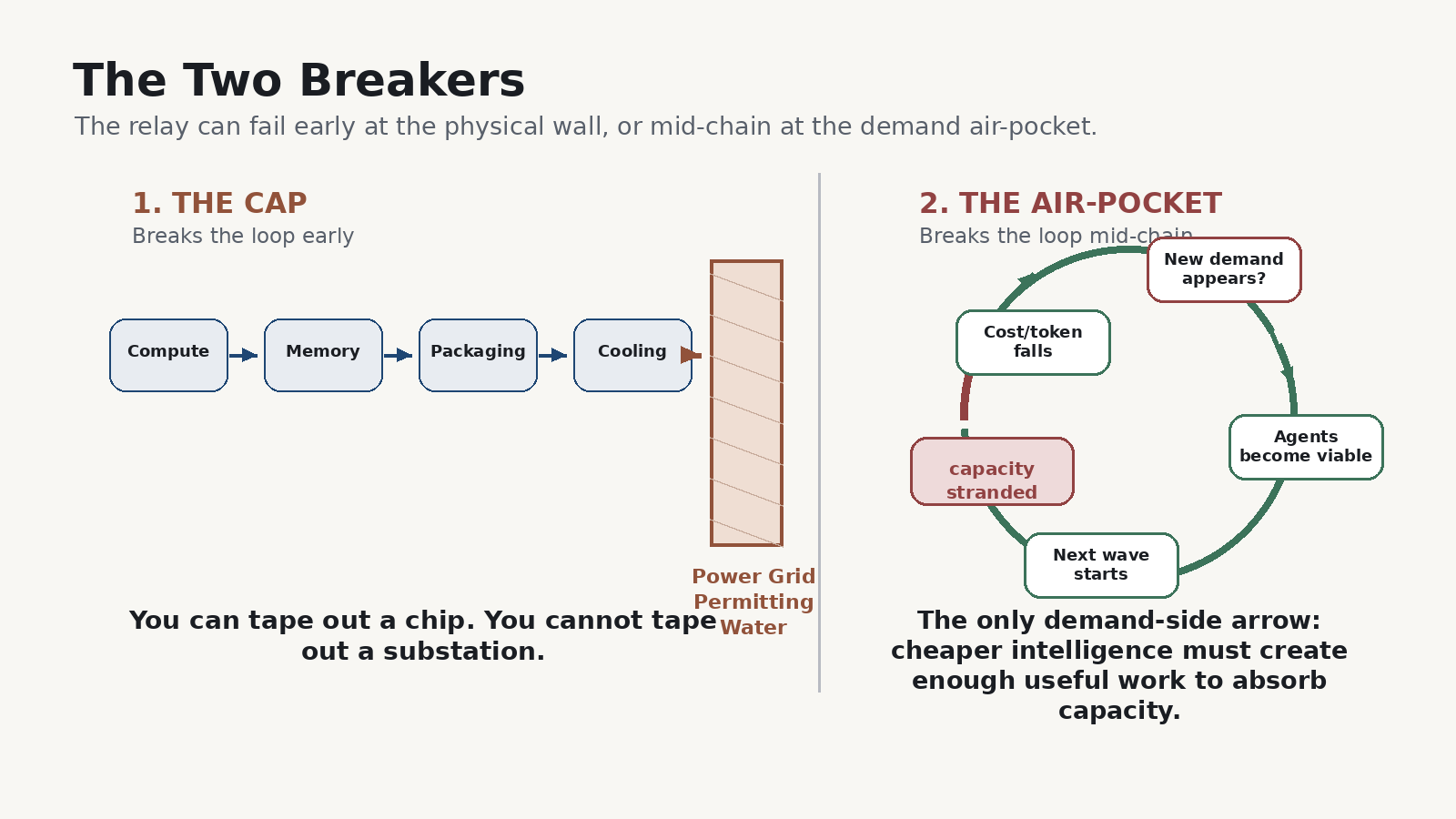
A relay where every wave arrives on schedule is a bull thesis in a lab coat. It is only worth trusting if it can break — and it breaks in two specific places.
The cap — the constraint that does not relay
Every bottleneck so far has a solver, which is why the baton keeps moving. One does not. Power. Grid interconnect. Permitting. Water. No clean solver, because it is not a chip — it is utility politics, land, transmission queues, water tables. You cannot tape out a substation. A constraint that capex cannot relieve does not pass the baton forward; it caps the loop. Every elegant relay above it can be executing perfectly and the loop still stops here, because the relieved compute has nowhere to plug in. Vertiv and peers relieve the thermal slice — liquid cooling, CDUs, distribution, a real recurring trade — but the grid slice stays capped, and thermal solvers cannot reach it. The most important bottleneck in the build-out may be the one with no ticker that cleanly expresses it.
The air-pocket — the one link doing all the work
The relay is a loop, and it closes at a single link: cost-per-token falls → new demand appears → the next platform becomes economically viable → the next wave starts. Every other step is supply-side, engineering-bounded, with a known solver. This one is a demand step — the only genuinely uncertain link in the structure. If cost falls and useful demand does not show up fast enough, the most recently relieved layer is left stranded and the relay breaks mid-chain — not at the bottom where you'd watch for it, but in the middle, at whatever layer just solved its constraint into a market that wasn't ready. The whole structure assumes AI demand stays elastic enough to keep swallowing each newly-cheapened layer. Probably right. Not guaranteed.
V. What you do with it
The relay sorts the whole build-out into three kinds of position, and the kind tells you how to hold it.
- Strategic core — held untouched. The Tier-1 layers: NVIDIA the clock, memory the co-clock (SK Hynix its product-leading expression, the socket watched), the CPU the rising layer (track the layer, name Arm as the terrain, hold no false conviction on the winner). Sized once and held through the build-out, subject only to price — not traded around. Watch the threshold itself, because layers cross it both ways.
- Strategic, but actively sized — the rhyming bottlenecks. The recurring relays: advanced packaging, test, scale-out networking, BESI. You hold the franchise across generations, but you increase into each generation's binding phase and trim as it relieves, then add back as the next tick refreezes it. Long-term positions you trade around the sawtooth — without ever abandoning them.
- Trading positions only — the one-time solvers. The terminal relays: rented into the binding phase and exited before the relief. There is no strategic hold here; the de-rate is not a risk to the trade, it is the trade's clock.
Around all three: read the confirmations — Tier 3 for breadth, participation before you trust a move — and respect the two breakers: the power-and-grid cap that can end the loop early, and the cost-to-demand link that can break it mid-chain.
The relay runs down the stack and across generations — the same physics, one level up from a single chip's life cycle. Within one generation, leadership rotates through the layers as the ramp matures; across generations, the constraint relays from one solver to the next and the cycle repeats. You can watch the within-generation version live in the Rubin Build-Out sector reads.
The build-out is not a boom to ride. It is a relay to read. Hold the clock. Watch the layers cross the line. Trade the refreeze, rent the melt, respect the wall.
Heresies is a series of contrarian investment theses. This is reference-portfolio commentary, not individual investment advice — and we hold skin in the game on the themes we write about. Confidence tags throughout — Confirmed / Roadmap / Inferred — flag where forward claims rest on roadmaps or inference rather than shipped fact: NVIDIA's cadence past Rubin is a roadmap; the HBM4 socket outcome is contested; the CPU bellwether and Arm-as-terrain are open; hybrid-bonding dominance timing is a roadmap call.