Weekly Chart Pick · 2026-10-09
Cloud — the AI fund near its 2021 record while the chip funds fall back
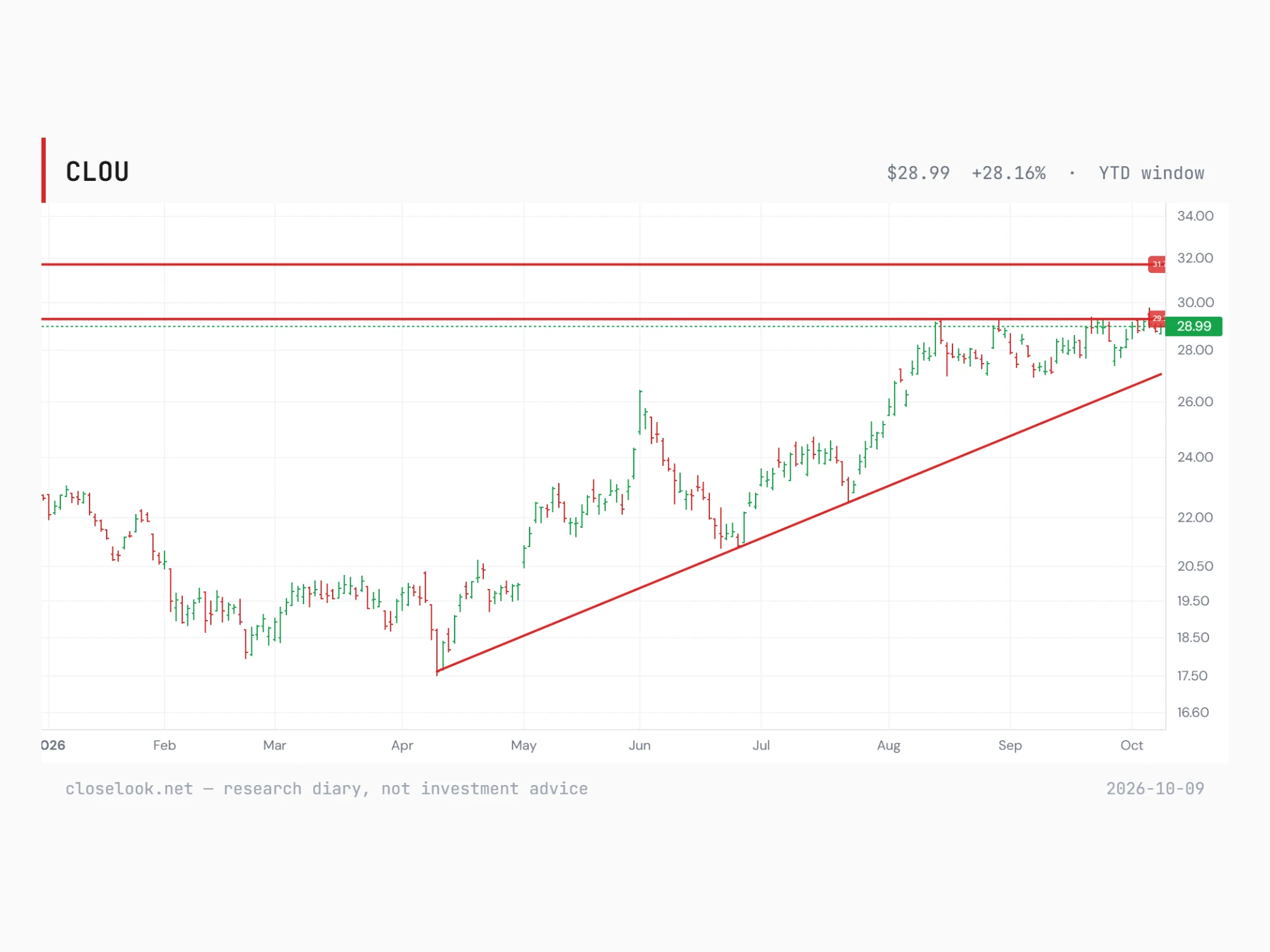
A fund of 38 cloud companies has risen 65% since its April low and is 8% below its record close from 2021. Since the chip funds peaked on 22 June it is up 35% while they are down 9% to 14%. It owns the companies that run AI and sell it as a service, so it gains from AI use without a bet on which application wins. Our read: the line at $29.20 has been tested since August, and a close above it opens the way to the 2021 record zone near $31.70.
- Near the old high. The fund closed at $28.99 on Thursday, 0.7% under its best close since November 2021 and 8% below its record close of $31.64 from that year.
- Beating chips since late spring. Since 22 June, the day the chip funds peaked, it is up 35.4%; the semiconductor funds are down 9.2% and 14.0%.
- Cloud and cyber lead. Of sixteen funds along the AI chain, cloud and cybersecurity are the strongest since June; chips, data centers and power the weakest.
- AI running costs are its revenue. Data platforms, monitoring, networks and security bill for every AI agent that runs, whichever application wins.
- The fear has calmed. An AI security launch sank cyber stocks by 8% in February; a new one this week barely moved them.
CLOU Global X Cloud Computing ETF last close 28.99 (2026-10-08)
The Setup
The claim: the cloud fund is the cleanest way to own the second half of the AI trade, the companies that run AI and sell it as a service, without having to guess which application wins. It is now 8% below its record from 2021, and it has beaten the chip funds by about 49 percentage points since the chip high in June.
Start with where the money went. On 22 June the large chip funds made their highs. Since then the semiconductor fund SOXX has fallen 14.0% and SMH 9.2%. The cloud fund rose 35.4% in the same months. On Thursday, the day the chip index fell 3.4% after OpenAI's revenue came in at about $50 billion rather than $70 billion, the cloud fund closed 0.7% higher at $28.99. This is the shift we have described since the spring: from AI spending on chips and buildings (capex) to AI spending on running it (opex) and to the applications that use it. Today's Daily Pulse traces the same shift through our own indices.
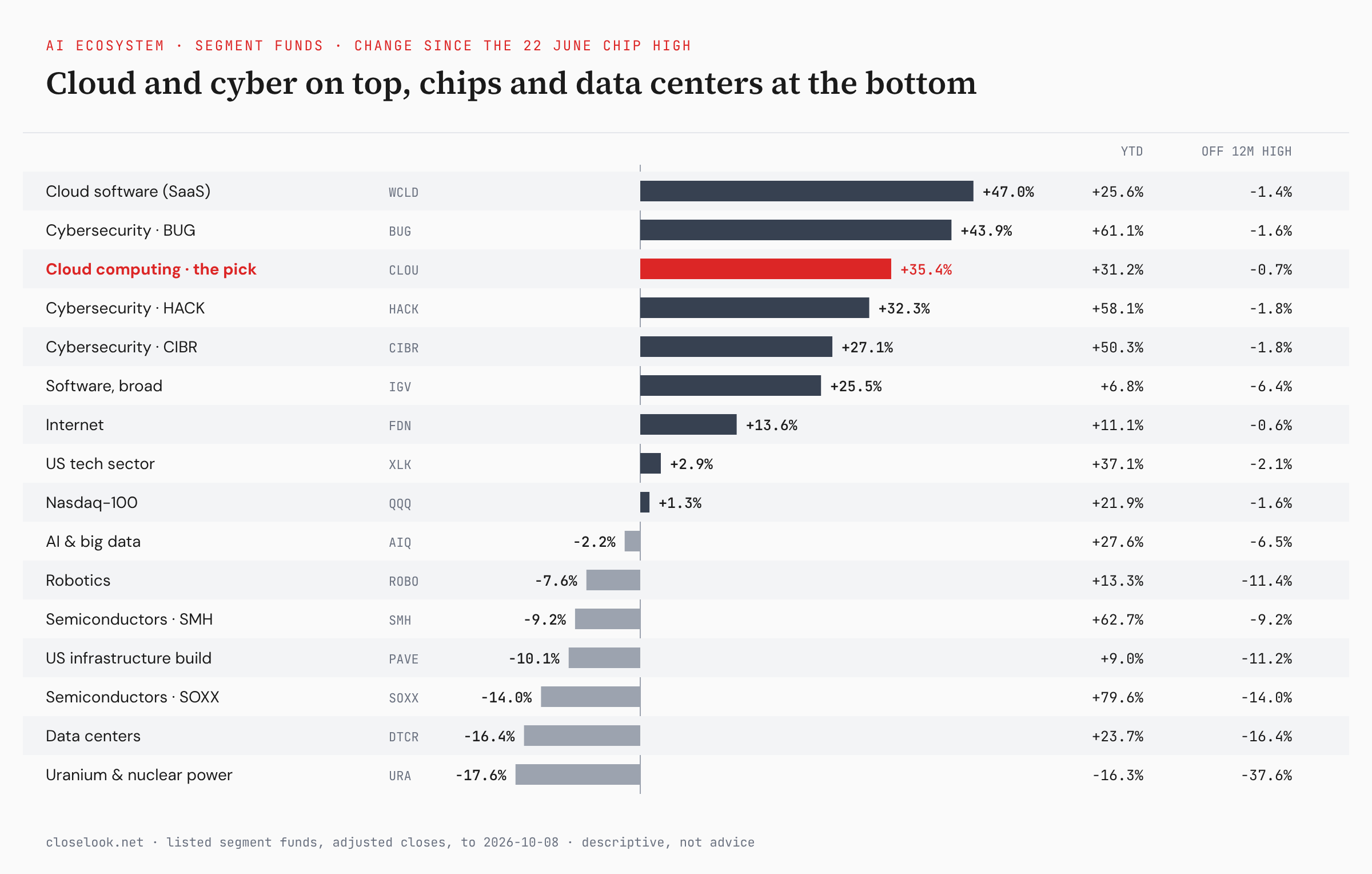
Where cloud stands among the AI segments. We lined up the listed funds for each part of the AI chain, from uranium and data centers through chips to software and security. Since 22 June the order is almost exactly the chain reversed: the builders at the bottom (uranium −17.6%, data centers −16.4%, chips −9% to −14%), the users and operators on top. Cloud and cybersecurity are the two strongest segments: the cloud software fund WCLD +47.0%, the cybersecurity funds +27% to +44%, the cloud fund +35.4%. Broad software (IGV) is up 25.5% from June but only 6.8% this year; it still carries the damage of the spring. Over the full year the picture flips: the chip funds are still up 63% to 80% in 2026. This is a rotation inside AI, not an exit from it.
Why this fund. Most of its large holdings are businesses whose revenue grows with AI use itself: the data platform Snowflake (7.0%), the monitoring service Datadog (6.0%), the communications platform Twilio (5.4%), Cloudflare (4.9%), Zscaler (4.6%), ServiceNow (4.4%), Workday (4.3%) and the smaller cloud host DigitalOcean (3.9%). Eight of its ten biggest positions are members of our Agentic Ecosystem index, two of them (ServiceNow, Workday) also of our Agentic Winners 40. Every AI agent that runs in a company needs data, compute, monitoring, network and security, and these companies charge for each of those steps. That is why the fund benefits from both waves now under way: the rollout of AI agents inside companies, and the use of AI by consumers. Owning the operators means owning the toll road, not betting on one car.
The fear has calmed. In February, when Anthropic launched an AI tool that finds security flaws in code, CrowdStrike and Cloudflare each fell about 8% in a day and the Global X cybersecurity fund lost 4.9%; the worry was that AI would replace the software these companies sell. On Thursday Anthropic announced a broader security push, a defense program for critical infrastructure and a free scanner for open-source code. That day the cybersecurity funds barely moved (BUG +0.2%, CIBR −0.4%) and Zscaler rose 1.5%. Fears of AI disruption still come back from time to time, but the market no longer sells first. The damage of the spring is visible in three holdings that are still below their January price, ServiceNow (−5%), Workday (−9%) and Zscaler (−2%), even after rising 50% to 75% since June. That is room, not a warning.
In the Closelooknet readings
Said plainly: this is the Global X Cloud Computing ETF (CLOU), launched in April 2019, which holds about 38 companies that sell software, data and infrastructure as cloud services. The fund is not in a Closelooknet index, but its holdings are: eight of its ten biggest positions (Snowflake, Datadog, Twilio, Cloudflare, Zscaler, ServiceNow, Workday, DigitalOcean) are members of our Agentic Ecosystem index, and ServiceNow and Workday also sit in our Agentic Winners 40. In the chain we follow, Build (chips, data centers) → Operate → Use, this fund is the Operate and Use end.
52-week range (closes): 17.6 – 29.2
The fundamentals
What the fund is. The Global X Cloud Computing ETF tracks an index of companies that earn most of their revenue from cloud services: software sold by subscription, data platforms, cloud hosting and security. It holds about 38 companies and charges 0.68% a year. Most holdings are mid-sized; the giant cloud landlords (Amazon, Microsoft, Alphabet) are not the core of the fund, which makes it a purer bet on the companies that sell on top of the cloud.
Concentration. The ten largest positions are about half the fund: Snowflake 7.0%, Datadog 6.0%, Twilio 5.4%, Paycom 5.0%, Cloudflare 4.9%, Zscaler 4.6%, ServiceNow 4.4%, Workday 4.3%, Qualys 4.3%, DigitalOcean 3.9%.
The holdings since 22 June (lake closes to 8 October): Paycom +86%, Qualys +79%, Zscaler +75%, Workday +66%, Cloudflare +57%, Snowflake +52%, ServiceNow +50%, Twilio +50%, Datadog +24%, DigitalOcean −26%. Nine of ten up, most of them by half or more.
Trend measures. The fund trades above its 50-day average ($27.94) and well above its 200-day average ($23.03).
For readers in Europe. The US fund is usually not available to private investors in the EU. The same strategy is listed as the Global X Cloud Computing UCITS ETF (ISIN IE00BMH5YF48, WKN A2QPBV, Xetra code CL0U), which tracks the Indxx Global Cloud Computing v2 Index.
Not the same as a broad AI fund. The Global X Artificial Intelligence UCITS ETF (ISIN IE0000XTDDA8, Xetra code QAIU) is often mentioned in the same breath, but its largest holdings are chip and memory makers — SK Hynix, Samsung, Micron, Broadcom, TSMC, Nvidia, AMD. It is the other side of this trade: −0.6% since 22 June (London USD line, $30.10 to $29.91), against +35.4% for the cloud fund. Over 2026 as a whole the two are level, at about +30% each.
The chart, read by hand
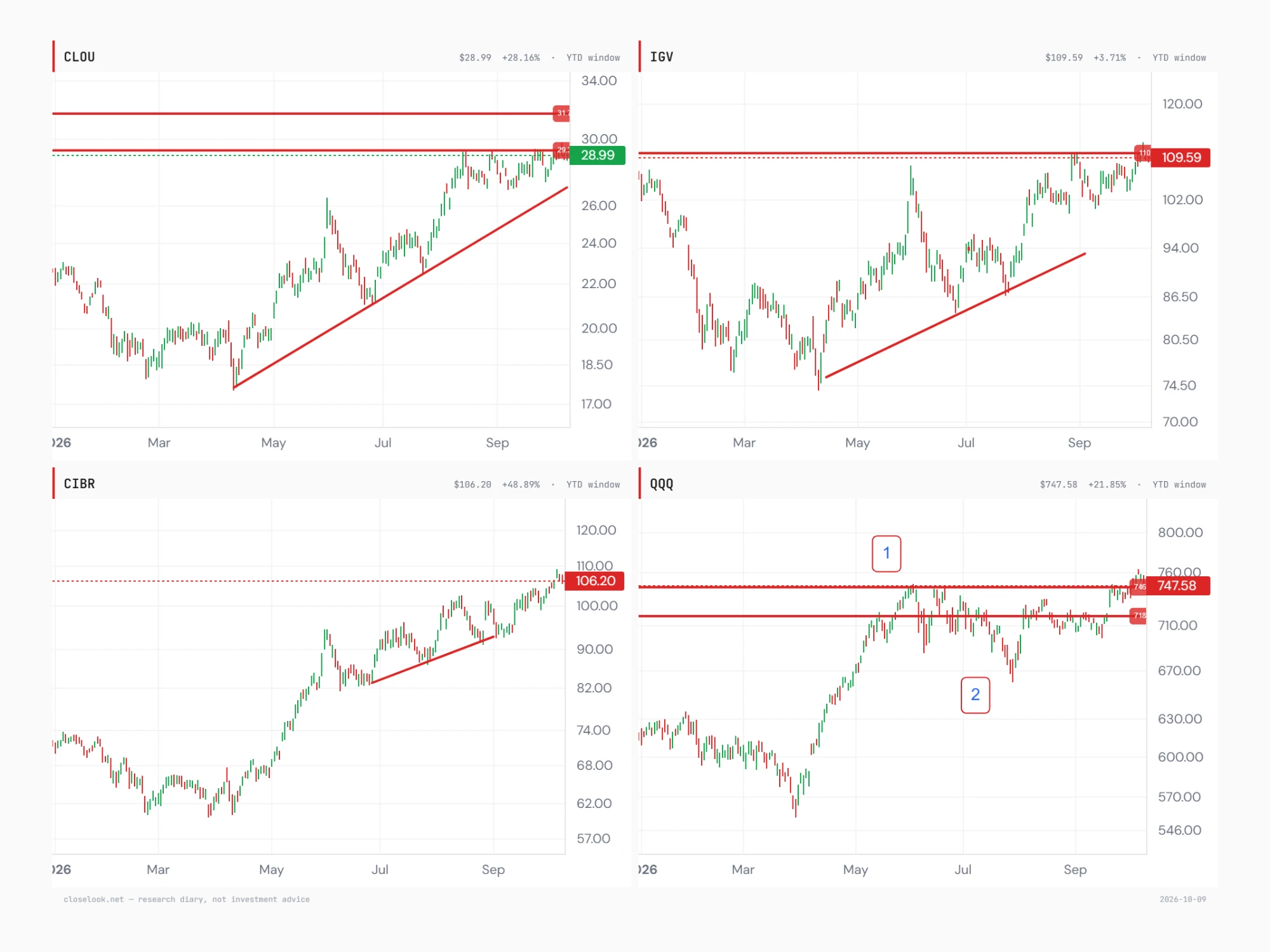
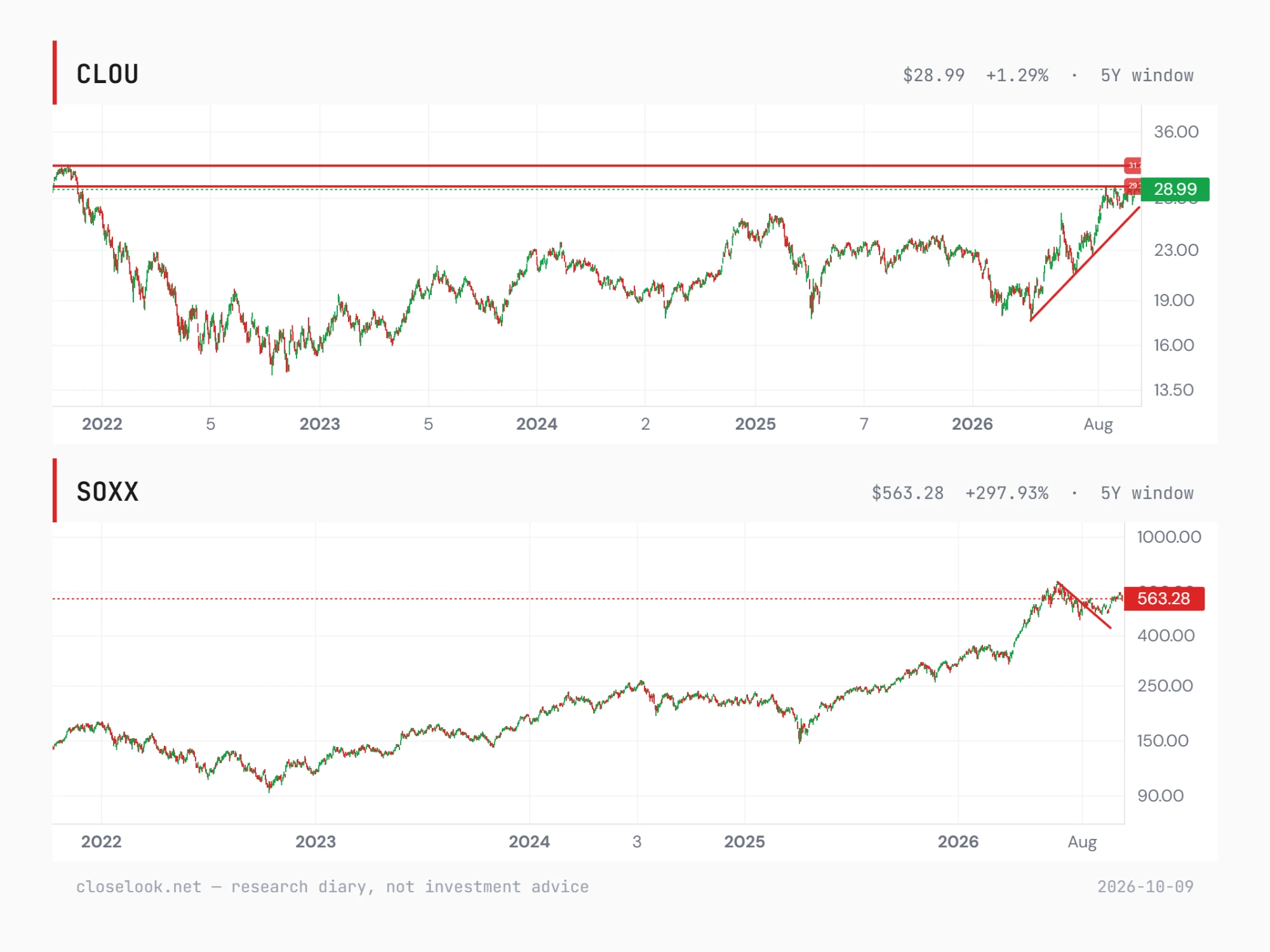
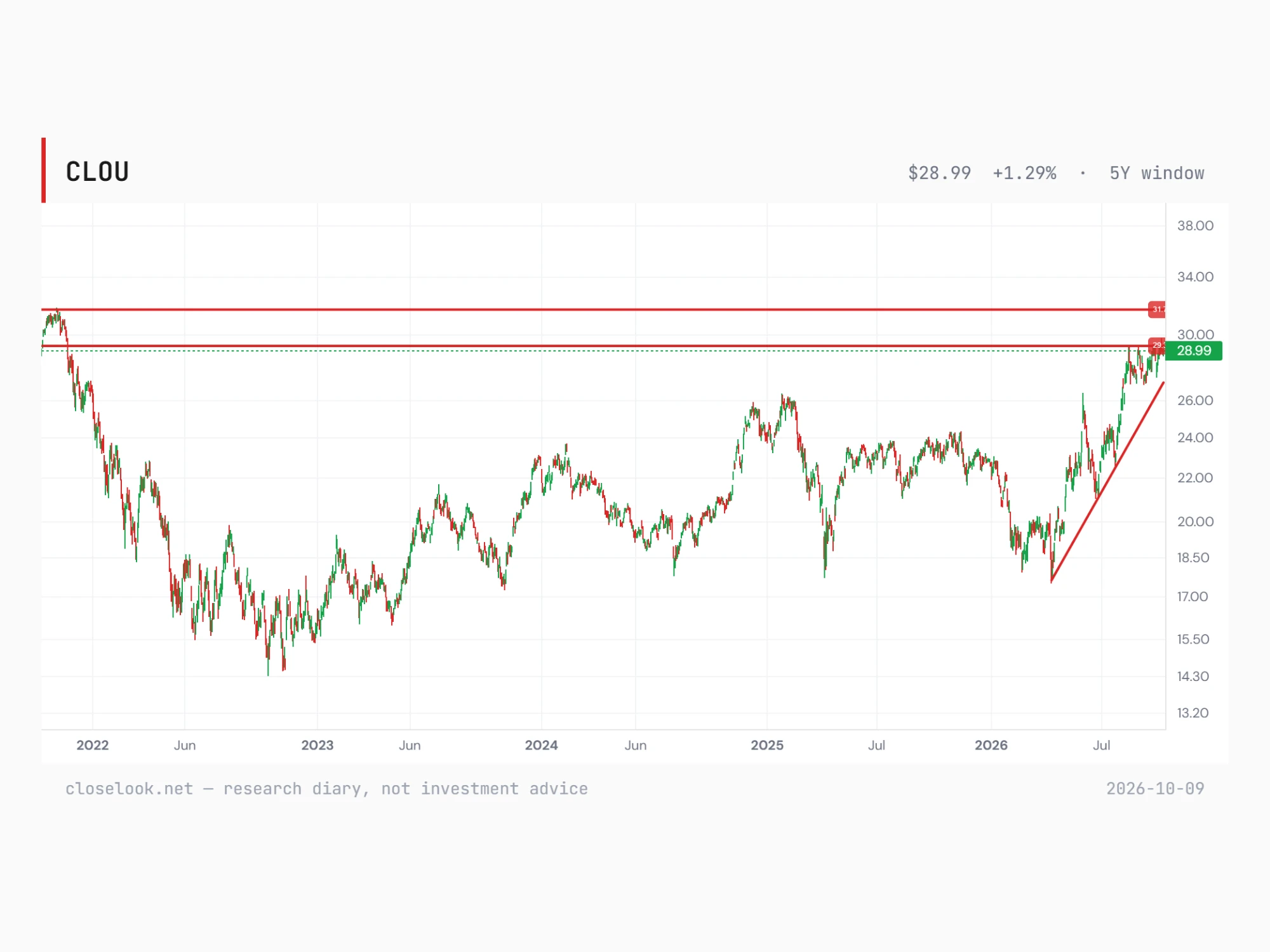
Trend: Thomas's charts lead. On five years the fund made its record in late 2021 (closing high $31.64, the $31.70 line), fell to about $14.60 in November 2022, and spent three years between about $16 and $26. The rise from the April 2026 low near $17.60 is the steepest in that history, and the price is now at $29.20, the highest closes since November 2021. Since August that line has been tested four times without a close above it, while the lows keep rising along the line from April. A sideways test right under an old high after a 65% rise reads as a pause, not a top. The chip fund SOXX shows the opposite picture: a falling line from its June high. The cybersecurity fund CIBR is already through its highs; broad software IGV is at its $110 ceiling; the Nasdaq-100 fund is at the top of its range between $718 and $746.
Key levels: $29.20 — the line tested since August and the best close since November 2021; a close above it opens the next leg · $31.70 — the 2021 record zone (record close $31.64) · Rising line from the 10 April low — about $27 now, the support · $27.94 — the 50-day average · $17.60 — the April 2026 low
What the machines say
Technical snapshot (as of 2026-10-08) — vs 20d +1.6% · vs 50d +3.8% · vs 200d +25.9% · off 52w-high -2.6% · stochastic K 67.1 / D 73.4 · Uptrend stack intact
Pattern engine (scan 2026-10-08) — directional-flow 47/100, warm, accelerating up (5d +3.2%, 21d +14.6%)
Machine blocks render only where our engines actually cover the name — nothing is padded.
The risks, equal billing
The risk the fund trades on first: disruption by AI itself. The fear that AI agents will replace software sold by the seat came back several times this year, in February and March each time with a new AI launch, and it can return. Three of the ten largest holdings are still below their January price.
Valuation and rates. Cloud companies are valued on profits years out; higher long-term interest rates hit them harder than the market. The 2021 record was made at the peak of the low-rate boom, and the fund then lost more than half.
A capex bust spreading. If the cut in AI infrastructure spending deepens into a broad tech sell-off, cloud will not be spared, even if its business keeps growing. A gap between infrastructure and real use, as in fiber optics in 2000, would be the bear case for the whole chain.
The earnings season. Most holdings report between late October and early December; after a rise of 50% or more since June, an ordinary quarter can be sold.
Our forecasts
Next weeks: A daily close above $29.20 would in our view end the pause and start the next leg toward the 2021 record zone near $31.70; the holdings' quarterly reports from late October are the likely trigger. A close below the rising line from April, about $27 now, would put the trend in question.
12 months from now: Higher, in our view, and above the 2021 record of $31.64, if the use of AI keeps spreading from chips to the companies that run and sell it. If the AI capex cut turns into a broad tech sell-off, the April low near $17.60 is the level that matters.
Diary views, not advice — held publicly alongside the scored record.
Why publish this name? Because our Directional Flow readings are what let us say it: stocks with this or a similar setup have often — historically — done well over the following twelve months. That is the engine's backtested observation about the past, not a forecast; past performance may not be an indication of future performance. Which is exactly why every pick is scored publicly against the tape from today, at one week, one month, three, six and twelve. Twelve months. A diary view, not advice, and not an entry price. Thomas's charts lead; the counts and levels are ours and are open to correction. Related funds for the same theme are the cloud software fund WCLD and the cybersecurity funds (CIBR, BUG), which lead since June; in Europe the UCITS version (Xetra CL0U).
Closelooknet publishes an investment research diary, not investment advice. Every pick is scored publicly against the tape at 1w/1m/3m/6m/12m from publication — the record, not the single call, is the product.
Open the live CLOU terminal → All picks & the running record →
A note from the editor: the Weekly Chart Pick is free. Its price is one click — add Closelooknet as a preferred source on Google, and you support this work in Google Discover and Search every time you read.
Google opened in a new tab. Add Closelooknet there, then come back to this tab — the Chart Pick unlocks the moment you return.
The preferred-source setting lives in your Google account — if Google asks you to sign in first, you will land on the selection page right after. Google does not tell us whether you saved the selection. Clicking “Done” unlocks the Weekly Chart Pick on this device for 12 months.