Weekly Chart Pick · 2026-10-02
Memory chips — the basket that more than doubled in three months, then went sideways for seven weeks while every maker inside it posted record profits
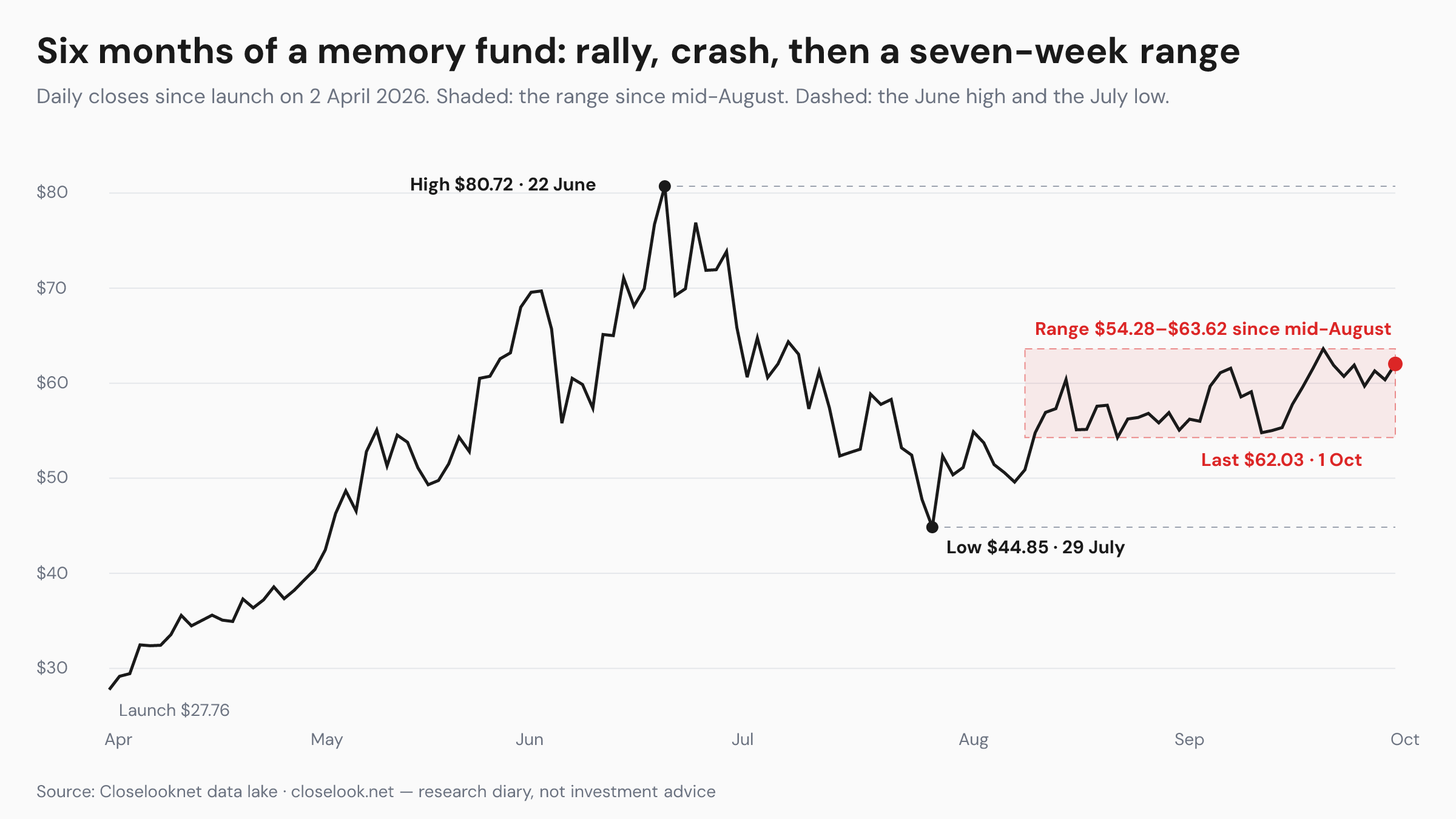
A fund that holds the world's memory-chip makers rose from $27.76 on its first day in April to $80.72 in late June, fell 44% into the end of July, and has traded between about $54 and $64 since mid-August. In those months its biggest holdings reported the best quarters in their history — operating margins of 75% and more — and the stocks still went nowhere. Our read is that the range is the market digesting the size of the numbers, not doubting them, and that the next leg starts at the top of the range.
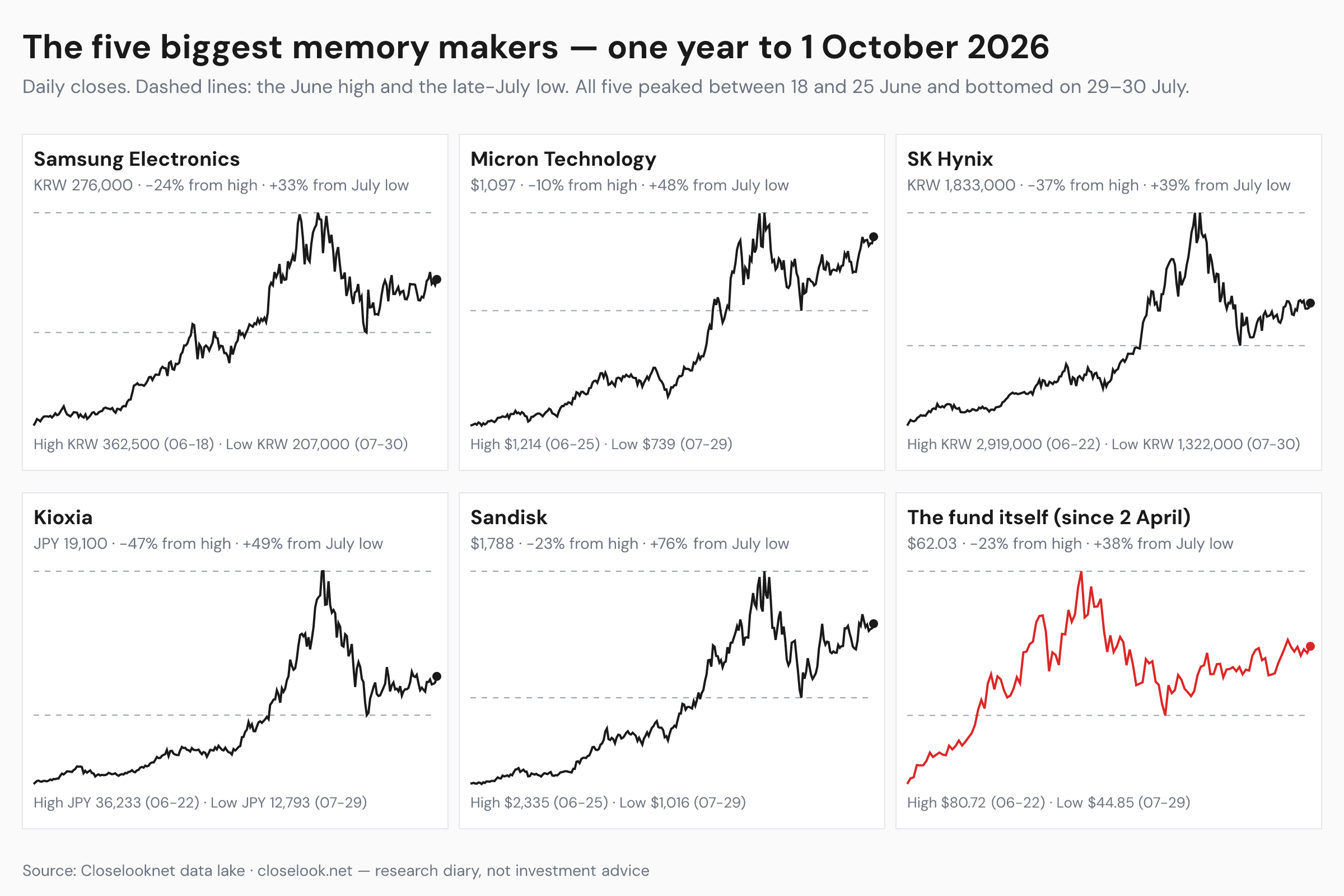
- Five companies, one pattern. The five largest memory makers peaked between 18 and 25 June and bottomed on 29 and 30 July. Since that low they are up between 33% and 76%, yet still 10% to 47% below their June highs.
- The numbers kept beating. One Korean maker reported an operating margin of 76% for the June quarter and fell 11% on the day; a Japanese flash maker reported a gross margin of 80%; the largest US maker guided this quarter's revenue about 8% above estimates — and barely moved.
- The basket has gone sideways for seven weeks. Since mid-August its price has stayed between $54.28 and $63.62. On Thursday it closed at $62.03, near the top of that range and 23% below its June peak.
- The calendar fills up. The biggest holding usually publishes preliminary third-quarter figures in the first days of October; analysts expect a record of more than 100 trillion won in operating profit. Its full results follow on 29 October.
- The risk is the cycle. Memory has always been boom and bust, and three companies make up about three quarters of the fund. A fall in memory prices would hit all of them at once.
DRAM Roundhill Memory ETF last close 62.03 (2026-10-01)
The Setup
The claim: the memory makers have spent ten weeks proving the boom is real, and the market has spent the same ten weeks deciding how much of it was already in the price. The sideways range in the fund is that decision being made — and it is close to done.
Start with how synchronised this group is. On our data the five biggest memory makers — Samsung Electronics, SK Hynix, Micron, Kioxia and Sandisk — all made their highs within one week, between 18 and 25 June, and all made their lows within two days, on 29 and 30 July. 29 July was the day SK Hynix reported an operating profit of 60.54 trillion won for the June quarter, up 557% from a year earlier at a 76% margin — and its stock fell 11%. That was the moment the market stopped asking whether memory profits were rising and started asking whether they had peaked.
Since then every company has answered the same way. Sandisk reported revenue of $8.97 billion for its June quarter, up 51% from the March quarter, and guided $10.3–10.8 billion for the next. Kioxia reported a gross margin of 80%. Micron reported revenue of $54.23 billion on Wednesday and guided $61.5 billion for this quarter. From the July lows the stocks are up 33% (Samsung), 39% (SK Hynix), 48% (Micron), 49% (Kioxia) and 76% (Sandisk). The fund, which holds all of them, is up 38% from its own low of $44.85.
But from mid-August the fund stopped trending. It has traded between $54.28 and $63.62 for seven weeks while its holdings kept reporting. That is what digestion looks like after a move of this size: the fund rose 191% from its first close of $27.76 to $80.72 in less than three months. The results now confirm the story; the price needed time to grow into it. On Thursday the fund closed at $62.03, within 3% of the top of that range.
Yardeni Research put the scepticism in one number: before its results, Micron traded at 6.8 times forward earnings — a multiple the market reserves for businesses it expects to shrink. More than 75% of Micron's 2027 output is already committed under long-term agreements, and the company now has 26 of them, up from 16 a quarter earlier. If the market starts paying for that visibility rather than discounting it as a cycle, the range ends upward. Thomas's read of the charts is that it will — and soon.
The Nvidia template. The memory charts look like Nvidia after its first big run. Nvidia closed at $135.36 on 18 June 2024, then went nowhere for a year: down to $94.18 in April 2025, back and forth in between, while revenue kept climbing. It took until 25 June 2025 to close at a new high, and by the end of September 2025 it stood at $186.34. The steep trend of the first run was broken, but a second, flatter channel formed after the sideways stretch, and it still pointed up. Thomas reads memory the same way: gains this large need substantial digestion, and at some point the fundamentals take over again.
Why the fundamentals should come back to the front. Inference — running AI models rather than training them — is a memory business. Every answer a model gives reads its weights and its working memory over and over, so demand for high-bandwidth memory and for storage grows with usage, not just with new data centres. And Thomas does not see Chinese makers entering the market in a way that could break the business of the three leaders: their output is growing, but in older, cheaper chips, not in the AI memory that carries the margins.
Memory is now allocated before it is priced. The I/O Fund laid out the supply side in a piece published on Friday. SK Hynix makes about half of the world's high-bandwidth memory, the stacked memory that sits next to every AI chip; Samsung has about 33% and Micron 18%. Morgan Stanley estimates that Nvidia (37%), Alphabet (36%) and AMD (about 12%) will take 85% of all such memory made in 2027, leaving about 15% for every other AI chip program. Each gigabyte of it needs about four times the factory floor of ordinary memory, so supply cannot catch up quickly, and SK Hynix expects demand to exceed supply until at least 2030. Nvidia's CFO speaks of "extreme pricing conditions in memory" with prices "headed even higher into next year". Micron has signed 26 multi-year take-or-pay contracts, in which customers pay even if they do not take delivery; it expects them to make up about 35% of its revenue through 2030, and customers had committed $32 billion, mostly as cash deposits, by 30 September. The squeeze spreads beyond AI: data centres take about 70% of all memory made this year, and new contract prices for car memory are up 70% to 100%. That is the earnings visibility the charts have not priced yet.
In the Closelooknet readings
Said plainly: this is the Roundhill Memory ETF (DRAM), an actively managed fund launched on 2 April 2026 that holds about 15 memory and storage makers. It is not a Closelooknet index member, but its holdings are: Samsung Electronics, SK Hynix, Micron, Kioxia and Sandisk all sit in the memory and packaging layer of our Rubin 100. On our automated report pipeline the fund is one of three ETFs in the chips section; its own history is only six months long, so this pick reads the fund through the charts of the companies inside it.
52-week range (closes): 27.76 – 80.72
The latest print
The holdings, in their own latest numbers.
- Micron (quarter to August, reported 30 September): revenue $54.23 billion against about $51 billion expected, adjusted earnings $33.42 a share, gross margin about 87%. Guide for the quarter to November: $61.5 billion. On our Print Record card the stock closed its first session after the report at $1,097.39, just above the $1,097.06 that counts as paid; the window is graded on 5 October.
- SK Hynix (June quarter, reported 29 July): revenue 79.32 trillion won, up 257%; operating profit 60.54 trillion won, up 557%, a 76% margin and the fifth record quarter in a row. Shipments of the newest high-bandwidth memory for AI chips (HBM4) started in the quarter, with the ramp in the second half. The stock fell 11% on the day.
- Samsung Electronics (June quarter): a record operating profit of 89.5 trillion won; the stock fell 7% on the report. For the September quarter analysts expect about 106 trillion won (Citi 104.1, Kiwoom about 107). Full results are due on 29 October; Samsung usually publishes preliminary figures in the first days after the quarter ends.
- Sandisk (quarter to June, reported 5 August): revenue $8.97 billion, up 51% from the previous quarter, two thirds of it from higher prices; fiscal-year revenue $20.25 billion, up 175%. Guide for the quarter to September: $10.3–10.8 billion.
- Kioxia (quarter to June): revenue 1.767 trillion yen, up 415% on the year; gross margin 80%, operating margin 75%. The stock rose 18% on the report.
Company releases and results presentations as reported; Samsung consensus as reported by Aju Press; Micron forward multiple and agreements per Yardeni Research.
The fundamentals
What the fund is. The Roundhill Memory ETF holds the companies that make memory chips (DRAM and high-bandwidth memory for AI servers) and flash storage. It is actively managed and rebalanced each quarter. Assets were about $25.7 billion in mid-September — large for a fund launched in April — across about 15 holdings, at a fee of 0.65% a year.
Concentration. Samsung Electronics, SK Hynix and Micron make up about 73% of the fund, each roughly a quarter, part of it held through swaps rather than shares. Kioxia is about 5%; the rest is spread across Sandisk, Western Digital, Seagate, Nanya, Winbond and others. In practice the fund is a basket of three companies with a storage tail.
Why the fund and not one name. The three largest makers report in three currencies and on three calendars; the fund holds them in one US-listed line. The price for that is concentration and the swap structure, and a history too short to say much on its own — which is why this pick reads the companies' charts.
Fund data from the issuer and our ETF data (asOf 14 September 2026); weights as reported for 29 September 2026.
The chart, read by hand
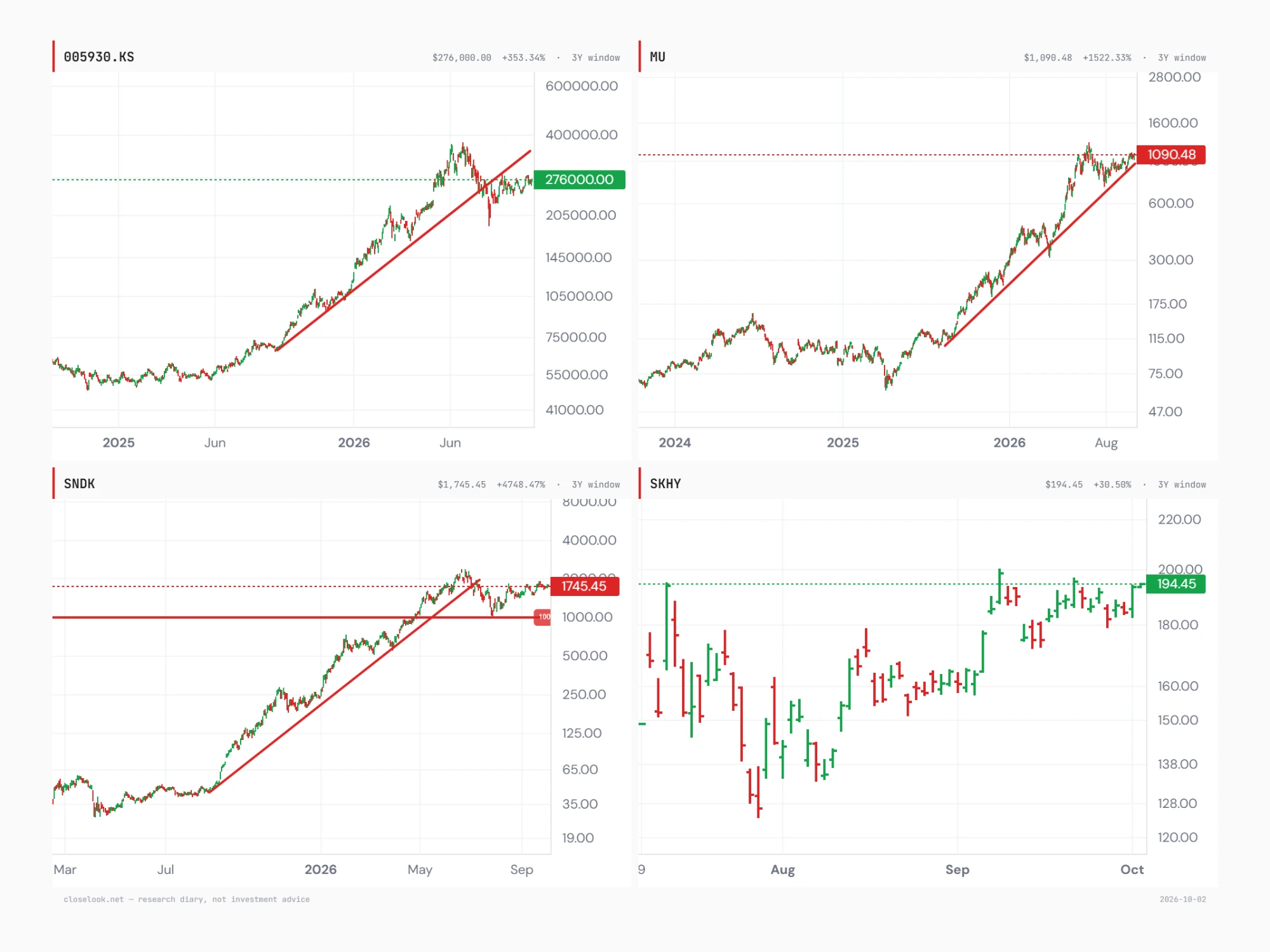
Trend: Thomas's charts lead. The fund's daily chart since launch shows three phases: a steep rise from $27.76 on 2 April to $80.72 on 22 June; a fall to $44.85 on 29 July, the day SK Hynix reported; and from mid-August a sideways range between $54.28 and $63.62, with the price on Thursday at $62.03, at the top of that range. Thomas expects another leg up soon. Because the fund is only six months old, the read rests on his four constituent charts. Micron is the cleanest: still riding the rising line it has held since early 2025, now just under its June peak. Sandisk broke its line in July but held the $1,000 floor and has climbed back. SK Hynix's US shares, listed only since July, are back at the $195 to $200 line of the July high, the level that decides the next move. Samsung is the laggard: it slipped under its rising line in the summer and has moved sideways around KRW 276,000 since. Thomas's reading of the pattern: the very steep trend of the spring is broken, but after a sideways phase like this one a new channel usually forms — less steep than the first, still pointing up. The August-to-September higher lows in all four charts are where that second channel would start. Three of four are pressing on their highs; that is the setup behind the call.
Key levels: $63.62 — top of the range since 14 August; a close above it ends the range · $65.86 — the highest close since July · $80.72 — the record close of 22 June · $54.28 — bottom of the range since mid-August · $44.85 — the 29 July low
The risks, equal billing
The risk the fund trades on first: the cycle. Memory has been the most cyclical part of the chip industry for forty years. Prices rise when supply is short, makers build factories, and prices fall when the new capacity arrives. Micron alone plans about $25 billion of plant spending in the first half of its new year. If memory prices turn, all of the fund's holdings fall together.
Concentration. Three companies are about three quarters of the fund. A disappointment at one of them — a Samsung quarter, a delay in SK Hynix's new AI memory — moves the whole basket.
Rates and currency. With the US 10-year yield at 5.24%, high-multiple stocks are under pressure, though memory trades on low multiples. Two of the three largest holdings are priced in Korean won; a stronger dollar lowers their value in the fund.
Structure and age. Part of the exposure is held through swaps, and the fund has only six months of history: no full cycle has tested how it trades.
China. Chinese memory makers such as CXMT and YMTC are adding capacity with state backing. Thomas does not see them disrupting the leaders in AI memory; the risk is in the commodity chips, where extra Chinese supply could push prices down faster than the cycle alone would.
Our forecasts
Next weeks: A daily close above $63.62, the top of the seven-week range, would in our view start the next leg; Samsung's preliminary figures and the US earnings season are the likely triggers. A close below $54.28 would put the range in question.
12 months from now: Higher, in our view. The June record close of $80.72, 30% above Thursday's close, is the first objective if memory prices hold through 2027 and the makers' long-term contracts keep spreading. If prices turn, the late-July low of $44.85 is the level that matters.
Diary views, not advice — held publicly alongside the scored record.
Why publish this name? Because our Directional Flow readings are what let us say it: stocks with this or a similar setup have often — historically — done well over the following twelve months. That is the engine's backtested observation about the past, not a forecast; past performance may not be an indication of future performance. Which is exactly why every pick is scored publicly against the tape from today, at one week, one month, three, six and twelve. Twelve months. A diary view, not advice, and not an entry price. Thomas's charts lead; the counts and levels are ours and are open to correction. The fund is six months old, so its own chart carries less weight than the charts of the companies it holds.
Closelooknet publishes an investment research diary, not investment advice. Every pick is scored publicly against the tape at 1w/1m/3m/6m/12m from publication — the record, not the single call, is the product.
Open the live DRAM terminal → All picks & the running record →
A note from the editor: the Weekly Chart Pick is free. Its price is one click — add Closelooknet as a preferred source on Google, and you support this work in Google Discover and Search every time you read.
Google opened in a new tab. Add Closelooknet there, then come back to this tab — the Chart Pick unlocks the moment you return.
The preferred-source setting lives in your Google account — if Google asks you to sign in first, you will land on the selection page right after. Google does not tell us whether you saved the selection. Clicking “Done” unlocks the Weekly Chart Pick on this device for 12 months.