Weekly Chart Pick · 2026-09-18
This bitcoin miner turned itself into a landlord for AI: 949 megawatts under contract worth $26.6 billion, a $35 billion Anthropic cloud deal routed through its Texas campus — and the stock sits 26% under its June record
The company calls itself an energy-infrastructure platform with a ‘power-first’ operating philosophy: it underwrites scarce electricity, then decides whether the megawatts mine bitcoin or host AI. In the June quarter it closed $7.5 billion of project-level financing, non-recourse to the parent and fully amortising, for two campuses — one in Louisiana, one in Texas — whose leases the company says are backstopped by investment-grade counterparties: 949 megawatts of IT capacity under contract, roughly $26.6 billion of expected base-term contract value, $1.75 billion of average annual net operating income once built. Since then the wires have put Anthropic’s $35 billion cloud agreement with Nvidia-backed Lambda on its Texas campus, Wells Fargo has set a $175 target, and the stock has corrected from a $133.02 record on 2 June to a $77.57 low on 1 September and on Friday jumped 8.5% to $98.74 — an intraday high of $99.01 — to sit on the upper line of a three-year triangle, a whisker under the 8 September high. Twelve-month view: higher, in our view, in a wider band than any pick so far — this is a bitcoin beta with a 2027 delivery schedule attached.
- The frame is a conversion, not a trade: a bitcoin miner with power contracts became a developer of contracted AI campuses. The company reports three things that did not exist a year ago — 949 megawatts of IT capacity under lease with roughly $26.6 billion of expected base-term contract value, $7.5 billion of project financing closed in one quarter, and an 8.7-gigawatt development pipeline across eleven sites, 5.4 gigawatts of it under diligence. The mining business is now an affiliated tenant: about 700 megawatts serve a listed mining affiliate in which the company holds the majority stake, and that tenant produced 935 bitcoin in the quarter against 308 a year earlier.
- The numbers the market can hold today are small next to the numbers it is discounting. Second-quarter revenue $74.9 million, up 81%; compute revenue $72.5 million from $34.3 million; gross margin 64% from 47%; adjusted EBITDA $10.4 million. GAAP net loss $177.1 million, of which $138 million was a non-cash mark-to-market on digital assets. General and administrative expense $76.1 million, $43.6 million of it share-based compensation. Unrestricted cash $233.6 million at the parent; restricted cash $6.8 billion in project accounts earning $27.1 million of interest in the quarter.
- The financing is the story and the risk in one line: $7.6 billion of consolidated debt, almost all of it project-level senior secured notes — $3.25 billion for the Louisiana campus over 16.5 years, $4.25 billion for the first phase of the Texas campus, rated a notch higher and priced 20 basis points inside — non-recourse to the parent and fully amortising. Parent-level recourse debt was eliminated through the conversion of the convertible notes and a $200 million FalconX term loan that refinanced a Coinbase facility from 9% to 7% and released 3,300 bitcoin from collateral.
- What the wires added after the print: Anthropic signed a $35 billion cloud agreement with Nvidia-backed Lambda at the end of August and the reporting places that capacity on the company’s Texas campus; the second Texas lease, 352 megawatts with roughly $9.8 billion of expected contract value, takes the campus to a full gigawatt under contract; the Canadian managed-cloud business was sold to Opti9; and on 17 September Wells Fargo set a $175 price target. The delivery dates are the fact the stock trades against: Louisiana’s first data halls in the second quarter of 2027, Texas Phase 1 energised in the first quarter of 2027 with data halls in the third.
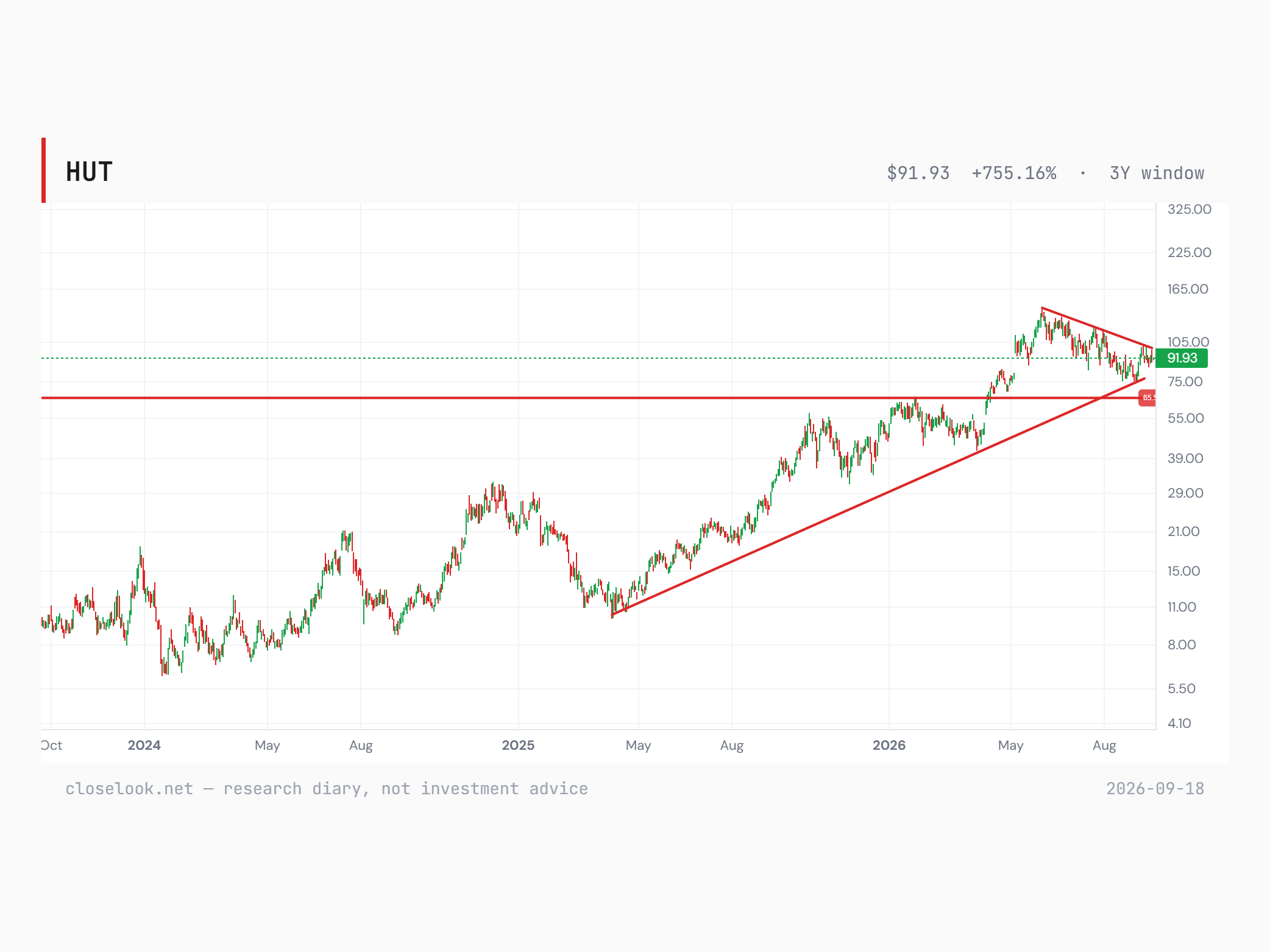
- The chart is a triangle three years in the making, and Friday put the stock on its upper line. A rising line from the April 2025 low near $10 has held every test since — the 1 September low at $77.57 sat on it to the dollar — and a descending line off the 2 June record at $133.02 runs through the July and 8 September highs; the two meet a few weeks out. Friday’s close of $98.74, up 8.5% on 7.3 million shares with a high of $99.01, sits against the upper line near $100 and a whisker under the 8 September high of $99.49, with the 50-day at about $93 now beneath price and the rising 200-day near $77. Under the whole structure lies $65.50, the late-2025 and February highs, the floor of 2026. Year to date +115%, twelve months +161%, three years +840%.
- Peers, as the market prices them: IREN earns operating revenue from both mining and its own GPU cloud; Applied Digital hosts miners and builds and leases AI data centres; our pick mines through its majority-owned affiliate while it builds contracted AI campuses — bitcoin operations today, a substantial rental business from 2027. Core Scientific, Cipher and TeraWulf trade in the same cohort. A beta near 6 against the S&P 500 is the price of admission.
HUT Hut 8 last close 98.74 (2026-09-18)
The Setup
The claim: the market is pricing Hut 8 as a bitcoin miner with an AI option, and the company has spent 2026 turning the option into contracts — 949 megawatts, $26.6 billion of expected contract value, $7.5 billion of financing — while the stock corrected 42% from its record and held its 200-day average.
Start with what the correction was. The stock ran from about $33 to a record close of $133.02 on 2 June, roughly the period in which the Beacon Point and River Bend financings were arranged; it then fell to $77.57 by 1 September as bitcoin softened and the equity market repriced long-duration cash flows on a 5% 10-year — every dollar in Hut 8’s valuation that is not bitcoin is a 2027 cash flow, and 2027 cash flows are the ones a higher discount rate hits hardest. The rebound from $77.57 to $99.49 in a week followed the reports that Anthropic’s $35 billion Lambda agreement runs through the Texas campus; the drift back to the low $90s was the market waiting for a delivery date it cannot verify yet — and Friday’s 8.5% jump to $98.74, on 7.3 million shares, was the market deciding not to wait, with the stock closing on the upper line of the triangle.
The setup is therefore a name whose contracted future is larger than its market value, whose delivery is eighteen months out, whose funding is in place and non-recourse, and whose stock has already absorbed a 42% drawdown without breaking its longer trend. That is the shape the diary likes: the bad scenario has been priced once, the good scenario has not been delivered, and the levels are clean.
What we do not claim: that the leases are risk-free because a counterparty is investment grade, that the 2027 dates will hold, or that bitcoin will not decide the next six months regardless of the campuses. A beta near 6 means the stock moves with the coin first and the contracts second until the data halls energise.
In the Closelooknet readings
Said plainly: Hut 8 holds no seat in a Closelook index and carries no Closelook fundamentals score yet — the scanner’s modules need a filing history the conversion has not produced. It sits in the diary’s power-and-compute sleeve, in the agentic-demand family of names whose revenue is the AI build-out’s electricity bill. Thursday’s technical bake read it as a pullback inside an uptrend stack — 2.5% under the 50-day average, 17.7% above the 200-day, 35% under its 52-week high, slow stochastic 59 over 53 and turning up — before Friday’s 8.5% jump took price back above the 50-day and to the upper line of the triangle. The Street block carries one action, Wells Fargo’s $175 target set on 17 September, 92% above Thursday’s close. Our company snapshot files it as a customer of the grid and a supplier of compute; the capital-return block shows no distribution and a share count that has grown from 101 million at the end of 2024 to 105 million a year later and 123 million today — the dilution is part of the model. As a pick this is a wider band than TSMC or Soitec were: the diary holds it as a possibility with a 2027 delivery schedule attached, not as a level.
52-week range (closes): 33.16 – 133.02
The latest print
The second quarter, reported 4 August, was the quarter the company changed what it is. Revenue $74.9 million, up 81% from a year earlier, on more mining capacity and higher bitcoin production; compute revenue $72.5 million against $34.3 million as the Vega and Drumheller sites ran at capacity; 935 bitcoin mined against 308. Gross margin 64% from 47% on operating leverage inside the compute segment, and 66% inside ASIC compute alone — before a dollar of contracted AI data-centre revenue has been booked. Adjusted EBITDA $10.4 million from $4.2 million, excluding the mark-to-market on digital assets. The GAAP line was a net loss of $177.1 million, of which $138 million was that non-cash mark-to-market; general and administrative expense was $76.1 million including $43.6 million of share-based compensation. Power revenue fell to $1.2 million from $5.5 million after the Far North portfolio was sold in February.
What management said the quarter was about. $7.5 billion of project-level financing closed: $3.25 billion of senior secured notes for River Bend with a 16.5-year duration, fully amortising construction financing at the project level; $4.25 billion for Beacon Point Phase 1, rated one notch higher and priced 20 basis points inside. Consolidated debt $7.6 billion, non-recourse to the parent; restricted cash $6.8 billion held for construction, debt service reserves and specified purposes, earning $27.1 million of interest in the quarter from short-duration instruments; unrestricted cash $233.6 million at the parent. Contracted AI capacity 949 megawatts of IT load, roughly $26.6 billion of expected aggregate base-term contract value, $1.75 billion of average annual net operating income from leases the company says are backstopped by investment-grade counterparties. The second Beacon Point lease, 352 megawatts with roughly $9.8 billion of expected contract value and $655 million of average annual net operating income, takes that campus to a full gigawatt under contract. Development pipeline 8.7 gigawatts across eleven sites, 5.4 gigawatts of energy capacity under diligence averaging more than 650 megawatts per site, managed as five regional pods.
The two sentences the stock trades on. Chief executive Asher Genoot: ‘Execution is not something that we hope for. It’s something we design for’ — sequencing and procurement decided before construction begins, behind-the-meter generation under evaluation for River Bend to beat the grid queue. Chief financial officer Sean Glennan: the $7.5 billion is non-recourse and fully amortising, designed to ring-fence development risk and preserve corporate flexibility. The dates: River Bend’s initial data halls in the second quarter of 2027; Beacon Point Phase 1 energised in the first quarter of 2027, data halls delivered in the third. Everything in the valuation that is not bitcoin is a 2027 cash flow.
The fundamentals
What the business is. Hut 8 procures power, builds and manages sites, and then decides what the megawatts do: mine bitcoin through its majority-owned affiliate American Bitcoin, host other miners, or house AI tenants under long triple-net leases. Management calls the philosophy ‘power-first’: underwrite scarce electricity, not a particular application, so the same site can move between workloads as the economics move. Four reported segments — Power, Digital Infrastructure, Compute and Other — with Compute carrying almost all of today’s revenue and Digital Infrastructure carrying almost all of tomorrow’s.
Today’s numbers and tomorrow’s. Today: $74.9 million of quarterly revenue, a 64% gross margin, $10.4 million of adjusted EBITDA, about 700 megawatts of infrastructure serving American Bitcoin, which produced 935 bitcoin in the quarter. Tomorrow, as the company reports it: 949 megawatts of contracted IT capacity, roughly $26.6 billion of expected base-term contract value, $1.75 billion of average annual net operating income, an 8.7-gigawatt pipeline. The bridge between the two is $7.6 billion of project debt and two construction schedules that deliver in 2027. The market capitalisation near $11 billion is, on this reading, a claim on the second set of numbers discounted by the risk of the bridge.
The balance sheet, read honestly. Total assets rose from about $2.6 billion at the end of March to about $10 billion at the end of June because the financing proceeds sit in restricted project accounts; long-term debt rose the same way. The parent carries no recourse debt after the convertible conversion and the FalconX refinancing, and holds $233.6 million of unrestricted cash plus 3,300 bitcoin freed from collateral. The share count is the other side of the story: about 101 million shares at the end of 2024, 105 million at the end of 2025, 118 million at the end of June and 123 million now, with $43.6 million of share-based compensation in a single quarter. Growth is being paid for in shares as well as in notes.
The peer group, as Thomas frames it. Three names share the shortlist and differ in exposure. IREN: bitcoin mining plus its own GPU cloud, with direct operating revenue from both. Applied Digital: hosts bitcoin miners and charges for capacity, builds and leases AI data centres — an infrastructure provider serving both industries. Hut 8: mining through its majority stake in American Bitcoin plus mining infrastructure today, alongside large contracted AI campuses that become a rental business from 2027. Core Scientific, Cipher and TeraWulf sit in the same cohort and trade with it.
The chart, read by hand
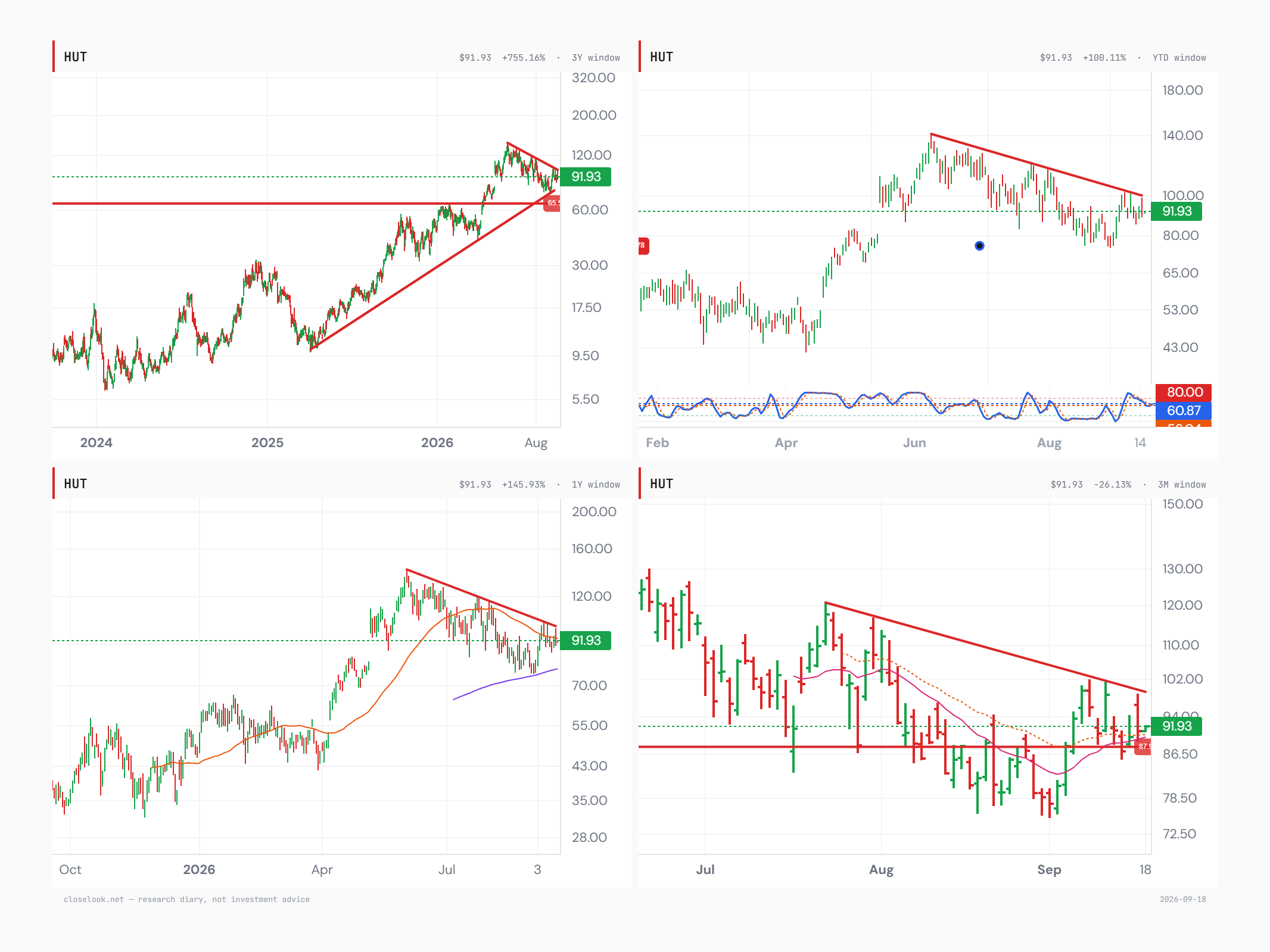
Trend: Thomas’s three charts lead; they were drawn with the stock at $91.93 on Friday afternoon, and by the close it had run to $98.74. The three-year chart, log scale: a rising line from the April 2025 low near $10 that has caught every pullback since, most recently the 1 September low at $77.57, and a descending line off the 2 June record at $133.02 through the July and 8 September lower highs. The two converge into a contracting triangle whose apex lies a few weeks out; on Friday the upper line ran near $100, the lower near $78, and the stock closed at $98.74, on the upper line, after an intraday high of $99.01. The $65.50 horizontal beneath — the late-2025 highs and the February highs — is the floor of the entire 2026 structure. The one-year panel adds the averages: Friday’s close put price back above the falling 50-day near $93, with the 200-day rising toward $77. The three-month panel shows the same descending line capping the 8 September high at $99.49, the 15 September low bouncing from a $87.50 pivot, and the 20-day turning up under price. A contracting triangle inside a rising trend resolves in the trend’s direction more often than not; Friday was the test of the line, and Monday’s close, with the expiry pins released, is the answer.
Oscillators: Slow stochastic 67.4 over 57.7 on Friday’s close, recomputed from the bars after the 8.5% jump — K over D and rising fast out of the middle of the band; Thomas’s chart, drawn at $91.93 in the afternoon, showed 60.9 over 59.0. A test of the upper line with the oscillator this high is the profile of a break in the making, not of a rejection; a close through $100 with the stochastic through 80 is the confirmation the setup wants, and a Monday reversal back under $93 would say Friday was the expiry, not the market.
Key levels: $133.02 — record close, 2 June 2026 · about $100 — descending line off the record, Friday’s value; a close above it breaks the triangle upward · $99.49 — 8 September high · $99.01 — Friday’s intraday high · $98.74 — Friday close, on the line · $93 — 50-day average, now beneath price · $87.50 — 15 September pivot, the three-month horizontal · about $78 — rising line from the April 2025 low, Friday’s value · $77.57 — 1 September low, on the line · $77 — 200-day average, rising · $65.50 — the 2026 floor: late-2025 and February highs · $33.16 — 52-week low
What the machines say
Technical snapshot (as of 2026-09-18) — vs 20d +4.1% · vs 50d -2.5% · vs 200d +17.7% · off 52w-high -35.4% · stochastic K 59.1 / D 52.9 · Pullback inside an uptrend stack
Machine blocks render only where our engines actually cover the name — nothing is padded.
The risks, equal billing
The risk the stock trades on first: the coin. A beta near 6 against the S&P 500 says the market treats Hut 8 as a levered bitcoin position, and until the data halls energise that is what it is: 935 bitcoin mined in a quarter, 3,300 bitcoin freed from collateral, a $138 million mark-to-market swing in one quarter’s GAAP line. If bitcoin loses its range, no lease signed for 2027 holds the stock in 2026.
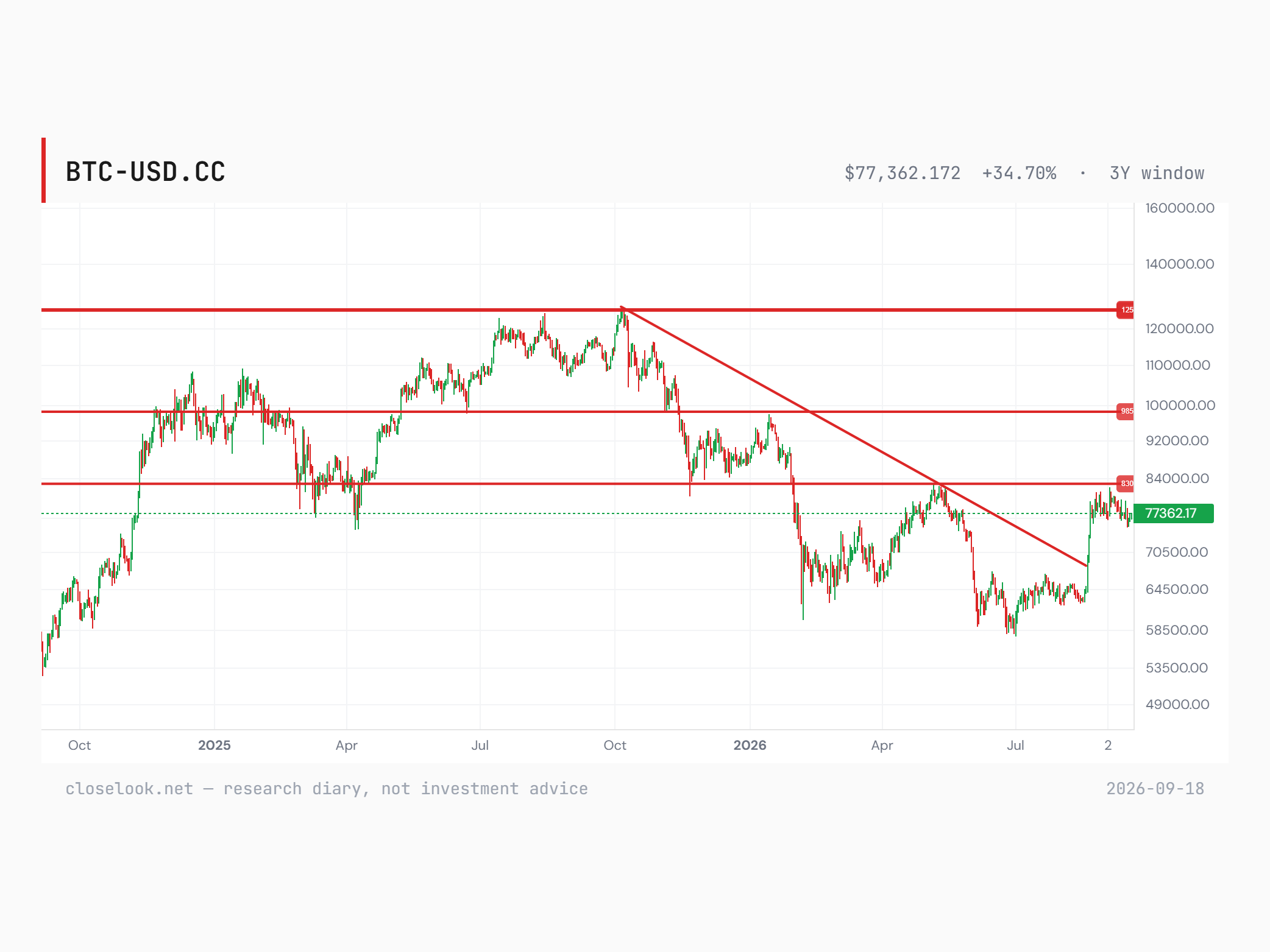
Read the coin’s chart before the stock’s. Bitcoin broke the descending line off its October 2025 record at $125,000 in August, ran straight to the $83,000 horizontal — the floor of spring 2025 — and was turned back there; Friday it closed at $77,362, above the broken line, below the shelf. Above $83,000 the next shelves are $98,500 and the record; back under the broken line, near $67,000, the summer range at $58,500–64,500 reopens, and with a beta near 6 that is the difference between the triangle resolving up and a 40% drawdown in the stock. The stock’s triangle and the coin’s shelf are the same trade until 2027.
The risk the contracts carry: delivery. Everything in the valuation that is not the coin is a construction schedule — Beacon Point energised in the first quarter of 2027, River Bend’s data halls in the second. Power queues, permitting, behind-the-meter generation still under evaluation, and the equipment lead times of a 2027 build are the variables; the company’s own line, ‘execution is something we design for’, is a statement of intent, not a delivery.
The risk the balance sheet carries: $7.6 billion of notes and a growing share count. The notes are non-recourse and fully amortising, which protects the parent and constrains the projects; the amortisation starts before the campuses earn. The parent has funded growth in shares as well: 101 million to 123 million in twenty months, $43.6 million of share-based compensation in a quarter. And the leases are only as good as the tenants and the guarantors behind them — the company says investment grade, the diary has not seen the paper.
The risk the rate says. A 10-year at 5% discounts an 18-month-out cash flow harder than any other kind, which is why the stock fell 42% in a summer the company spent signing contracts. If the curve rises again, this is the kind of name that falls first.
Our forecasts
12 months from now: Higher, in our view, in a wider band than any pick so far. If Beacon Point Phase 1 energises on schedule in the first quarter of 2027 and River Bend’s first data halls are delivered in the second, the market will start capitalising the $1.75 billion of average annual net operating income the company reports, and the June record at $133.02 is the first objective, 35% above Friday’s close, with the analysts’ $175 above it. If a delivery date slips or bitcoin breaks its range, the 1 September low of $77.57 and the 200-day average are the levels that decide whether the twelve-month view survives. A diary view, not advice.
The next few weeks: The stock closed Friday on the upper line of a contracting triangle: the descending line off the June record near $100, the 8 September high at $99.49, and Friday’s own high at $99.01 are one level. A close above it breaks the triangle upward and puts $110–120 in play into the year-end build reports; because Friday was the quarterly expiry, Monday’s close is the one that counts. A close back under the 50-day near $93 says the break failed; a close below $77.57 breaks the rising line, the higher low and the 200-day at once, and the diary steps back until the chart rebuilds — $65.50 is the next floor. Between the lines, the coin decides the day and the contracts decide the quarter.
Diary views, not advice — held publicly alongside the scored record.
Why publish this name? Because our Directional Flow readings are what let us say it: stocks with this or a similar setup have often — historically — done well over the following twelve months. That is the engine's backtested observation about the past, not a forecast; past performance may not be an indication of future performance. Which is exactly why every pick is scored publicly against the tape from today, at one week, one month, three, six and twelve. Twelve months. A diary view, not advice, and not an entry price. Thomas’s charts lead; the count and levels are ours and are open to correction. Hut 8 carries no Closelook score yet; the machine layer below is price and technical only. First checkpoint, one week (25 September close): −1.9% — 96.82 against the 98.74 reference close, while the S&P 500 fund SPY rose 1.3% (761.69 to 771.35), so the pick trails the market by 3.2 points. The triangle did break upward: Monday closed at 103.42, the close the forecast named as the one that counts, and Tuesday at 106.61, +8.0% on the reference. The stock then gave it back over three sessions as bitcoin slipped from about $86,600 to $83,800, and Friday closed back under the $100 line. It holds above the 50-day near $93, the level the forecast set for a failed break, so the read is on probation, not broken. Next checkpoint: one month.
Closelooknet publishes an investment research diary, not investment advice. Every pick is scored publicly against the tape at 1w/1m/3m/6m/12m from publication — the record, not the single call, is the product.
Open the live HUT terminal → All picks & the running record →
A note from the editor: the Weekly Chart Pick is free. Its price is one click — add Closelooknet as a preferred source on Google, and you support this work in Google Discover and Search every time you read.
Google opened in a new tab. Add Closelooknet there, then come back to this tab — the Chart Pick unlocks the moment you return.
The preferred-source setting lives in your Google account — if Google asks you to sign in first, you will land on the selection page right after. Google does not tell us whether you saved the selection. Clicking “Done” unlocks the Weekly Chart Pick on this device for 12 months.