Weekly Chart Pick · 2026-08-14
This company collects a toll on every AI memory chip that ships. Our Directional Flow flagged it — and the wave count says the move is still running
Every HBM stack and every AI accelerator that ships must pass its machines, and the market it dominates is effectively a two-player game. Our Directional Flow has held this name warm-to-hot all year; the hand count reads wave 3 ongoing from the May-2025 low. This week the memory complex put the whole cohort back on the front foot.
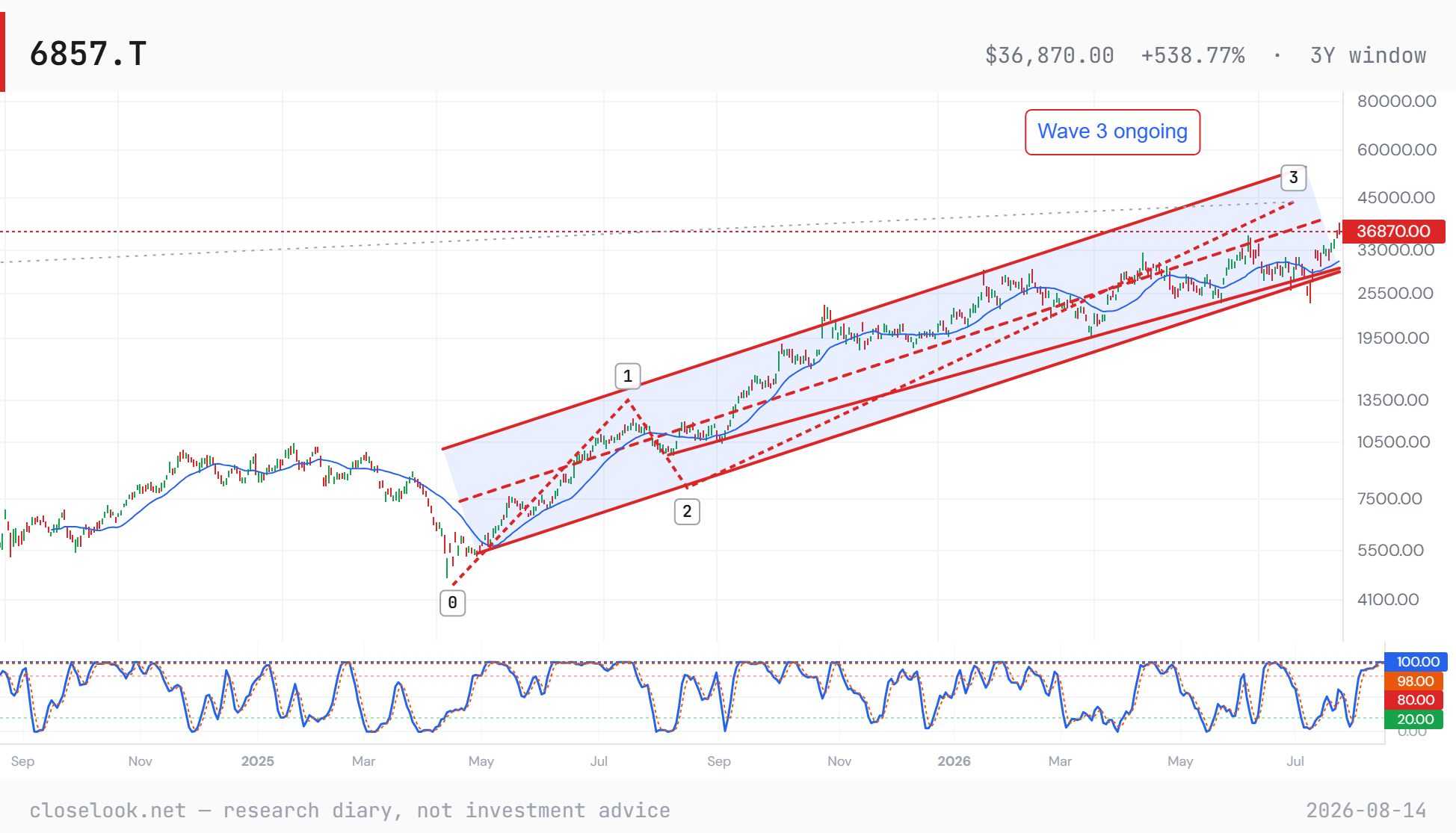
- The Elliott Wave count from the May-2025 low reads 0-1-2 complete, wave 3 ongoing, inside an ascending channel that has held for fifteen months.
- Directional Flow score 75 — warm, one of the more persistent readings in the Rubin universe, though decelerating from hot over the last month.
- Friday's Tokyo session closed +14.5% at a fresh 52-week high — the pick publishes on a vertical day, and the risk section treats that honestly.
- The tape behind it: +88% year-to-date, +256% over twelve months, +657% over three years; its Rubin sector was a top-five weekly performer at +9.1%.
- The business logic: test intensity RISES with HBM stacking and advanced packaging — the memory supercycle pays a toll per device tested, and two companies collect it.
- Scored publicly from today at 1w / 1m / 3m / 6m / 12m — the record, not the single call, is the product.
6857.T Advantest last close 36,870 (2026-08-14)
The Setup
The selection came from the confluence, not from one signal. Our Directional Flow — the scanner score that grades persistence and quality of directional movement — has held Advantest at 75/100, in the warm band, through a month in which most of the Rubin universe cooled; the score's own momentum is decelerating from hot, which is what mature-but-intact trends look like in this engine, not what breakdowns look like.
On top of that sits the hand work: the wave count from the May-2025 low reads 0-1-2 complete and wave 3 ongoing, and the fifteen-month ascending channel that contains the whole advance is intact — price sits in its upper half without having broken the structure once. Testing & Metrology, Advantest's cohort inside the Rubin Build-Out 100, closed this week at +9.1%, fifth-best of twenty-four sectors, in the same week Seoul entered a bull market and the memory complex led the US leaderboard.
And the business sits where we like toll booths: every HBM stack and every AI accelerator that ships must be tested, test intensity rises with stacking and advanced packaging, and the ATE market is effectively a duopoly. The memory supercycle pays this company per device, whichever memory maker wins.
In the Closelooknet readings
Rubin Build-Out 100 — Testing & Metrology cohort (fifth-best Rubin sector this week at +9.1%). Not a constituent of HALO, the Agentic Ecosystem or Agentic Winners — this is a pure physical-buildout name.
52-week range (closes): 10,045 – 36,870
The latest print
The earnings story is the cycle's: tester demand follows HBM and advanced-packaging volume, and both are running ahead of the industry's own plans. We treat the fundamental block qualitatively this week — the print record for Japanese names joins our coverage as the scoring machinery extends — and let the cohort data carry the quantitative weight.
The chart, read by hand
Trend: The entire advance from the May-2025 low has run inside one ascending channel — fifteen months, no break. Price trades in the channel's upper half above a rising 50-day line; Friday's +14.5% session pushed it to a fresh 52-week closing high at 36,870.
Oscillators: The stochastic has spent most of the advance pinned above 80 and sits near 91/89 now. In a trending name, an oscillator that stays overbought is trend behavior, not a standalone sell signal — but it means entries here rely on the structure holding, not on any pullback cushion.
Elliott Wave count: 0 at the May-2025 low (~4,600) → wave 1 into July 2025 → wave 2 complete August 2025 (~8,900) → wave 3 ongoing. The count stays valid while the wave-2 structure and the channel hold; we mark the count, not a target.
Key levels: 36,870 — Friday's close and the 52-week high · ~33,000 — the August shelf that Friday's gap left behind · ~30,000 — the channel floor and 50-day zone; first structural test · the wave-2 low region — a break there invalidates the count entirely
What the machines say
Technical snapshot (as of 2026-08-07) — vs 20d +7.9% · vs 50d +9.4% · vs 200d +30.0% · off 52w-high -10.4% · stochastic K 90.8 / D 88.8 · -2.2% at the close
Pattern engine (scan 2026-08-13) — directional-flow 75/100, warm, decelerating up (5d -0.9%, 21d -13.7%)
Machine blocks render only where our engines actually cover the name — nothing is padded.
The risks, equal billing
The entry day is the biggest risk. This pick publishes on a +14.5% session at a fresh high — vertical days in this name have historically given back part of the move within days, and nothing in our process requires chasing the first print of a breakout.
The oscillator offers no cushion. Stochastics pinned above 90 mean the structure, not mean-reversion, is the only support argument. A daily close below the channel floor near 30,000 would put the wave-3 read on probation; a break of the wave-2 structure would invalidate the count outright.
The macro chain is specific: a memory-cycle rollover, a sharp yen strengthening (the BoJ chain remains our top structural risk under this tape), or a digestion phase in test capex would each hit this name directly. And customer concentration cuts both ways — the HBM boom that feeds the toll booth comes from a handful of buyers.
Why publish this name? Because our Directional Flow readings are what let us say it: stocks with this or a similar setup have often — historically — done well over the following twelve months. That is the engine's backtested observation about the past, not a forecast; past performance may not be an indication of future performance. Which is exactly why every pick is scored publicly against the tape from today, at one week, one month, three, six and twelve.
Closelooknet publishes an investment research diary, not investment advice. Every pick is scored publicly against the tape at 1w/1m/3m/6m/12m from publication — the record, not the single call, is the product.
Open the live 6857.T terminal → All picks & the running record →
A note from the editor: the Weekly Chart Pick is free. Its price is one click — add Closelooknet as a preferred source on Google, and you support this work in Google Discover and Search every time you read.
Google opened in a new tab. Add Closelooknet there, then come back to this tab — the Chart Pick unlocks the moment you return.
The preferred-source setting lives in your Google account — if Google asks you to sign in first, you will land on the selection page right after. Google does not tell us whether you saved the selection. Clicking “Done” unlocks the Weekly Chart Pick on this device for 12 months.