AI Economic Scenarios — Three Futures for 2030
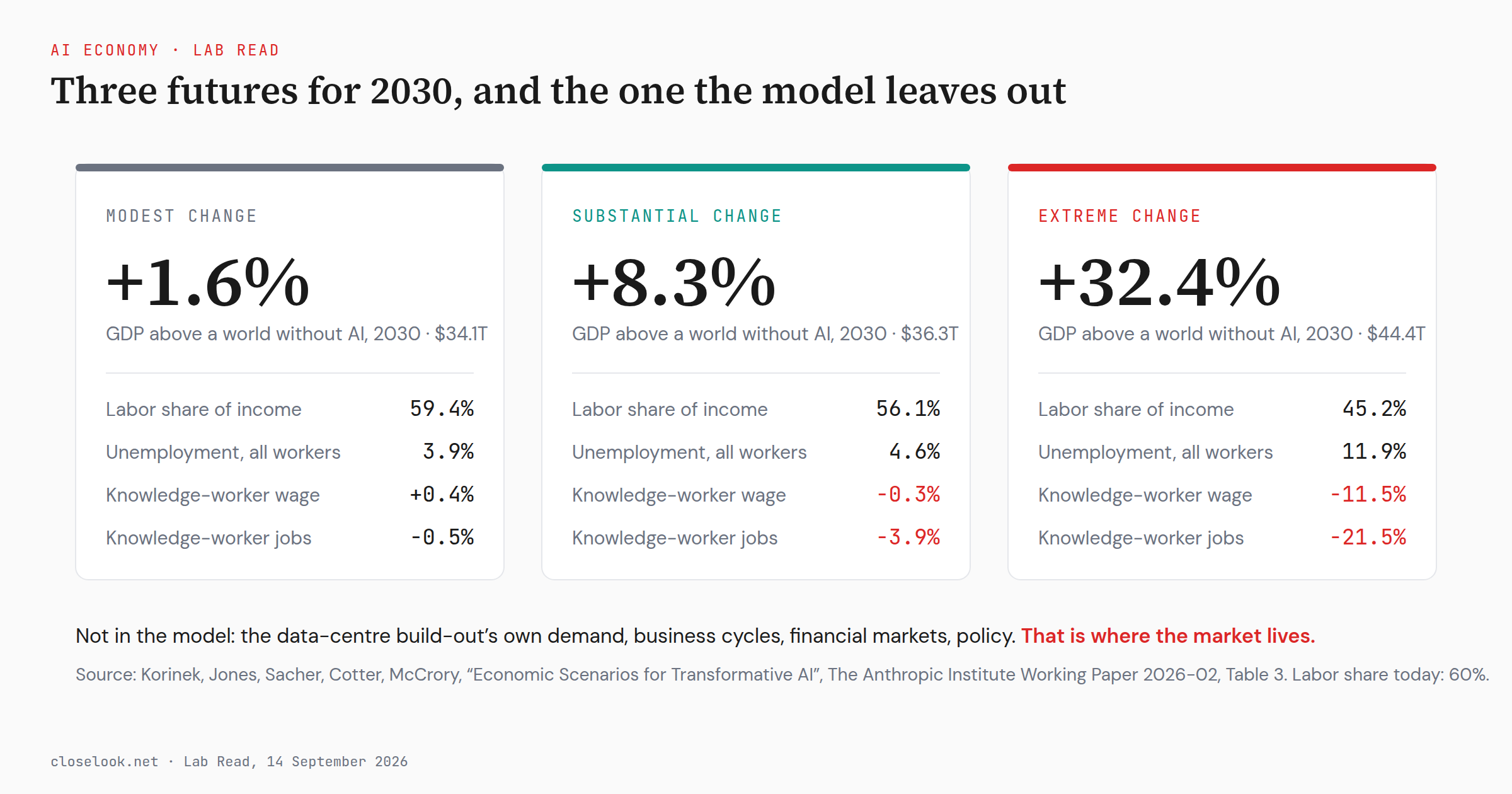
Economic scenarios for transformative AI are the Anthropic Institute’s framework for turning arguments about what AI does to the economy into five measurable settings: how much knowledge work AI can do, how much of it is used, whether it works alone, how much faster the task gets done, and how long a displaced worker needs to find a new occupation. Three settings give three American economies in 2030: modest (GDP +1.6%), substantial (+8.3%) and extreme (+32%, labor share 60% to 45%, one in five knowledge workers unemployed). This entry explains the model, the three futures, the levers, where it stands and what it leaves out.
What it means
The framework is a task-based model of the US economy with two groups of workers. Cognitive occupations (management, professional, sales and office jobs) are the ones AI can reach; all other occupations are not directly exposed. AI automates or augments a growing share of cognitive tasks, raises productivity, and pushes displaced workers to search for jobs in the other group, which takes time. Output rises, cognitive employment shrinks, other employment grows, and because wages lag output the labor share of income falls. The paper attaches no probabilities: it is a way to state disagreements about AI as disagreements about a few numbers.
The three futures
Modest: 4% of tasks affected by 2030, GDP 1.6% above the no-AI path, growth 2.4% a year, labor share 59.4%, unemployment 3.9%, knowledge-worker wages +0.4%. AI is the internet. Substantial: 12% of tasks, GDP +8.3%, growth 5.4% a year (above the 1999 peak), labor share 56.1%, unemployment 4.6%, knowledge-worker wages −0.3% and jobs −3.9%, wages elsewhere +5.9%. Extreme: 30% of tasks, GDP +32.4% and growth 15.4% a year, labor share 45.2%, unemployment 11.9% overall and 17.9% for knowledge workers, whose wages are 11.5% and jobs 21.5% below their path while wages elsewhere are 33.6% above it. Total labor income in the extreme case is what it would have been without AI; the whole gain is capital income, up 81%.
The five levers
Capability starts at 0.14 of all tasks (late-2025 usage) and reaches 0.20, 0.30 or 0.50 by 2030. Adoption starts at 0.10 (18% of firms use AI, 32% by employment) and reaches 0.20, 0.40 or 0.60. Autonomy, the share of AI work done without a person, is about 0.5 in consumer chat and 0.75 through the API today; the scenarios use 0.50, 0.75 and 0.90. Productivity per affected task is 0.30 to 0.45 in log terms from field trials; the extreme case needs 0.80. Re-employment takes about three months in normal times; the substantial and extreme scenarios halve and quarter the odds of crossing occupations. A sixth setting, new human tasks per task automated, is 0.5, 0.25 and zero.
Where it stands
The authors surveyed 10,980 US adults in August 2026. The median respondent expects a capable AI (six of eight benchmark tasks by 2030) but limited use of it, and the model turns those answers into an economy close to the substantial scenario: GDP +8.6%, unemployment 4.6%. About one respondent in ten holds views in line with the extreme case. The scenarios share today’s readings and separate only after 2027, so none can be ruled out yet; each lever is a statistic that will be published over the next two years.
What can go wrong
The model leaves out policy responses, business cycles, aggregate demand and financial-market disruptions, catastrophic risks and capable robots. Reviewers asked the authors to be clearer that it excludes the demand effects of the data-centre build-out, and several argued it underestimates how much AI could accelerate technological progress. The cost to knowledge workers arrives either as lower wages or as unemployment depending on how sticky wages are: fully flexible wages give a 42% wage fall and 2.6% unemployment; very rigid wages give a 2.8% wage gain and 24% unemployment. Whether labor keeps any of the gain depends on how fast capital can be added: with capital in short supply the return to capital rises to 10.3% and the average wage falls below its no-AI path.
Why it matters for the tape
The capital stock the scenarios need — 14% or 56% above the no-AI path — is being ordered now, and its supply chain is the Rubin Build-Out 100. The shrinking cognitive wage bill is the top line of seat-based software and the demand base of the Agentic Winners. Rising wages in the trades are the Physical AI and grid layers. Unemployment at 11.9% with growth at 15% is the combination the credit tape watches for. Full treatment, including who wants the brakes after the pacing weekend, in AI Economy — Three Futures for 2030, and the One the Model Leaves Out.