Daily Pulse · · 4 min read · macro · DXY


The dollar has spent years doing almost nothing — in a way that matters enormously.
Since the 2022 spike toward 114, the Dollar Index has neither collapsed nor resumed a durable bull. It has been trapped in a wide band, roughly 96 to 102, turned back again and again at the 101-102 ceiling and rescued again and again in the mid-to-high 90s. Range markets are boring until the moment they aren't. This is that moment.
The level
DXY is printing 100.97, pressed against the same 101-102 resistance that has capped every rally for three years — the hard line is 102.00, with 101.40 the near-term shelf. What makes this test different from the last several is the shape underneath it: a sequence of higher lows since the early-2026 low near 96, climbing into a flat ceiling. That is a coil — an ascending compression that usually resolves in the direction of the pressure. The pressure points up. It is not yet confirmed.
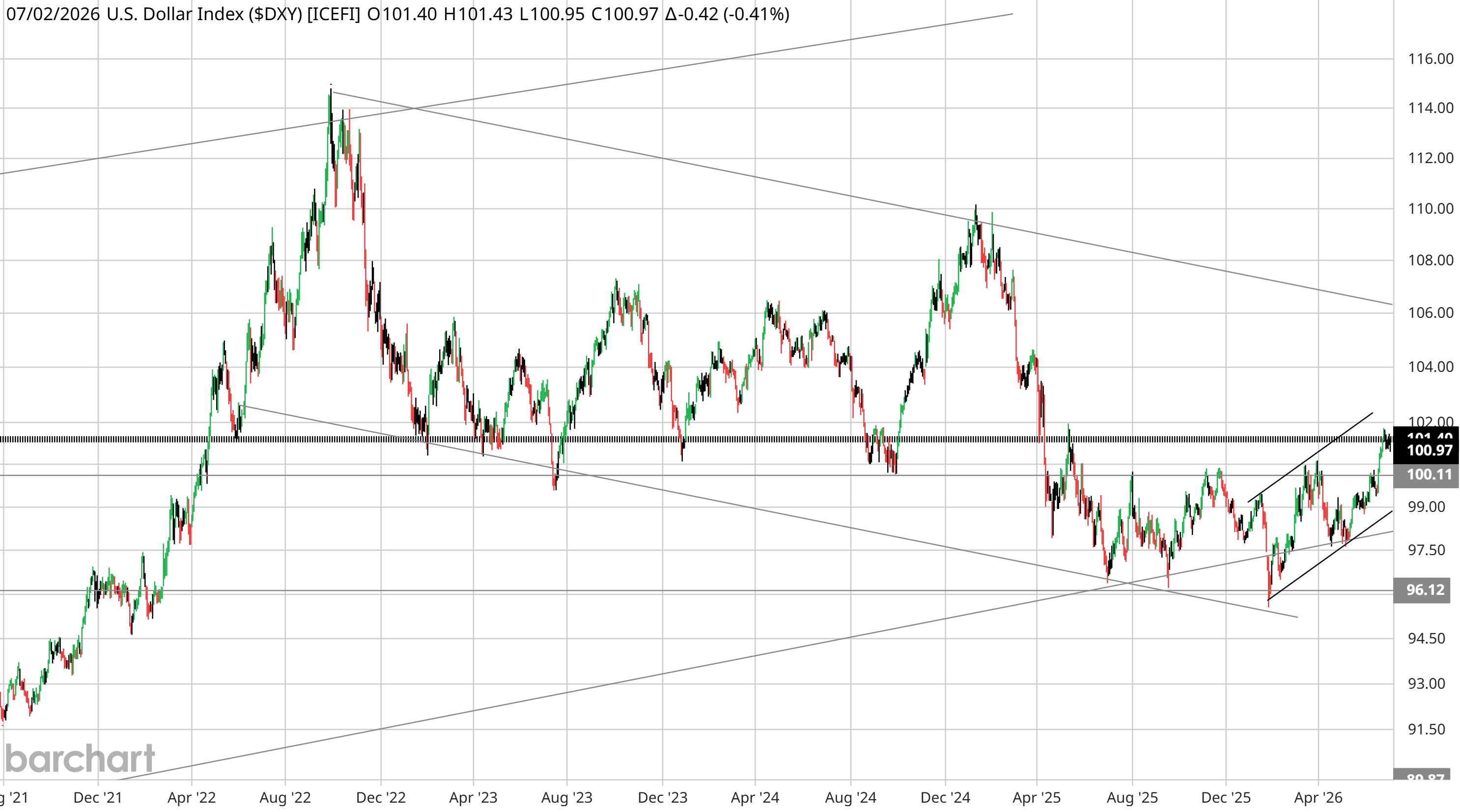
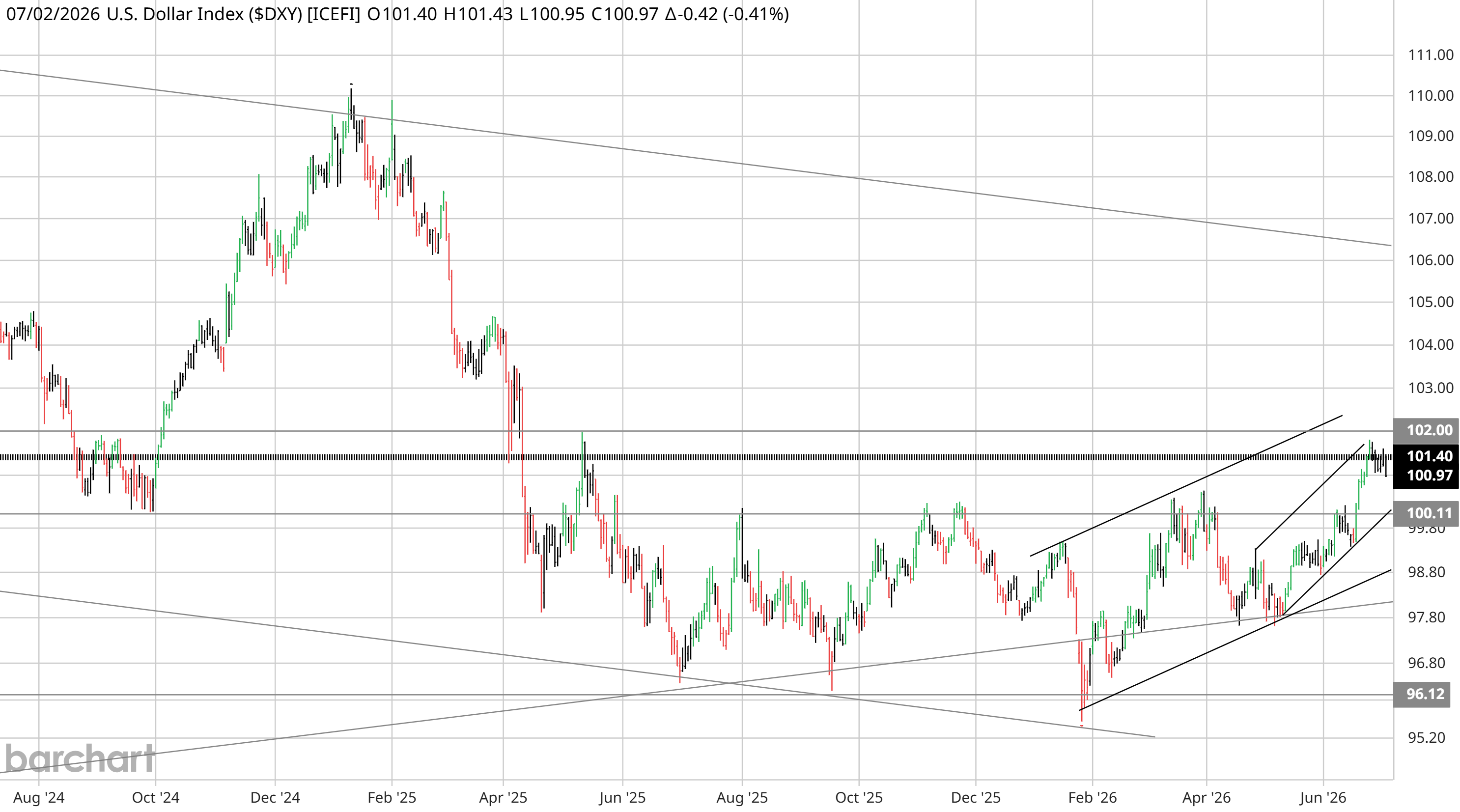
Below 102, the dollar is still range-bound and this is just another failed probe. Above it, the dollar changes character — and so does the macro backdrop.
Why a break would be a regime signal, not a daily move
Four supports sit under the possibility of a stronger dollar, and they are structural, not tactical:
- Short rates. The dollar is a yield currency as much as a growth currency. While US short rates sit above the rest of the developed world, global capital has a standing reason to stay in dollars — more so when no other large currency offers the same mix of liquidity, yield, and perceived safety.
- Growth differential. If the US keeps growing faster than Europe and Japan, the dollar earns a premium. Capital chases not only rate, but the economy where it expects to be treated best — still, on balance, the US.
- Structural euro and yen weakness. The euro carries weak growth, fractured fiscal politics, and thin productivity momentum; the yen carries Japan's rate and demographic structure. Both can rally tactically. Structurally, both stay vulnerable if the dollar moves.
- Real rates — the one that matters most. If nominal rates stay high while inflation does not accelerate enough to erode them, real yields stay dollar-supportive. In that world the dollar doesn't need a crisis to rise. It rises because the real return on dollar cash is simply attractive.
The dollar is the discriminator
This is where the level reaches past FX. The belief-line read on gold and Bitcoin turned on a single question: where do the proceeds go when the hedges break — into the real economy (rotation) or into cash (forced de-risking)? A dollar breakout answers it. If gold and Bitcoin lose their lines while DXY clears 102, the proceeds are going to the dollar — and that is the forced-de-risking tell, not the rotation-into-growth one. The dollar is the needle on that gauge.
It also arms the new-regime problem directly. Higher real rates are the cost-of-capital column of the Numerator Regime — the thing that turns “cash-flow scrutiny” from a phrase into a market. A dollar that breaks out on real rates pressures the very multiples the whole AI-capex complex trades on: the reflexive trap named in Heresy X, now with a price and a level attached.
What a break would do to everything else
A stronger dollar tightens global financial conditions almost mechanically. It pressures commodities, emerging markets, gold, and the parts of the equity market that run on easy liquidity. Most of all, it breaks a lazy assumption — that falling inflation automatically buys a broad risk-on. A dollar breakout says liquidity is not improving everywhere at once: relief is selective, and the trades priced for relief are the exposed ones.
The other side
Multi-year resistance earns respect. First tests of a ceiling this old fail more often than they break, and false breakouts above obvious levels are a favorite trap. The dollar smile cuts both ways: a genuine US growth wobble, or a Fed that cuts faster than the rest, and the range reasserts with the reflation trade intact. A rejection here that loses 100.11 and the rising channel says the coil resolved down, and the easy-liquidity story lives another quarter. The setup leans stronger-dollar. It is not a foregone break.
The read
- Below 102 — 🟡 range regime intact. The reflation and easier-liquidity narrative keeps the benefit of the doubt. Nothing to reprice yet.
- Decisive close above 102 — 🔴 regime change. Stronger dollar, higher real rates, tighter global conditions. Bullish the dollar; bearish the relief. This is the “cash is the only bid” macro — and the confirmation the gold and Bitcoin break would be waiting for.
For years the dollar has been the quietest chart on the board. It is about to say something. Watch 102, not the forecasts.
Stay close. Look closer.
Fundamental drivers are stated as structural setup, not current point forecasts. Positioning language is reference-portfolio logic, not a recommendation to the reader; publishing and money management remain separate. Levels as marked on the accompanying DXY charts.
C — free account
The free C account unlocks the full Daily Pulse — every section of this read.
One tap with Google or one email — no password, no card. You are signed in until you sign out, on this browser, from then on.
Join the Look — freeAlready joined on this browser? The full edition shows automatically — if it doesn't, sign in again here. Looking for the archive, portfolios and realtime? That is C+.