Heresy · 14:45 CET
Gold — The Grandchildren Problem · Closelooknet Heresy XV
Gold bugs watch the dollar. They should watch Asia's grandchildren.


Gold bugs watch the dollar. They should watch Asia’s grandchildren.
Gold fell as much as 3.1% on Wednesday, 18 November, to $3,745 an ounce in New York futures trading. That is the lowest level since September 2025 and a third below the intraday high of $5,586 on 29 January. Silver lost about 4% on the day.
The usual explanations apply. The dollar index rose 0.3% to 103.8, the 10-year Treasury yield is near 5.1%, and markets fully price a December rate hike. Gold pays no interest, so every point of yield on the alternatives raises the cost of holding it.
The Fed added to the pressure on Wednesday morning. Governor Christopher Waller told CNBC that a half-point hike at the 8–9 December meeting is probably necessary, and that the Fed has to reverse last year’s three rate cuts and may need to go further. “You might need to, like, shock people,” he said. Futures already price a quarter point in December, another move in January and at least one more increase before the end of 2027, according to CME FedWatch.
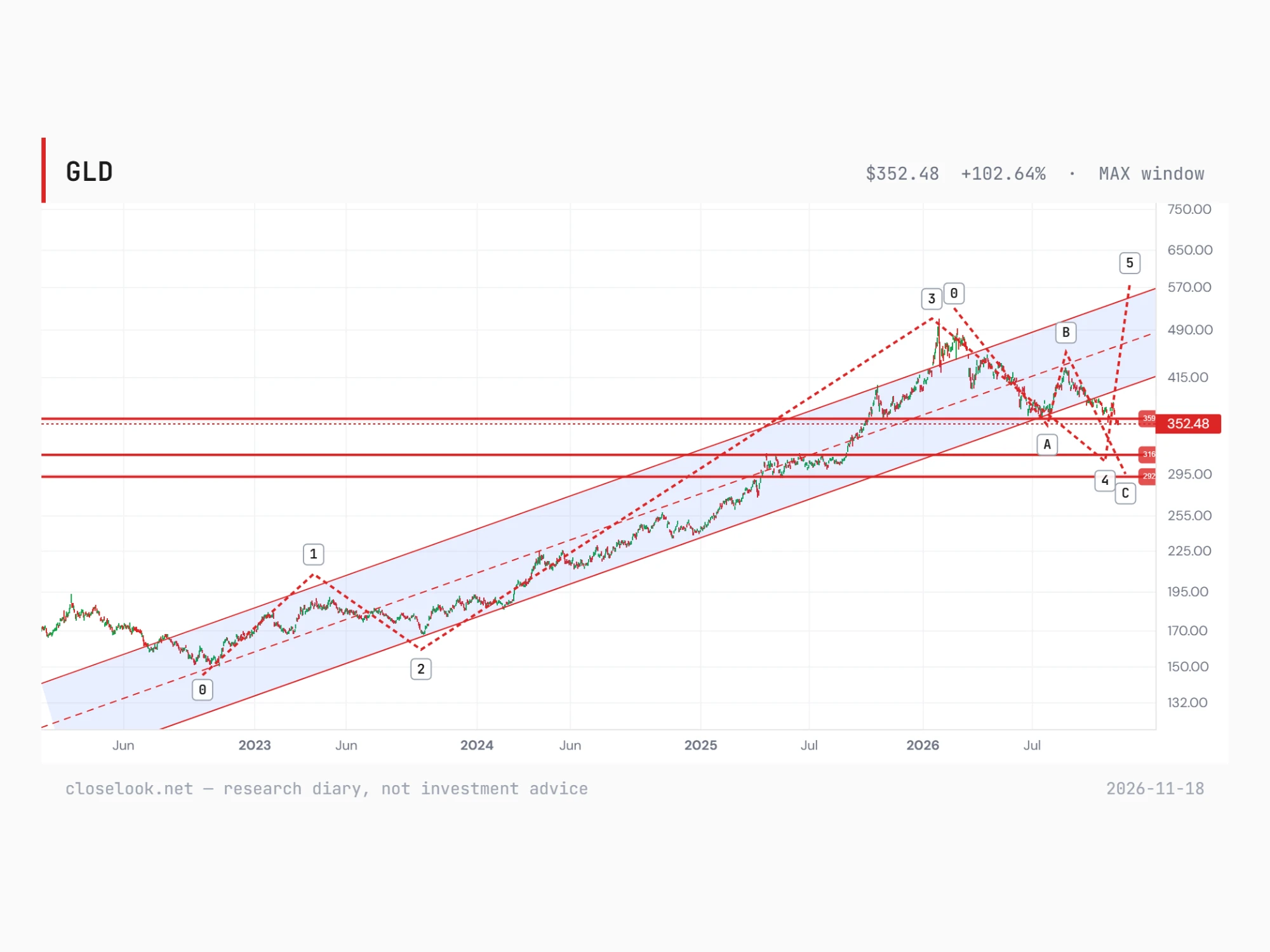
So this is not a call on the next move. My chart says the bull market in gold is correcting, not over. The Heresy below is about the decade: who will hold the metal that already exists, and at what price.
The heresy: Western gold bulls argue from geology and debt: governments print money, nobody prints gold. But gold’s price is set by the people who already own it. About a quarter of all gold above ground sits with Indian households and Chinese private holders. Their heirs have choices their grandparents never had. Gold may stay scarce forever. That does not mean the next generation will want to hold as much of it.
The numbers behind that sentence are large. Indian households and the Chinese non-central-bank sector hold an indicative 55,800 tonnes, about one quarter of the world’s above-ground gold. A permanent shift of only 5% of that pool into other assets over ten years would mean about 279 tonnes of selling a year, equal to roughly 20% of global gold recycling in 2025.
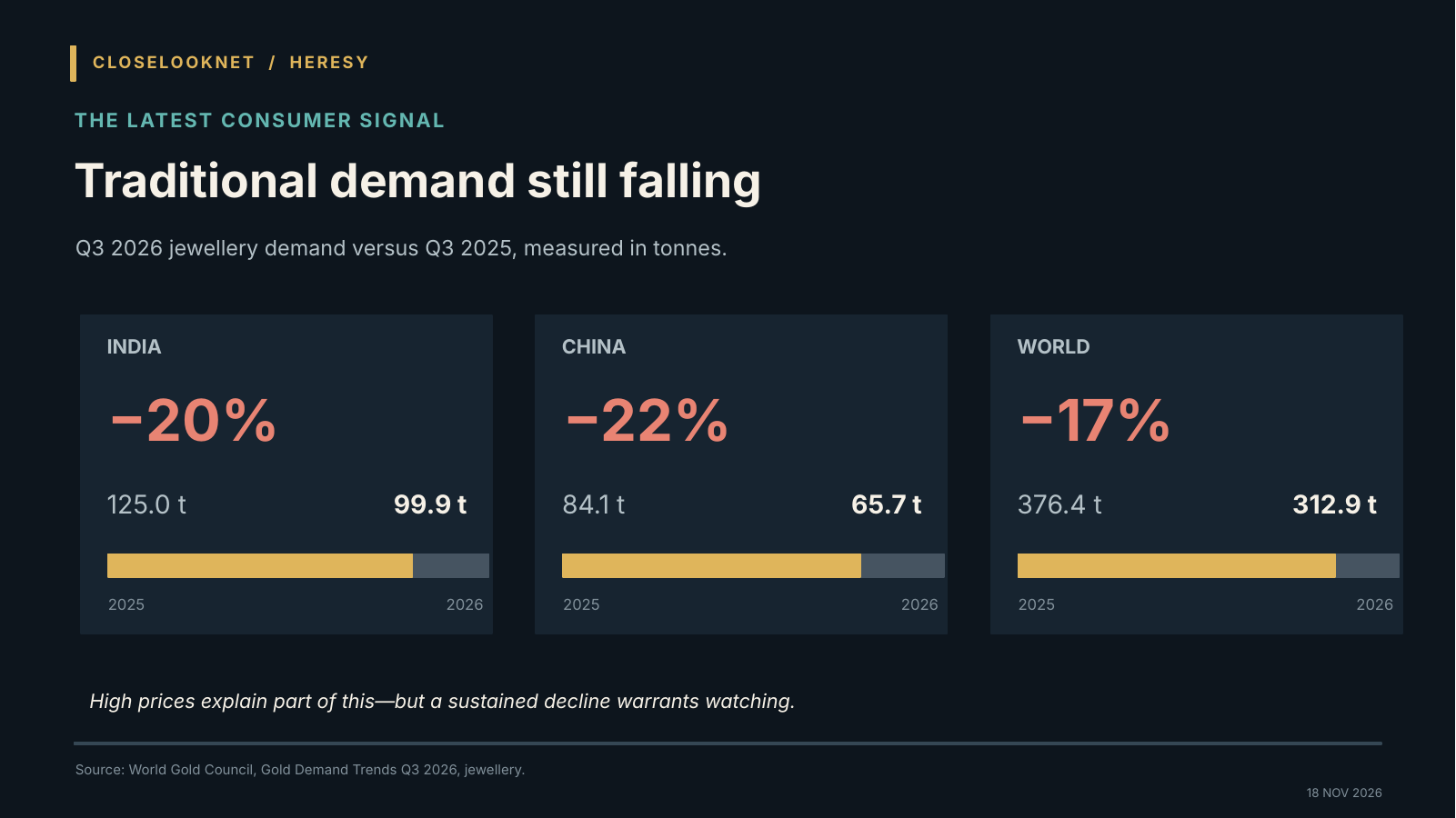
That is a scenario, not evidence that it is happening. But the traditional buyers are already buying less: jewellery purchases in India fell 20% and in mainland China 22% in the third quarter of 2026, compared with a year earlier.
Scarcity is not a valuation model
Gold supply cannot expand on a political whim, and that has made it monetary wealth for centuries. But the step from limited mine output to a price that must rise does not follow. The price also depends on how much gold existing owners want to keep, and at what price compared with everything else they could own.
Oil is produced and burned; wheat is grown and eaten. Gold is accumulated. The World Gold Council estimates 224,200 tonnes above ground at the end of the third quarter of 2026, of which about 98,700 tonnes, or 44%, is jewellery. Mine production in 2025 was about 3,672 tonnes, so the existing stock equals more than 60 years of mining.
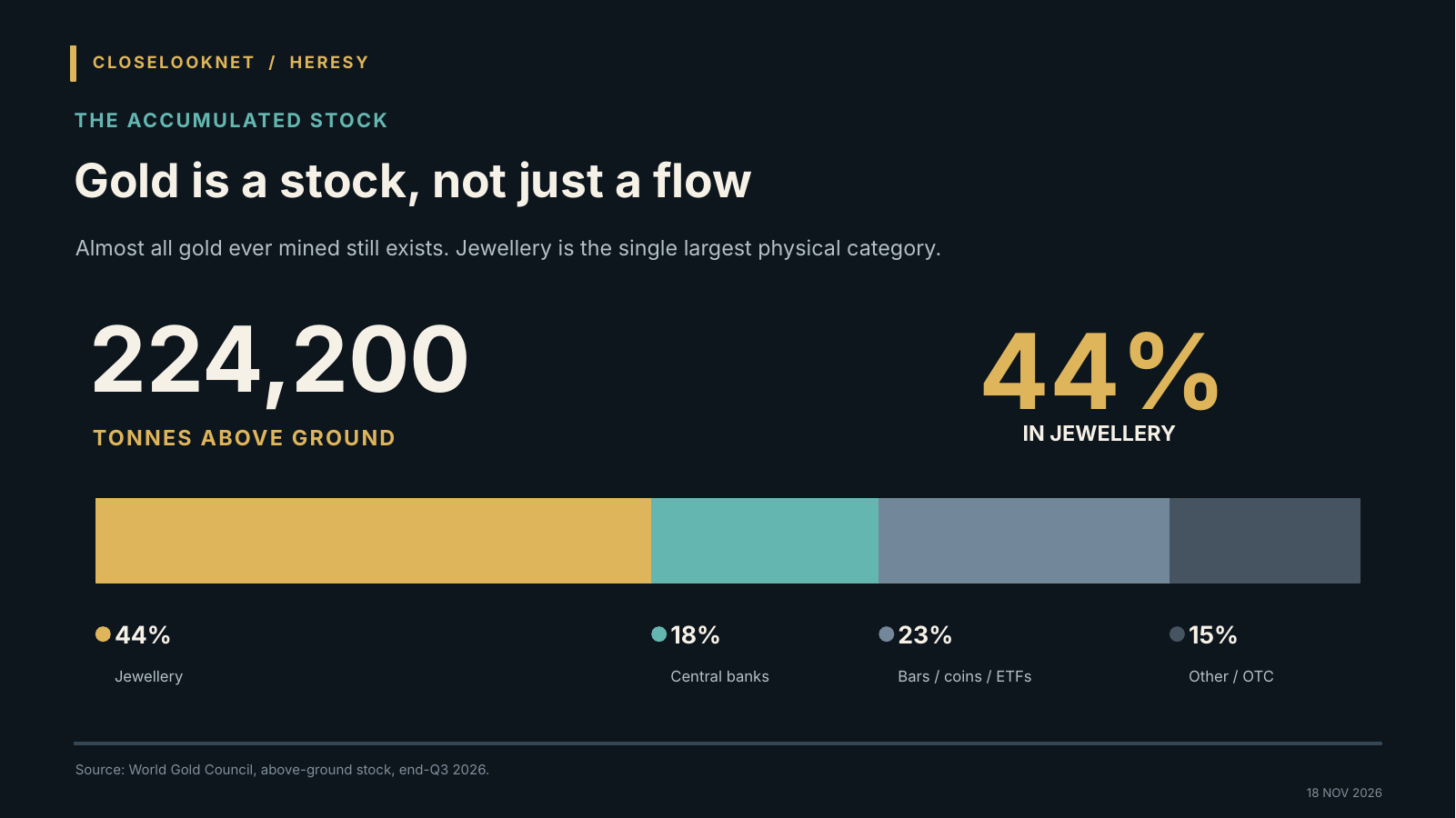
Industry barely touches that stock. Electronics, dentistry and other technical uses took about 323 tonnes in 2025, which is 6.5% of a year’s supply and 0.14% of the metal above ground. At that rate the existing stock would last industry almost 700 years.
Altea Research puts a deliberately hypothetical number on it. Its comparison of 21 metals values gold’s industrial use at $8,000 to $15,000 a kilogram, or about $250 to $470 an ounce. Against a price near $3,750, that leaves roughly 88% to 93% of the price above the industrial benchmark. It is a thought experiment, not a price floor: a world that priced gold only for industry would mine, recycle and substitute differently.
Gold’s scarcity is geological. The premium paid for that scarcity is behavioural.
The same logic sits behind Heresy VII — Price Is the Only Truth: a story about why something is valuable is not the price. The price is what the marginal owner will pay to keep holding it.
The top looked like a top
I saw the January peak up close, and it had the marks of a bubble top. Ordinary people queued in the street to buy bullion. The cab drivers and barbers who had talked crypto for years switched to gold. When the people with the least experience in a market become its most eager buyers, the move is usually late.
The reporting from those weeks says the same. On 27 January, two days before the high, Reuters described customers cramming into gold shops in Shanghai and Hong Kong, with dozens queuing outside one shop in central Hong Kong, some for hours. A Swiss dealer called January his best month in about 20 years and said deliveries of small bars were running late.
The rush had started in the West. In October 2025 Reuters reported long queues at the bullion shops of central Vienna, buyers looking for bars and coins in London’s Hatton Garden, and a Royal Mint estimate that about 40% of its buyers were new customers. The Perth Mint’s weekly visitors rose from about 5,000 to 8,750.
One group was missing from the queues. In mid-January, as prices set records, Reuters found Indian retail buying muted. “Jewellery demand is pretty much dead,” a Mumbai bullion dealer said. The buyers who built the world’s largest private gold hoard had already stepped back.
Why the fall is mostly a monetary story
The third of the price lost since January has conventional causes: a firmer dollar, higher US yields, a Federal Reserve that raised rates in September and is expected to raise them again, and speculative positions being unwound. Leverage and forced selling make such moves faster than the news behind them.
Fed officials now argue about speed, not direction. Waller wants half a point in December; St. Louis Fed President Alberto Musalem has floated as many as four hikes by spring 2027; Cleveland’s Beth Hammack and Dallas’s Lorie Logan favour a gradual path; and New York Fed President John Williams says the situation does not call for dramatic action. Every one of those paths raises the yield gold has to compete with.
Institutional buying has not stopped. In the third quarter, central banks bought about 321 tonnes and physically backed gold ETFs took in 211 tonnes. Strong reported demand came before a steep correction anyway.
The lesson is not that central banks don’t matter. It is that no single bull argument sets the price. The macro story explains the last ten months. It does not answer the long question of who will own the stock.
Asia is already buying less jewellery
The latest World Gold Council figures are blunt. In the third quarter of 2026, jewellery buying fell 20% in India and 22% in mainland China compared with a year earlier. Global jewellery consumption fell 17% to about 313 tonnes, the weakest third quarter in a series that goes back to 2000, and the thirteenth quarter in a row of year-on-year declines.
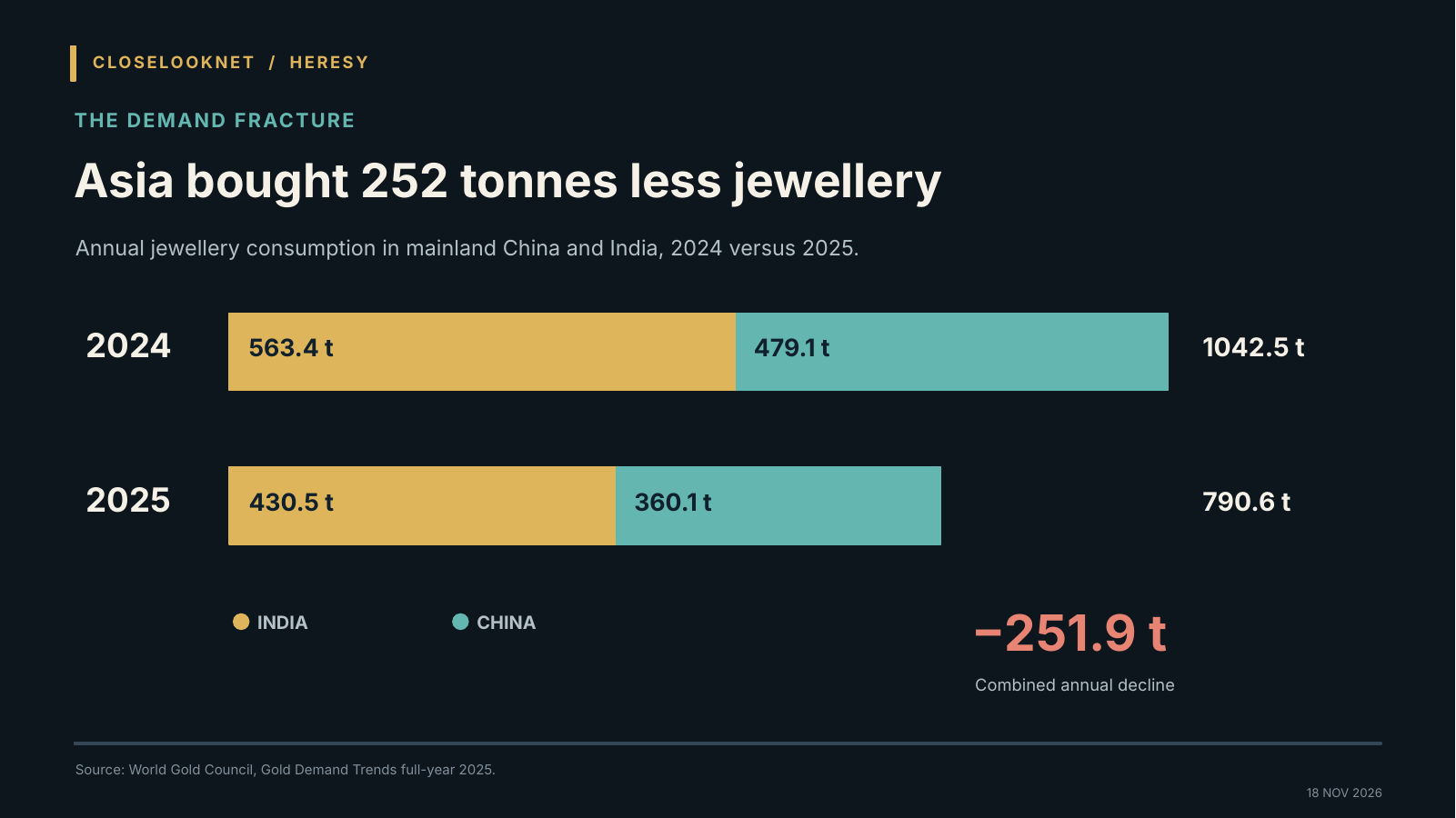
The full-year data showed the turn earlier. Combined jewellery purchases in India and mainland China fell from about 1,043 tonnes in 2024 to 791 tonnes in 2025, a drop of 24%.
High prices explain much of this. In the first nine months of 2026, the weight of jewellery sold worldwide fell 19% while spending on it rose 15%: shoppers bought less metal for more money. Indian festive buying picked up again as prices fell after mid-October, and at many retailers 40% to 60% of sales were exchanges of old pieces for new ones.
So weak jewellery volumes alone do not prove a weaker attachment to gold. What matters is whether years of unaffordable prices change habits: less jewellery bought as savings, smaller inheritances kept, more money put to work elsewhere.
Jewellery is consumption with gold inside
Buy a gold ring for $1,000 and offer it to the next jeweller for cash. The buyer pays for the gold content and purity, minus a dealer spread. What you paid for design, workmanship, retail margin and tax is mostly gone. For some pieces the immediate loss can reach 25% to 40%; plain high-purity jewellery with low making charges holds its value far better.
A piece bought decades ago may still have been a good store of family wealth, because the gold inside rose so much. But for a young saver with other options, the question is simple: why pay a consumer-product premium if the goal is to own gold? A ring and a gold ETF used to be the same decision. On a phone, they can be separated.
The stock in the jewellery boxes
A World Gold Council roadmap from August 2026 estimates that Indian households hold about 31,000 tonnes of gold, about 14% of the world’s above-ground stock by our calculation. At $3,750 an ounce that is about $3.7 trillion.
China is harder to measure. A July 2026 analysis by BMO Capital Markets estimated about 30,000 tonnes in the country, including about 5,200 tonnes it attributes to the central bank, more than official disclosures show. Taking out the central bank leaves about 24,800 tonnes in Chinese jewellery, bars and other private holdings. It is a model, not an audited count of heirlooms.
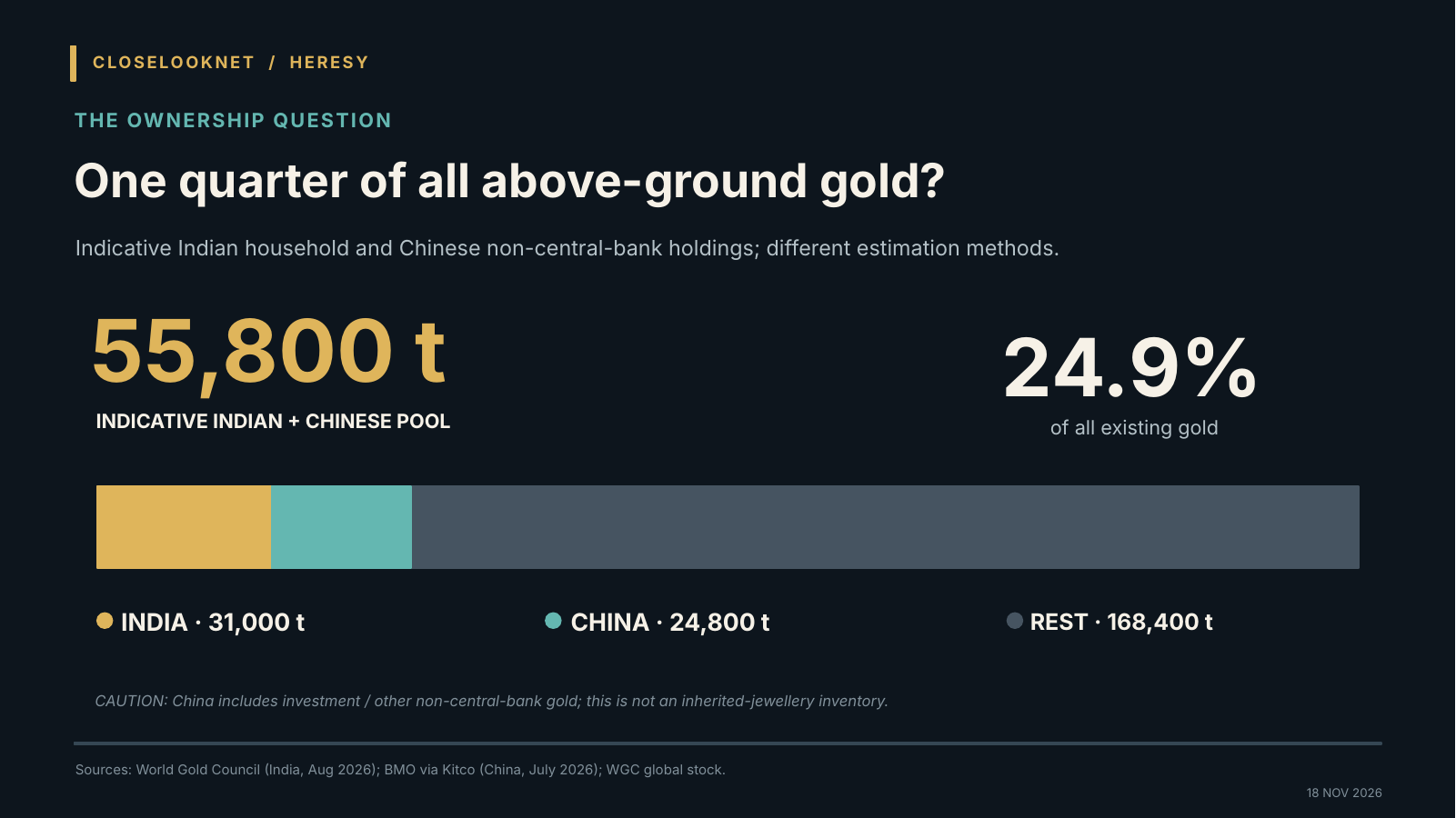
Not all of that pool is inherited jewellery. Some is in coins, bars and investment accounts, and nobody knows its exact distribution. But the scale makes the point: even a small change in how much of it families want to keep would be large next to a year’s trade.
The arithmetic of a slow exit
Suppose the 55,800-tonne pool shrinks gradually, not in a panic, through a permanent shift into other assets over ten years. A 1% shift means about 56 tonnes a year. A 5% shift means 279 tonnes a year. A 10% shift means 558 tonnes a year.
For scale: global recycled gold was about 1,404 tonnes in 2025. The middle case would add selling equal to about 20% of that.
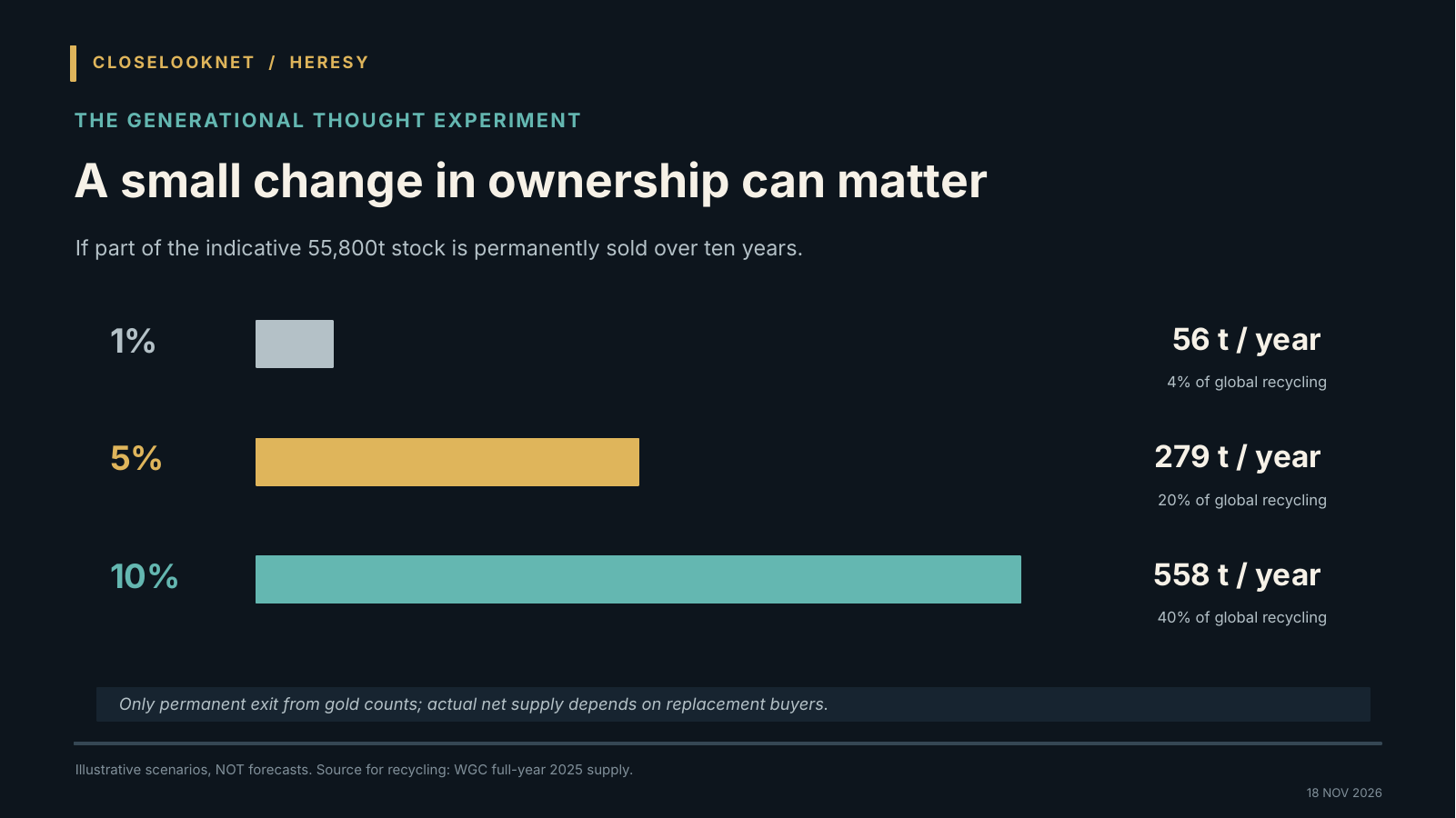
These tonnes cannot simply be added to lower jewellery demand to estimate a glut. Some sales stay inside the country, some are exchanges, and some proceeds go straight back into gold. Every seller also needs a buyer. If other households, ETFs, central banks and investors take the metal at today’s prices, the handover is benign. If the new marginal owner wants a lower price, the market reprices.
China: financialisation, not abandonment
China shows the strongest counterargument. In the first half of 2026, Chinese investment demand for gold was about 342 tonnes against 136 tonnes of jewellery. In 2025 investment overtook jewellery for the first time.
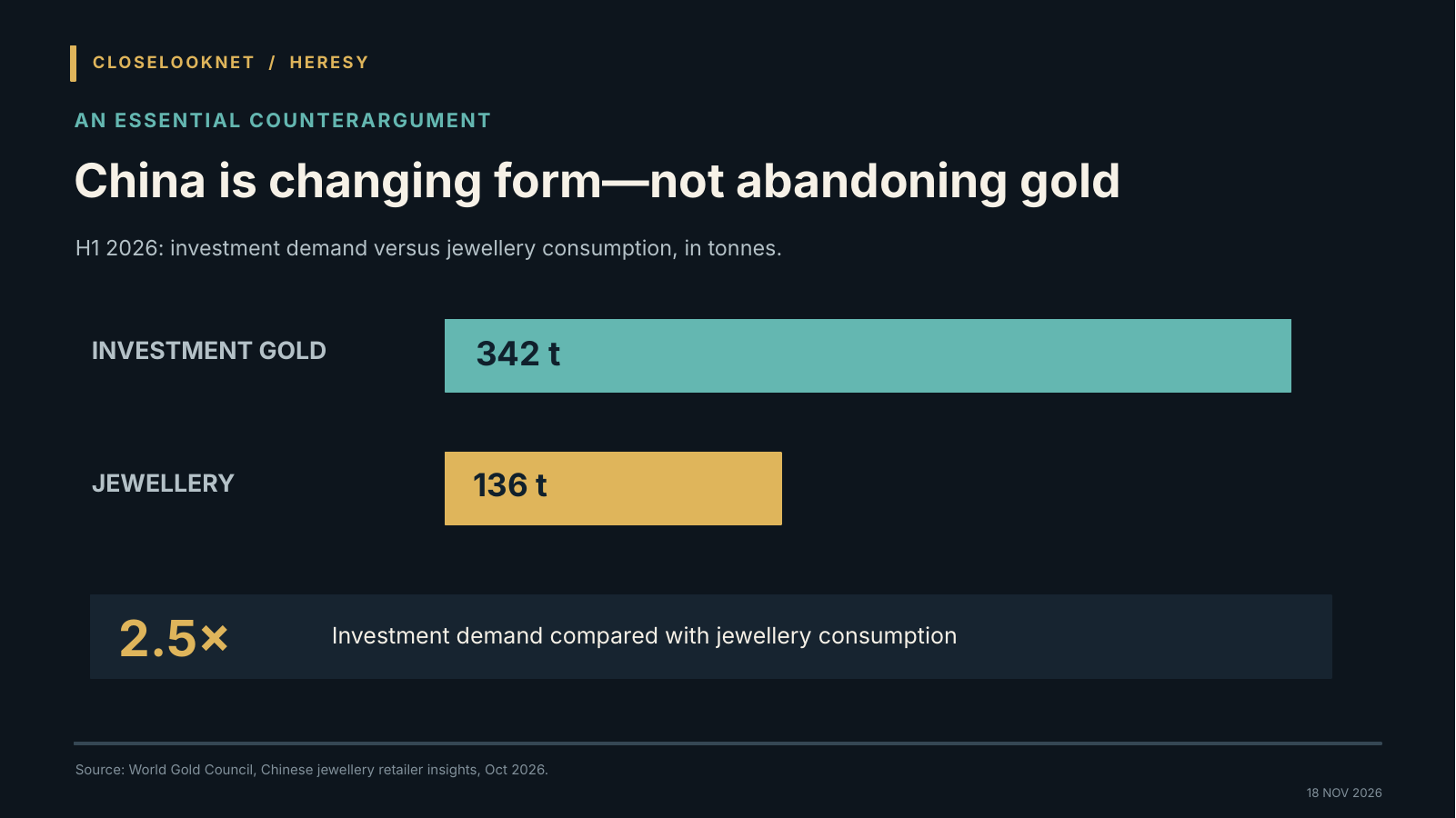
Younger Chinese buyers may be moving from ornaments to bars, coins and ETFs while keeping or even raising their gold exposure. The World Gold Council’s retailer survey points to lighter designs and buying for personal enjoyment. That is a change in the jewellery business, not a collapse in gold ownership. Any bearish case has to find people leaving the metal, not just selling old ornaments.
India has already built the exit
In India, the alternative is not a future possibility. The plumbing exists. The government reports about 241.6 billion payments over the UPI instant-payment network in the year to March 2026, up 30%, and about 555 million users signed up by June 2026. The National Stock Exchange counted about 137 million unique registered investors in September 2026, a count of registrations, not of people who trade every month.
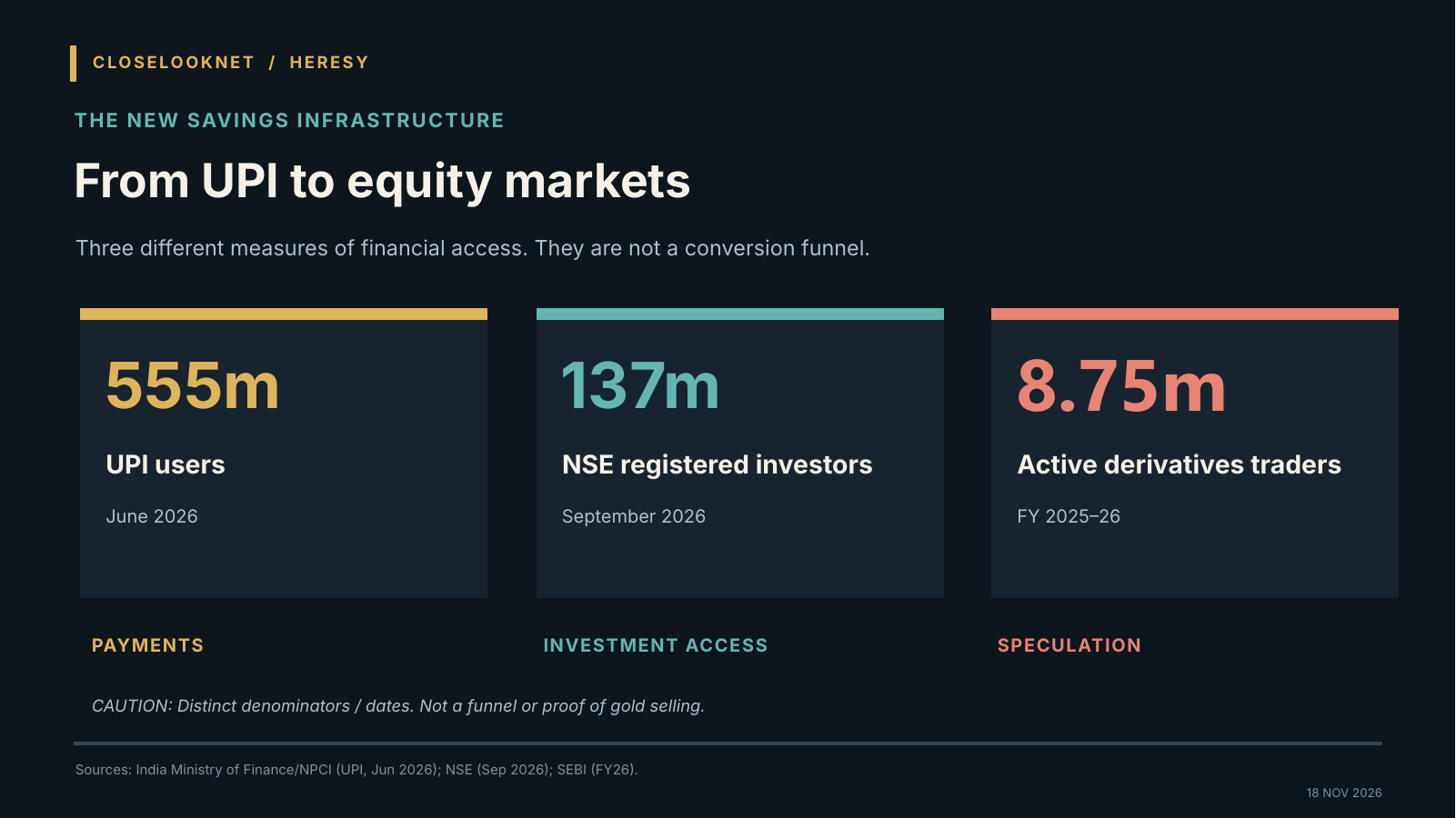
The platforms see the gold savers as their next customers. On 19 October 2026, PhonePe renamed its Share.Market brokerage PhonePe Invest. Founder Rahul Chari told Fortune India he wants to bring the millions of users who invest in gold and mutual funds on PhonePe into the equity market, calling the new platform a bridge for savers. That does not show those savers have sold family jewellery. It shows the industry is building the road for them.
The Economic Times reported in July a case that shows the road in use. A Mumbai couple sold inherited bangles and a bridal necklace for nearly ₹20 lakh (about ₹2 million) and put the money toward their first home in Navi Mumbai, cutting their monthly loan payment by about ₹20,000. One reported case is not a survey. But the replacement asset was not more gold: jewellery became home equity and lower debt.
There is a third route between keeping and selling: borrowing against the gold. At the end of May 2026, gold-backed loans stood at about ₹5.1 trillion at Indian banks and ₹3.3 trillion at non-bank lenders, up 105% and 70% in a year. Those are loan balances, not gold sales. They show how jewellery becomes cash without leaving the family, at the price of a debt that can force a sale if it goes bad.
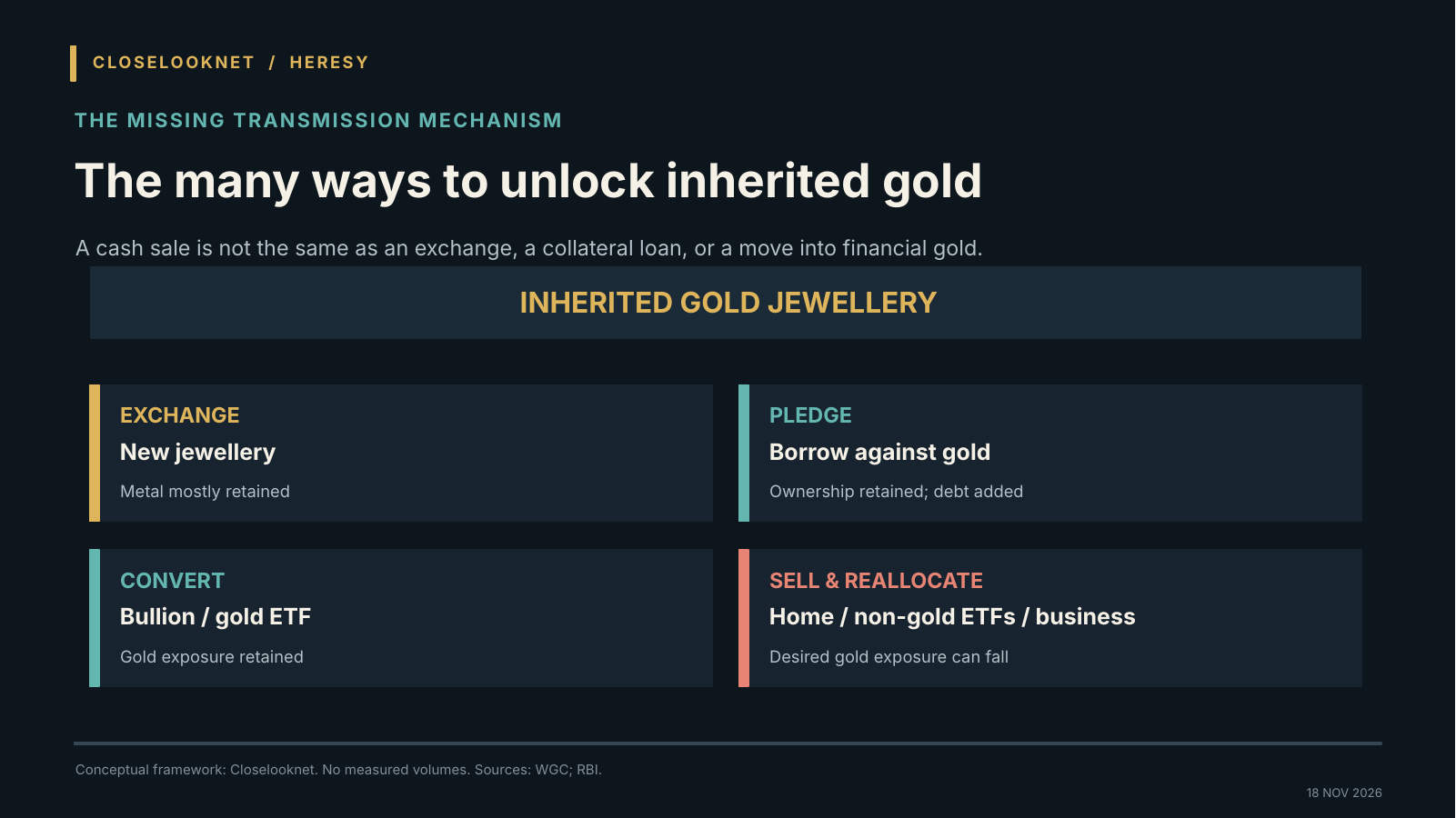
The overhang does not come from jewellery being exchanged, or even pledged. It comes when inherited gold is swapped for assets that are not gold.
From heirlooms to same-day options
India’s investing boom is not only producing patient, diversified savers. It has also produced a mass culture of short-dated options trading. The market regulator SEBI counted 8.75 million active individual equity-derivatives traders in the year to March 2026, 18% fewer than a year before. In its broker sample, 43% of traders with a known age were under 30.
Their time horizon is the opposite of an heirloom’s. About 59% of index-options turnover was in contracts expiring the same day, 75% within a day and 97% within a week. Two thirds of traders came from outside the 30 largest cities.
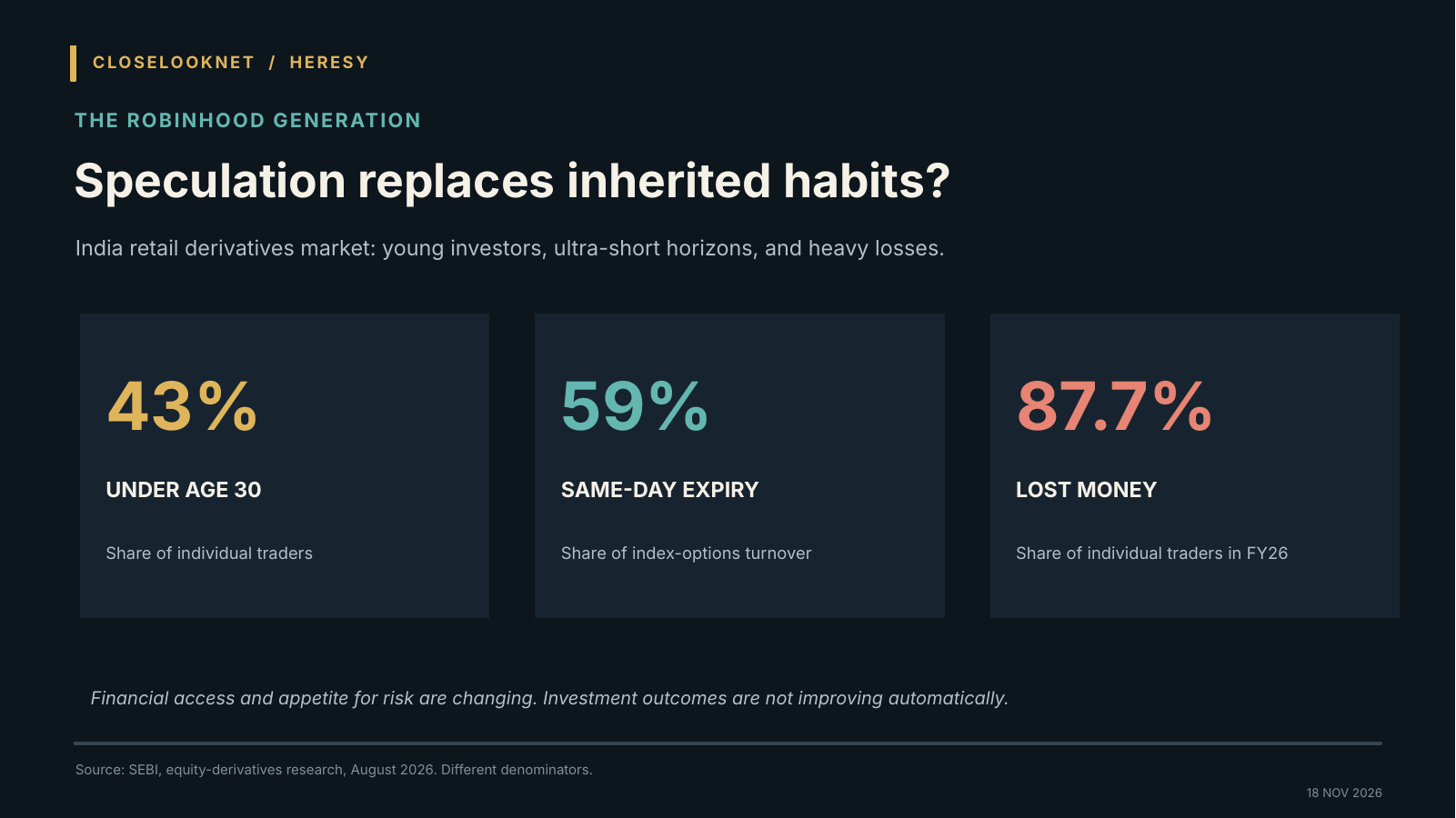
The results are poor: 87.7% of individual traders lost money, about ₹916.85 billion in total, 92% of it on options. More access does not mean better wealth preservation.
The contrast with the grandparents is stark enough. They held gold for decades as insurance; some grandchildren bet on index moves over hours. But these data do not show that young traders inherited gold, sold it, or traded with the proceeds; the groups have not been linked. Heavy losses could even make simple gold savings look better to the next cohort. What the data do show is that India’s risk appetite and time horizons are changing, which makes it harder to assume that heirs will copy their grandparents’ allocation.
Yesterday’s wealth technology
There is no good evidence that gold itself is becoming obsolete. Central banks keep buying, Chinese investment demand has grown while jewellery shrank, and ETFs make owning gold easy for a 25-year-old.
What may be ageing is a particular technology of saving: piling up expensive jewellery as the family’s default reserve. The granddaughter does not have to dislike gold to reject a necklace as a financial instrument. She can keep a smaller allocation in bars or an ETF and put the rest of her inheritance into a home, a fund, an education or a business.
Cheaper investing tools, and soon AI assistants that compare portfolios for free, push in the same direction. That does not mean they favour shares over gold; a sensible model may well recommend a gold position. But the question changes from we always buy jewellery to how much gold, and in what form?
Jewellery becomes consumption. Gold becomes an allocation decision.
The diamond comparison is tempting but limited. Natural diamonds lost ground to lab-grown stones; gold has no cheap manufactured substitute and a far deeper monetary role. The point is narrower: a material can stay rare while the premium society pays for its rarity changes.
The counterevidence: households are not rushing to sell
The strongest evidence against a selling wave today comes from recycling. In the third quarter of 2026, recycled gold supply fell 8% globally, about 12% in India and 20% in China, even with prices well above a year earlier.
Indian households often preferred to pledge their gold or exchange it for new pieces, and an old-for-new exchange does not count as recycling because it adds no metal to the market. In November the World Gold Council reported festive buying recovering as prices fell, and a fifth straight month of inflows into Indian gold ETFs.
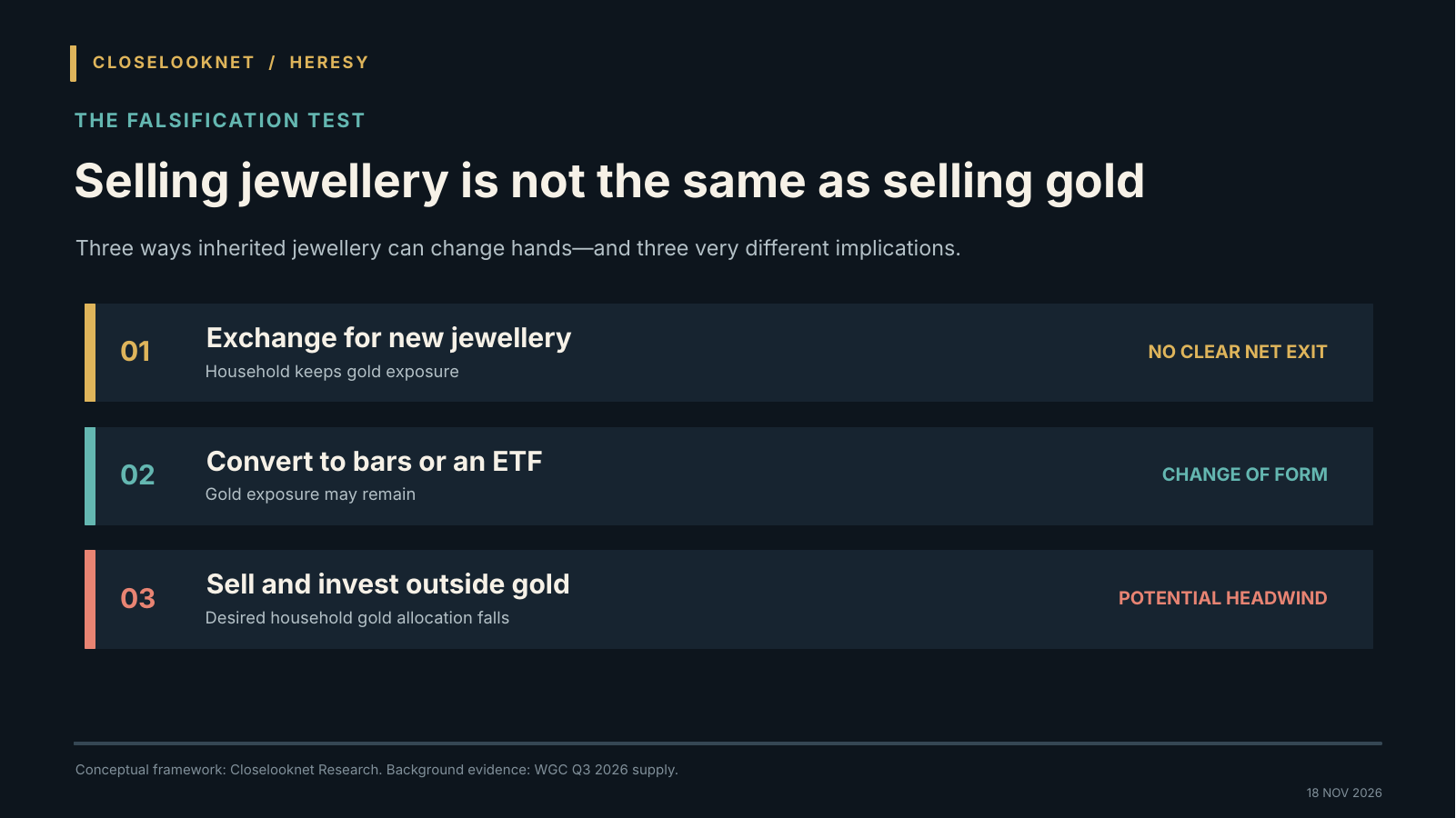
We can document falling jewellery demand and changing motives. We cannot yet document a large, lasting fall in how much gold the next generation wants to own. That is a real limit of this thesis.
Three outcomes, and what would settle it
Gold is financialised, not abandoned. Young households reject ornaments as savings but keep bars, coins and ETFs. Jewellery shrinks, financial gold grows. China already looks like this.
The inheritance becomes an overhang. Families sell old gold, buy less new jewellery and put the money into homes, businesses and other assets. If replacement buyers will not absorb the metal at current prices, gold faces a lasting headwind. This is the bearish case, and the least proven.
Institutions absorb the handover. Central banks and professional investors take what households release. The metal moves from jewellery boxes to vaults, and prices need not fall for long.
The three can run at once, in different countries and generations. The bearish case gains ground if sale proceeds visibly go into property and funds rather than back into gold, if jewellery demand fails to recover when prices ease, if outright cash selling rises for years instead of exchanges, if younger households report lower intended gold holdings, and if ETF and central-bank buying does not fill the gap. It loses ground if new jewellery buying recovers with affordability and inherited metal mostly changes form.
What this does not show: the 55,800-tonne pool combines different estimates and includes far more than inherited jewellery. The 1%, 5% and 10% cases are scenarios, not measured selling, net supply or price forecasts. The UPI, investor and derivatives figures describe different people, dates and units, and none of them proves that anyone sold gold. A generational thesis complements the macro picture of yields, the dollar and positioning; it does not replace it.
The most leveraged belief in gold
Western gold bulls may be right about debt, currency credibility and the appeal of a reserve no government issues. But a true statement about geology is not a complete valuation model.
Gold may be one of the most valuation-leveraged assets there is. Not because owners borrow to hold it, but because almost all of its value rests on non-industrial uses and on people choosing to keep holding it. Industry takes 0.14% of the stock a year. The rest of the price is jewellery, savings, reserves and culture.
That premium can be rational. Monetary networks, liquidity and insurance against disaster have real value, and gold has kept that value for centuries. But it depends on shared preferences, and preferences can shift. A small change in what owners of a very large stock want to hold is large next to a year’s flows. When the marginal buyer wants less, the adjustment does not show up in the geology. It shows up in the price.
The leverage runs both ways. When the premium expands, gold rises without becoming any more useful; when it contracts, the same metal can lose much of its quoted value, as the last ten months have shown on a smaller scale. Today’s drop is a monetary story. The longer story is in Mumbai and Shanghai, where the grandchildren are deciding what to do with their grandparents’ gold.
The biggest leverage in gold may not be borrowed money. It may be the belief that the next generation will value the metal as highly as the last.
Today’s market levels are in the Morning 10 for 18 November.
Sources and notes
- World Gold Council — above-ground gold stock, end-Q3 2026: 224,200 tonnes; jewellery about 98,700 tonnes.
- World Gold Council — Gold Demand Trends Q3 2026: jewellery India −20%, China −22%, global −17% to 313 t; central banks 321 t; ETFs +211 t; nine-month volume −19%, value +15%.
- World Gold Council — jewellery, full-year 2025: India and China combined 1,042.5 t (2024) and 790.6 t (2025).
- World Gold Council — Swarnim Udaan 2047, 4 August 2026: Indian household holdings about 31,000 t. The share of the global stock is our calculation.
- Kitco on BMO Capital Markets, 27 July 2026: about 30,000 t accumulated in China, about 5,200 t attributed to the central bank.
- World Gold Council — Chinese jewellery retailer insights, 16 October 2026: H1 2026 investment 342 t, jewellery 136 t.
- World Gold Council — India market update, 17 November 2026: festive demand, exchanges at 40–60% of sales, fifth month of ETF inflows.
- World Gold Council — supply, Q3 2026: recycling −8% globally, −12% India, −20% China; exchanges not counted as recycling.
- World Gold Council — supply, full-year 2025: mine production 3,671.6 t, recycling 1,404.3 t.
- World Gold Council — technology demand, full-year 2025: 322.8 t.
- Altea Research — Metals Utility Analysis (2026): hypothetical gold industrial value of $8,000–15,000/kg. Illustrative, not a price floor.
- Reuters via Kitco, 22 October 2025: Western retail demand, queues in Vienna, Royal Mint new customers, Perth Mint visitors.
- Reuters via MarketScreener, 16 January 2026: Indian retail buying muted at record prices.
- Reuters via Kitco, 27 January 2026: crowded gold shops in Shanghai and Hong Kong, queues in central Hong Kong.
- CNBC, 18 November 2026: Governor Christopher Waller on a 50bp December hike and reversing the 2025 cuts (Squawk Box interview); CME FedWatch pricing; St. Louis Fed President Alberto Musalem, 17 November 2026.
- Government of India (PIB), 30 April 2026: 241.6 billion UPI transactions in 2025–26, +30%.
- Government of India (PIB), 20 July 2026: about 555 million UPI users onboarded by June 2026.
- National Stock Exchange investor call, 9 November 2026: 13.7 crore (137 million) unique registered investors.
- PhonePe, 19 October 2026: Share.Market becomes PhonePe Invest.
- Fortune India, 19 October 2026: Rahul Chari on bringing gold and mutual-fund savers into equities.
- The Economic Times, 12 July 2026: inherited jewellery sold for a first-home deposit (names changed by the paper).
- World Gold Council — India Focus Q2 2026: gold-loan balances at end-May 2026.
- Reserve Bank of India — Lending Against Gold and Silver Collateral Directions.
- SEBI — Profitability of Individual Traders in Equity Derivatives, August 2026: 87.5 lakh (8.75 million) active individual traders, −18%; in the 15-broker sample 43% under 30 among traders with a known age; 87.7% loss-makers; ₹91,685 crore in losses, 92% from options; 59% / 75% / 97% of index-options turnover within the same day / one day / one week of expiry; 67% of traders outside the top 30 cities.
Market data for 18 November 2026: COMEX gold and silver futures, US dollar index and 10-year Treasury yield, as of about 13:30 UTC; GLD pre-market trade at 13:32 UTC. Charts 2–11 were produced for this essay from the sources above; the cover is an AI-generated illustration.
Heresies is a series of contrarian investment theses; this is Heresy XV. It is a falsifiable research hypothesis written as a research diary, not investment advice and not a recommendation to buy or sell gold or any security. Publishing and money management remain separate.