Weekly Chart Pick · 2026-11-27
Cybersecurity — the leader beat, raised and bought a rival; 27% off its high, we read $200 as support
A quarter above estimates and a raised outlook, released on the same Monday morning as an all-stock purchase of a network-security rival. The stock fell 8.8% in three sessions while its peers rose, and Wednesday’s close of $209.30 is $77.69 under the October high. That day it dipped to $194.70 and closed back above the $200 line the editor reads as support.
- Beat, raised, sold: revenue up 28% and above estimates, recurring revenue growing faster for the fifth quarter in a row, a raised outlook. Released the same Monday morning as an all-stock purchase of a network-security rival, it was sold 8.8% in three sessions while the cybersecurity fund CIBR rose 3.7%.
- The deal in one line: about 18.9% more shares for about 62% more annual recurring revenue. Per share that is about a third more, before a 34% premium, the integration and a closing that may take until January 2028.
- $77.69 under the high: the October high was $286.99 during the day; Wednesday closed at $209.30, 27.1% lower, on the lower line of the falling channel that began at the high.
- Support at $200: on Wednesday the stock fell to $194.70 and closed back above $200 and above the editor’s line at $196, the June high. It has not closed under $200 since 26 August.
- Little legacy: a platform built in the cloud, grown outward from the laptop and the server into cloud, identity and data, and now adding the network. In the editor’s book, the number one name in cybersecurity.
- Our own plan, diary not advice: add on dips toward $200. Spread over three names, with Okta and Rubrik, which report next week; over five, add Cloudflare and Palo Alto Networks.
CRWD CrowdStrike last close 209.3 (2026-11-25)
The Setup
The claim: the market sold the deal, not the quarter. On Monday 23 November, before the open, the company did two things at once. It reported the quarter to 31 October a week early, and it agreed to buy Zscaler, the network-security company, for about $43.9 billion in its own shares. The quarter beat estimates on revenue and earnings and came with a raised outlook. The stock fell 8.9% that day and stood 8.8% lower after three sessions, at $209.30, while the cybersecurity fund CIBR, the Nasdaq-100 and every large peer rose. The editor reads $200 as support and any dip toward it as a chance to add. That is the diary’s plan, not advice.
The quarter. Revenue of $1.58 billion, up 28%, against about $1.53 billion expected (data vendor). Annual recurring revenue (ARR, the yearly value of all subscription contracts) reached $6.26 billion, up 27%, and grew faster than a year earlier for the fifth quarter in a row. New ARR added in the quarter, $419 million, was 58% higher than a year ago and the most the company has ever added in one quarter. Free cash flow of $474 million was 30% of revenue. The company raised its full-year outlook (company release, 23 November). The details are in the report section below.
The deal. Each Zscaler share becomes 1.135 shares of the buyer, worth $260.41 at Friday’s close, a premium of about 34%. Zscaler holders end up with about 15.9% of the combined company, so the buyer issues about 18.9% more shares. Zscaler brings $3.9 billion of ARR; together the two start with more than $10 billion. The company targets $1 billion a year of extra revenue within 30 months of closing and $500 million of cost savings within 18 to 24 months. Closing is expected between August 2027 and January 2028, the second half of the buyer’s fiscal 2028, subject to a Zscaler shareholder vote and regulators. Jay Chaudhry, Zscaler’s founder, and his affiliates hold about 34% of Zscaler’s shares and have agreed to vote for it (company release, 23 November).
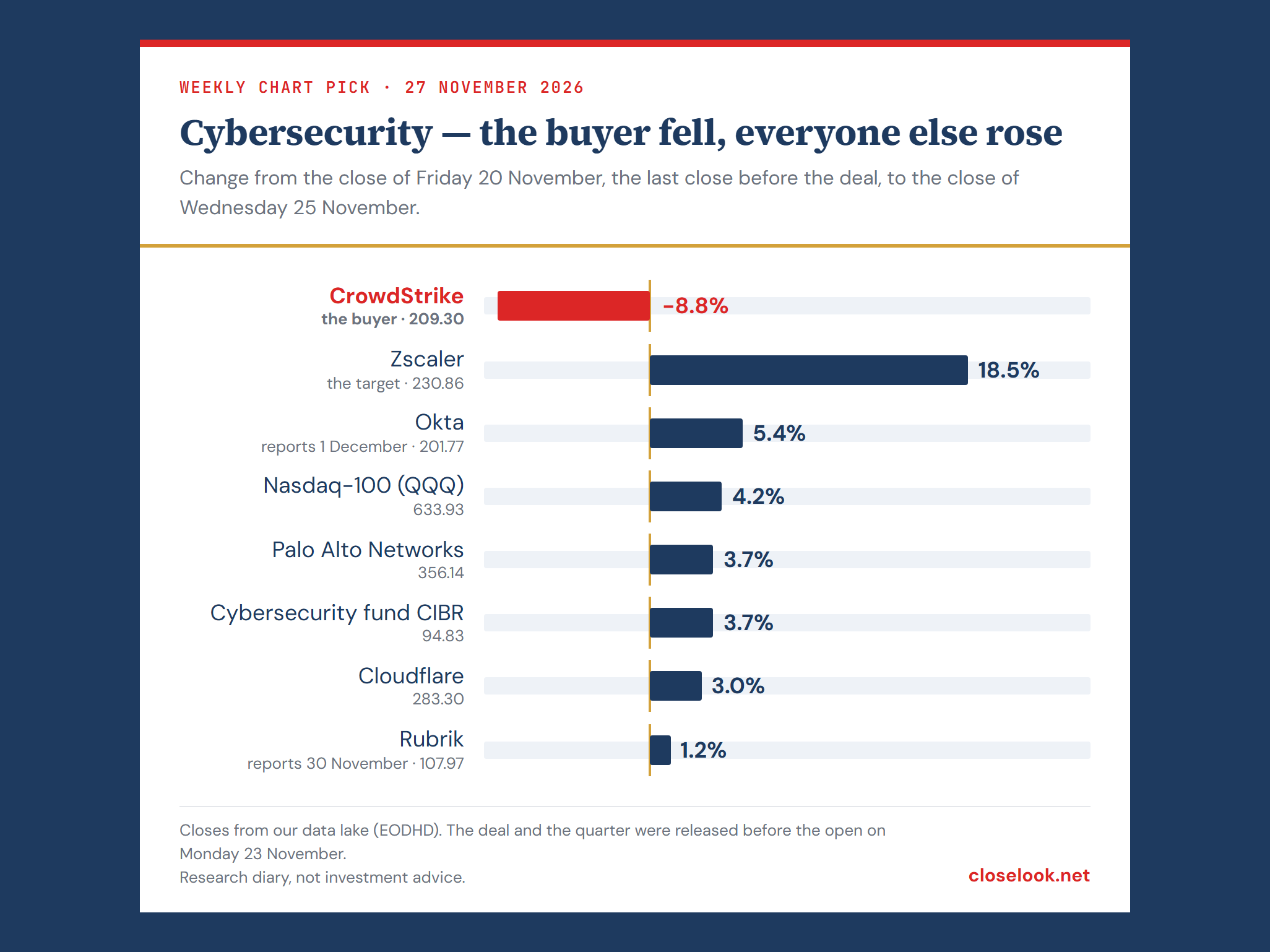
Why the buyer fell. In an all-stock deal the buyer pays with its own shares, so its holders own less of a larger company. Here they give up about 16% of it, at a 34% premium, for a business with a different product, the network, that has to be integrated. Monday’s volume, 42.4 million shares, was 4.6 times the 20-day average. A second force usually lasts until closing: funds that trade the deal buy the target and sell the buyer short, to lock in the gap between Zscaler’s price and the value of 1.135 shares. At Wednesday’s close that offer was worth $237.56, and Zscaler traded 2.8% below it. A narrow gap says the market expects the deal to close.
The arithmetic the market skipped. About 18.9% more shares buy about 62% more recurring revenue: $3.9 billion on top of $6.26 billion. Per share, ARR rises by about a third, before any of the targeted savings and extra sales. That is not a free lunch: it ignores how fast each business grows and what the buyer’s shares are worth, and integration costs money. But it is the reason the company calls the deal immediately accretive to free cash flow per share, and it is the side of the trade that Monday’s selling did not price.
Little legacy, built out from the endpoint. In the editor’s book this is the number one name in cybersecurity, and one with little legacy: no firewall boxes or on-premise appliances to defend, a platform built in the cloud from the start. It began on the endpoint, the laptop and the server, and grew outward into cloud workloads, identity, data and the security operations center. Customers buy more of it over time: 52% of subscription customers use six or more modules, 26% use eight or more. In the quarter it added protection for AI agents, which crossed $100 million of ARR in its first year, and expanded partnerships with Anthropic and OpenAI to secure their agents (company release). The deal adds the network, the piece the platform did not have: the endpoint is where an AI agent runs, the network is where it goes.
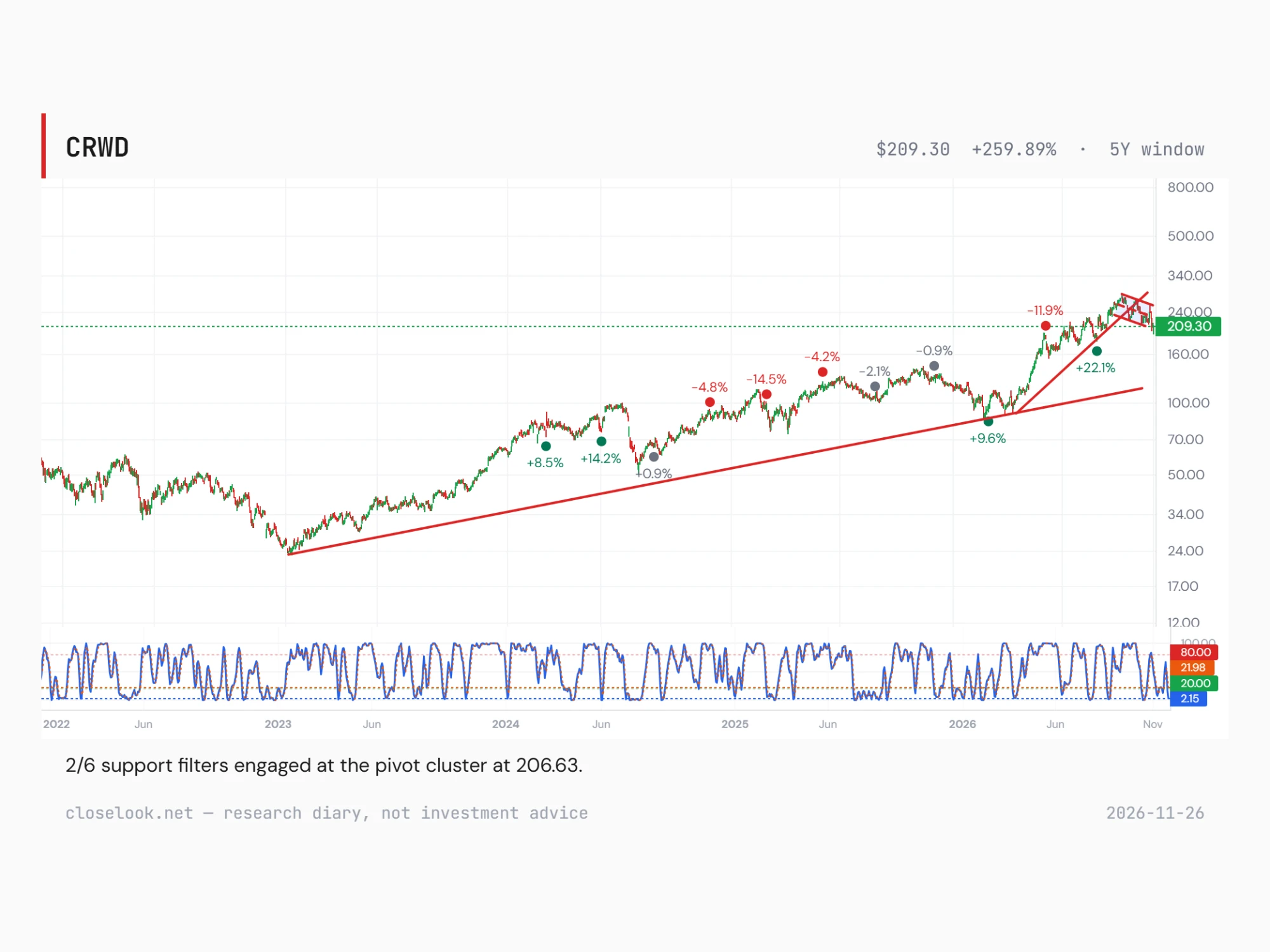
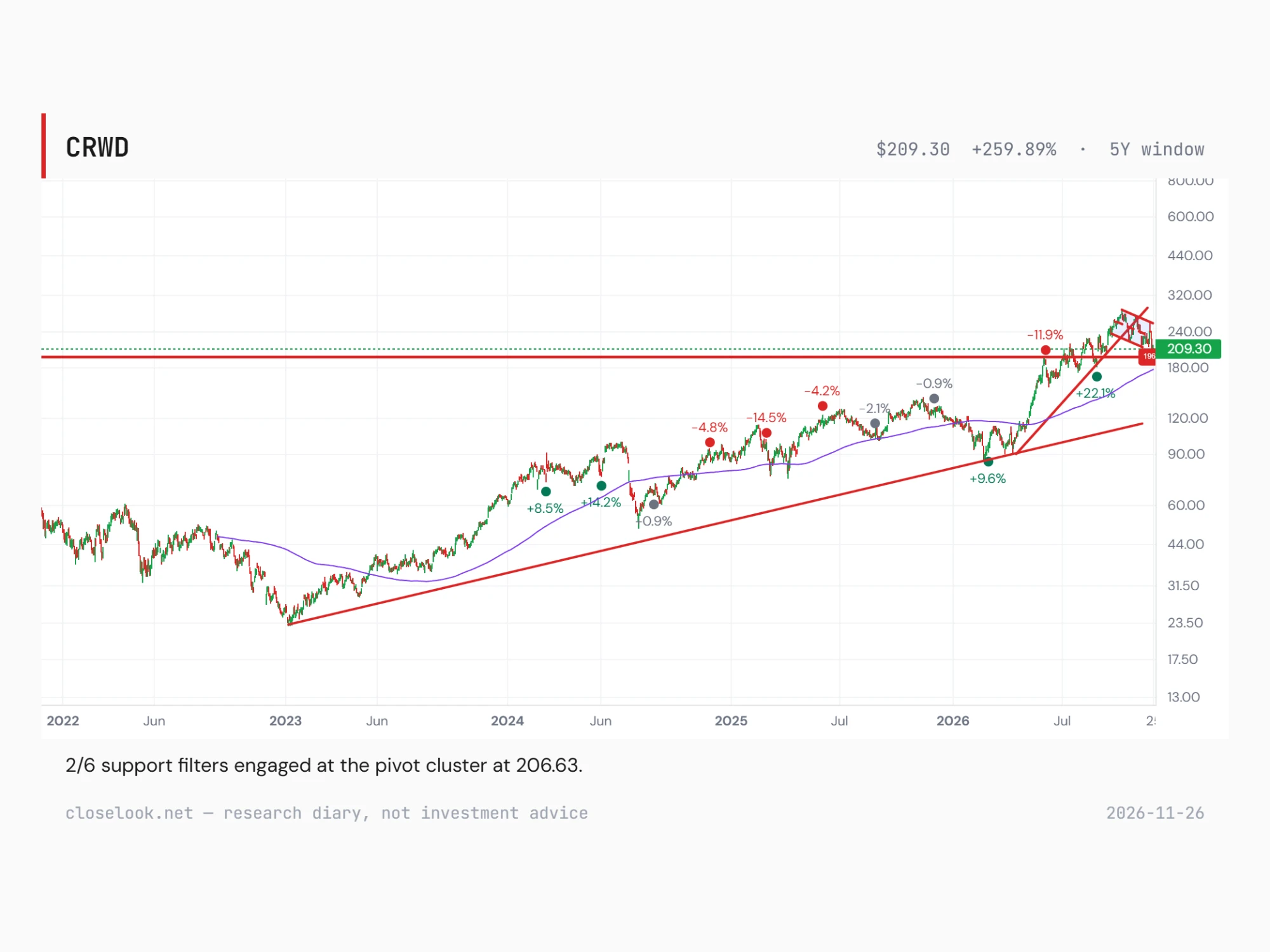
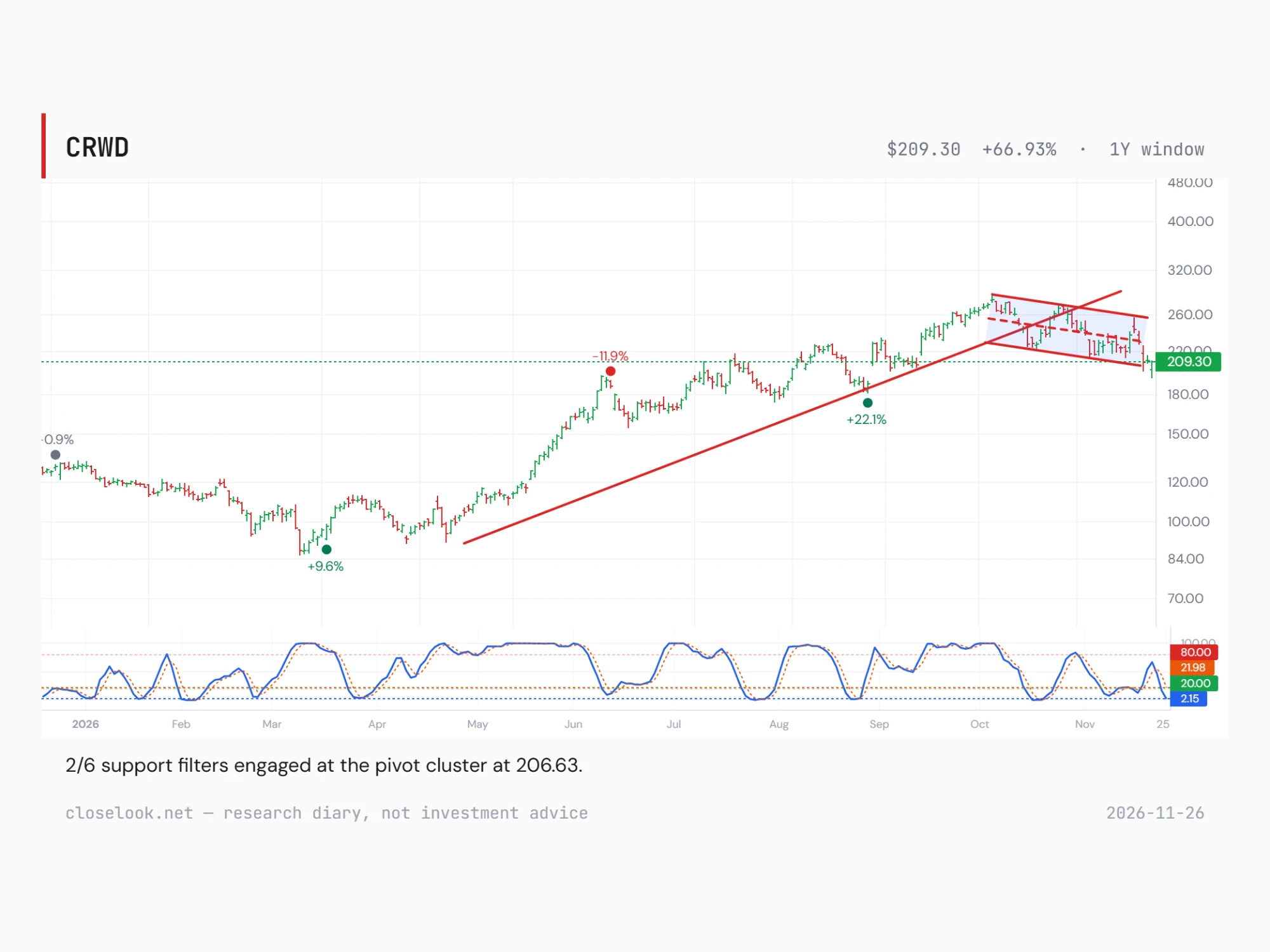
The chart. The intraday high was $286.99 on 6 October, the closing high $278.86 the same day. Wednesday’s close of $209.30 is $77.69, or 27.1%, below the intraday high. Since October the stock has traded inside a falling channel, and it now sits on the channel’s lower line, near $206. On Wednesday it fell to $194.70 during the day, under the $200 mark and under the editor’s red line at $196, the high of 1 June, and closed back above both. The stock has not closed under $200 since 26 August, the day of the August report. The stochastic on the editor’s chart, a measure of where the close sits in its recent range, reads 2 of 100.
What we do at this level (diary, not advice). The diary does not own the stock. The editor reads any dip toward $200 as a chance to add, in steps, because Wednesday showed the line can be crossed during the day. For a diary that prefers to spread the exposure, the editor’s three are this stock, Okta and Rubrik; with five, add Cloudflare and Palo Alto Networks. Two of the three report next week: Rubrik on Monday 30 November after the close, so Tuesday 1 December is its first trading day on the numbers, and Okta on Tuesday 1 December (company dates). The diary already holds two of the five: Cloudflare in the AI Buildout and Hypergrowth books, Rubrik in the AI Buildout book.
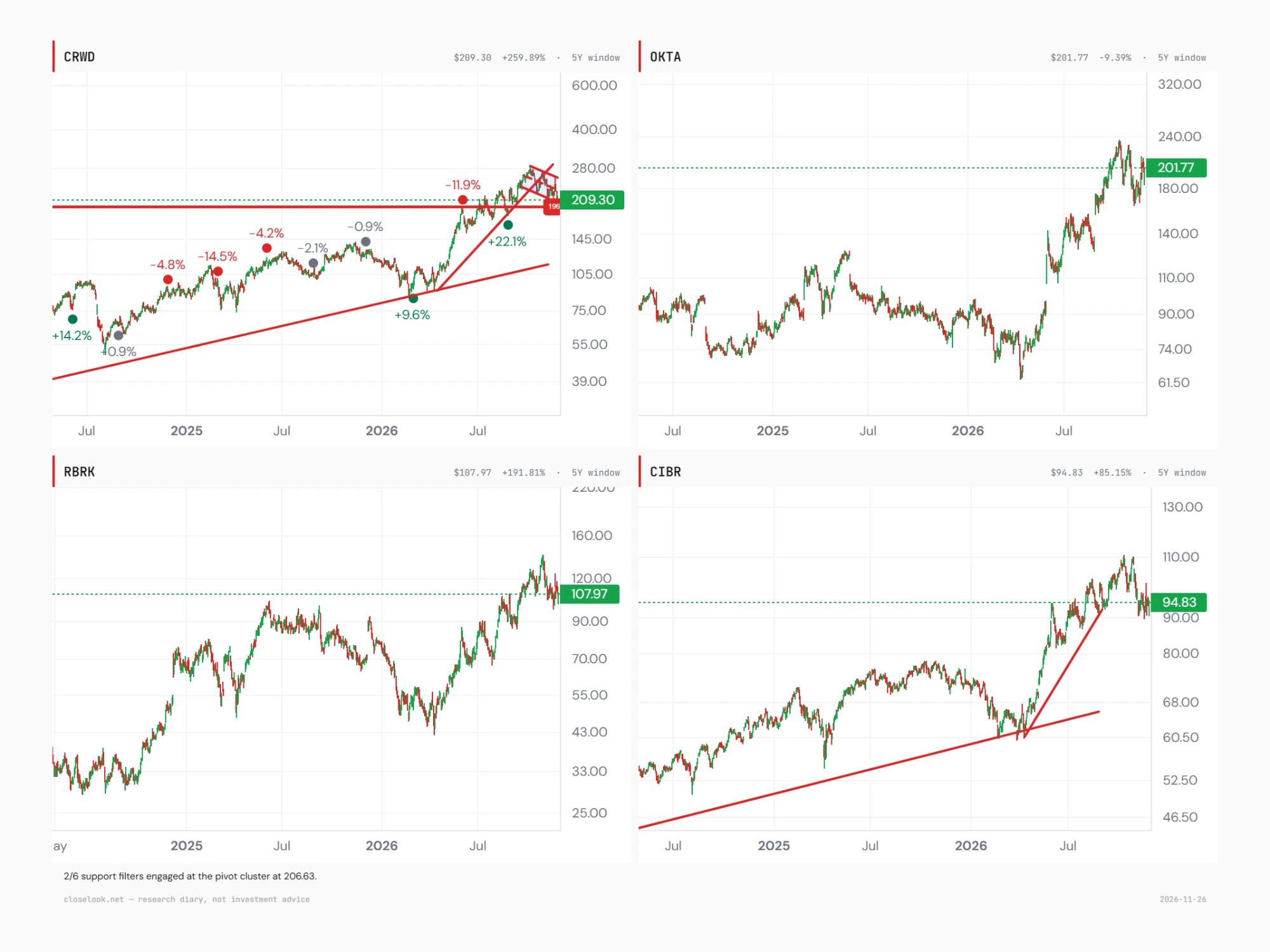
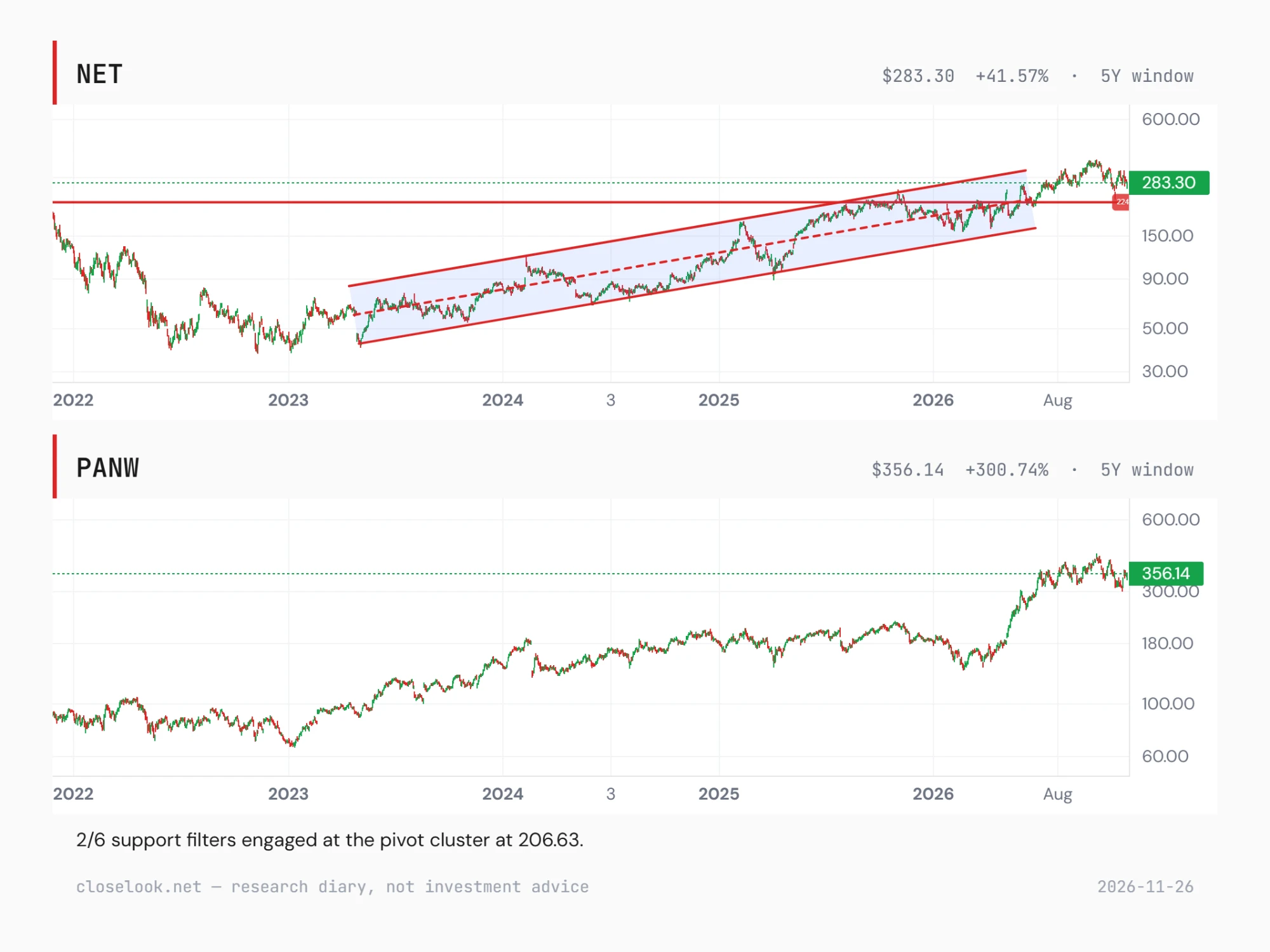
The other four, in numbers. Okta closed at $201.77, up 133.3% this year and 13.1% under its high close of 9 October. Rubrik closed at $107.97, up 41.2% this year and 20.6% under its high close of 28 October; on its earnings record the stock was sold after seven of ten reports. Cloudflare closed at $283.30, up 43.7% this year and 21.5% under its high close of 9 October; on the editor’s chart it broke above the channel it rose in from 2023 to 2026, and the red line at $224 marks the old top. Palo Alto Networks closed at $356.14, up 93.3% this year and 15.2% under its high of 6 October, after it beat and raised its outlook after the close on 18 November (earnings record). Since 6 October all four fell less than the pick: −7.7%, −14.2%, −20.2% and −15.2%, against −24.9%. In our Agentic Ecosystem index the pick, Palo Alto, Rubrik and Zscaler sit in the Agentic Security sector, Okta in Identity, Trust & Governance and Cloudflare in Edge & Distribution.
In the Closelooknet readings
Said plainly: this is CrowdStrike (Nasdaq: CRWD), the cybersecurity company behind the Falcon platform, software that started on the endpoint, the laptop and the server, and now also covers cloud workloads, identity, data and security operations. On 23 November it agreed to buy Zscaler (Nasdaq: ZS). It sits in our Agentic Ecosystem index, in the Agentic Security sector with Palo Alto Networks, Rubrik and Zscaler. The diary does not hold the stock; it holds two of the peers named below, Cloudflare and Rubrik.
52-week range (closes): 87.563 – 278.86
The latest print
Last report — Monday 23 November before the open, a week early. The company cancelled the call it had set for 1 December and reported with the deal. Revenue of $1.583 billion, up 28%, against about $1.53 billion expected; adjusted earnings of $0.34 a share against $0.31 (estimates: data vendor, as on our earnings record). ARR of $6.26 billion, up 27%; new ARR of $419.2 million, up 58%. Adjusted operating margin 26%, up from 21%; free cash flow $474.4 million, 30% of revenue; cash flow from operations $665.2 million. On the reported (GAAP) basis the company broke even: an operating loss of $0.8 million and net income of $24.9 million, $0.02 a share.
The outlook. For the quarter to 31 January 2027: revenue of $1,638.1 million to $1,644.1 million, adjusted earnings of $0.36 a share and ending ARR of $6,712.2 million to $6,716.2 million. For the full fiscal year: revenue of $6,078.1 million to $6,084.1 million and adjusted earnings of $1.28 a share. The company raised its guide for growth in new ARR this year by 10.6 points, to 45% at the midpoint (company release).
The reaction. Friday 20 November closed at $229.44. Monday opened at $217.63, fell as low as $200.53 and closed at $208.97, −8.9%. Tuesday closed at $210.86 and Wednesday at $209.30: −8.8% in three sessions. On our earnings record that is a beat on both lines that was sold, the fifth sold window in the eleven reports since June 2024; the August report had been paid with +22.1%.
Next report — early March 2027. The company has not set a date; last year’s fourth quarter came on 3 March 2026.
The fundamentals
Valuation at Wednesday’s close, the rest from the company release of 23 November. Prices in this edition are adjusted for the four-for-one split of 1 July 2026. The profile: growth near 30%, a free-cash-flow margin of 30%, almost no net debt, and a multiple that already prices years of both. Stock-based pay is the cost the adjusted numbers leave out: $372 million in the quarter, 23% of revenue.
The pick by the numbers
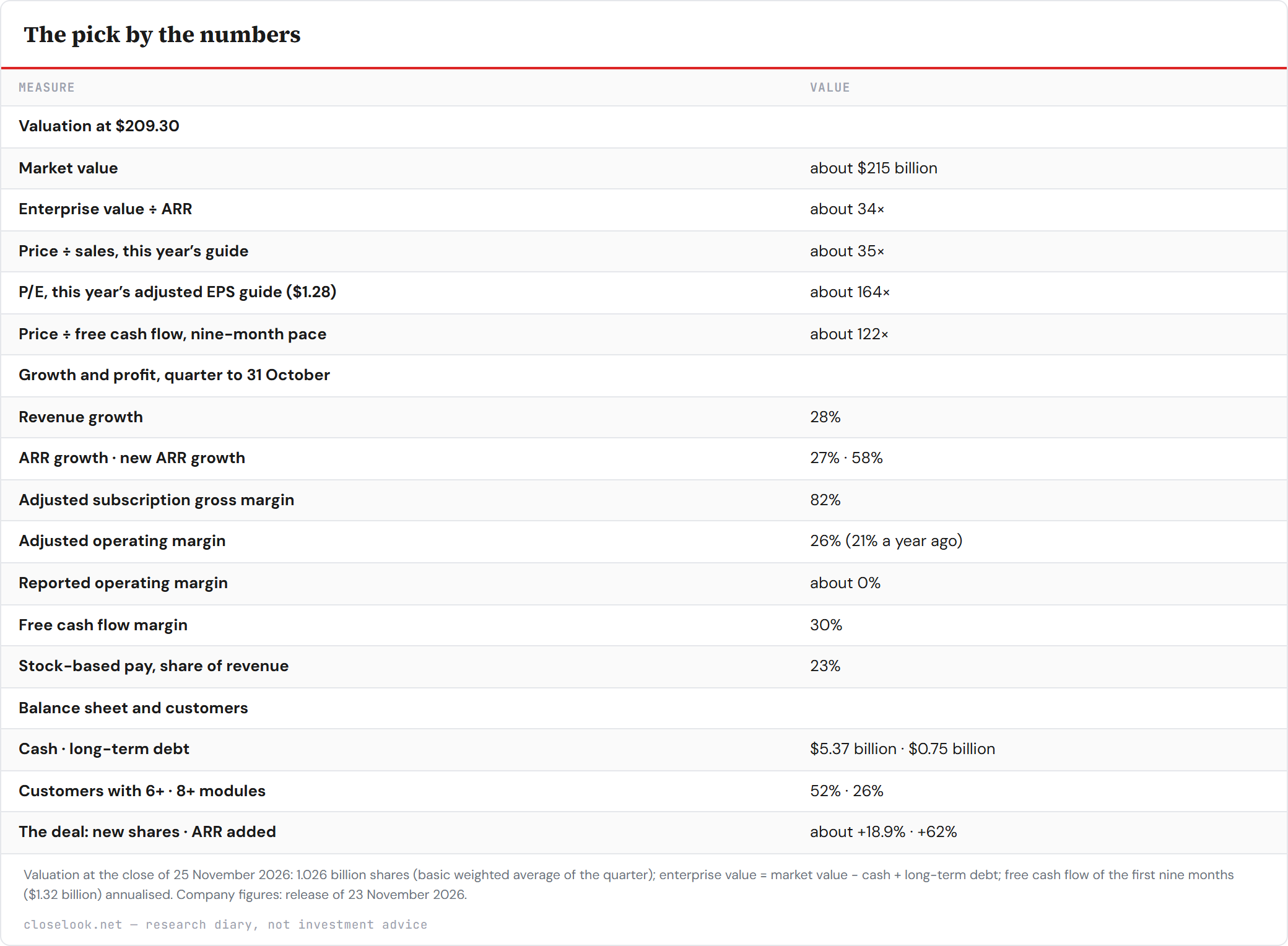
Table as text
| Measure | Value |
|---|---|
| Valuation at $209.30 | |
| Market value | about $215 billion |
| Enterprise value ÷ ARR | about 34× |
| Price ÷ sales, this year’s guide | about 35× |
| P/E, this year’s adjusted EPS guide ($1.28) | about 164× |
| Price ÷ free cash flow, nine-month pace | about 122× |
| Growth and profit, quarter to 31 October | |
| Revenue growth | 28% |
| ARR growth · new ARR growth | 27% · 58% |
| Adjusted subscription gross margin | 82% |
| Adjusted operating margin | 26% (21% a year ago) |
| Reported operating margin | about 0% |
| Free cash flow margin | 30% |
| Stock-based pay, share of revenue | 23% |
| Balance sheet and customers | |
| Cash · long-term debt | $5.37 billion · $0.75 billion |
| Customers with 6+ · 8+ modules | 52% · 26% |
| The deal: new shares · ARR added | about +18.9% · +62% |
Valuation at the close of 25 November 2026: 1.026 billion shares (basic weighted average of the quarter); enterprise value = market value − cash + long-term debt; free cash flow of the first nine months ($1.32 billion) annualised. Company figures: release of 23 November 2026.
Our company score reads 48 of 100: growth 79, momentum 71, quality 41. The quality module weighs reported profit, and on that basis the company only just broke even this quarter.
The chart, read by hand
Trend: Five-year view, log scale, prices adjusted for the July 2026 split. The long rising line runs from the January 2023 low near $23 through the February 2026 low near $86 and now sits near $118, far below. A steeper line from the April 2026 low near $91 through the August low near $181 carried the rise to the October high; the stock broke it in October. Since the high of 6 October, $286.99 during the day, the stock has traded in a falling channel, upper line near $257, midline near $228, lower line near $206 at Wednesday’s close. The editor’s red line at $196 is the high of 1 June: the stock broke above it in July and has not closed under $200 since 26 August. The dots mark the reaction three sessions after each report, from our earnings record; the report of 23 November, −8.8%, is not yet on the chart. The editor’s read: $200 is support, and a dip toward it is a chance to add.
Oscillators: The stochastic on the editor’s chart, computed on closing prices over 14 days, reads 2.15, with its signal line at 21.98: Wednesday’s close sat almost exactly on the lowest close of the last 14 days. The machine block below uses daily highs and lows and reads 19. Over the five years, readings this low came often and did not end trends by themselves; in 2026 they came near the February and April lows and in late August, before the +22.1% report reaction. The 14-day RSI, a slower gauge, reads 38, low but not extreme. The scanner marks a pivot cluster at $206.63, where 2 of its 6 support filters are engaged. The stock stands 14.7% under its 50-day average ($245.24) and 17.7% above its 200-day average ($177.82).
Elliott Wave count: No wave count drawn for this edition. The read rests on the falling channel from the October high, the June high at $196 and the round number at $200.
Key levels: $286.99 / $278.86 — the intraday and closing highs of 6 October · About $257 — the upper line of the falling channel; with the 50-day average at $245.24, the level a recovery has to take back to end the correction · $229.44 — the close of 20 November, the last before the deal and the report · $206.63 — the scanner’s pivot cluster, close to the channel’s lower line near $206 · $200 and $196 — the editor’s support: the round number and the high of 1 June; Wednesday’s low of $194.70 dipped under both, and the close came back above · $177.82 — the 200-day average; a close under $196 would put it in play
What the machines say
Technical snapshot (as of 2026-11-25) — vs 20d -8.9% · vs 50d -14.7% · vs 200d +17.7% · off 52w-high -27.1% · stochastic K 19 / D 27.7 · Resizing — 27.1% off its high
Pattern engine (scan 2026-11-25) — directional-flow 120/100, hot, decelerating up (5d -4.1%, 21d -8.0%)
Closelooknet scores (as of 2026-11-25) — composite 48/100 · momentum 71/100
Machine blocks render only where our engines actually cover the name — nothing is padded.
The risks, equal billing
What would prove us wrong. A close under $196, the June high, would turn the support back into a ceiling and put the 200-day average near $178 in play; the long rising line from 2023 sits much lower, near $118. The deal carries its own risks: a different business to integrate, a shareholder vote and regulatory approvals, and a closing that may take until January 2028. Until then, funds that trade the deal can keep selling the buyer, and the stock trades partly as the currency for Zscaler. The valuation leaves little room for a slip: about 164 times this year’s adjusted earnings and about 34 times ARR. Stock-based pay of 23% of revenue sits outside the adjusted numbers, and the reported operating margin is about zero. Costs of the July 2024 outage still run through the accounts, $11.3 million in the quarter. The group has two reports next week, Rubrik and Okta, and the Fed decides on 9 December with a hike priced. And the market itself is fragile: the Nasdaq-100 went into Thanksgiving 16.6% under its record (Daily Pulse of 26 November).
Our forecasts
Next 2–4 weeks: The editor reads $200 as support, and Wednesday’s dip to $194.70 was bought back the same day. The tests come fast: Rubrik reports on Monday 30 November after the close, Okta on 1 December, and the Fed decides on 9 December. A close under $196 would say the support has failed and point to the 200-day average near $178. A close above the channel’s upper line, near $257, would end the correction from October.
The deal, to closing in 2027: Until the deal closes, the stock trades partly as deal currency, and the gap between Zscaler’s price and 1.135 shares of the buyer measures the market’s doubt: 2.8% on Wednesday. A gap that widens would be the first sign that the market doubts approval; a gap that stays narrow leaves the stock to trade on its own numbers.
The report in early March 2027: The first outlook for the fiscal year to January 2028, with the deal pending. The bar is new ARR, guided to grow 45% this year. On our earnings record a beat has been paid for three times in eleven reports; a beat that is paid for would say the market has digested the dilution.
12 months: If $200 holds, the way back runs through the channel top near $257 and then the October highs, $279 to $287. The editor’s case is the platform: built out from the endpoint, with little legacy, now adding the network, and a business that grows near 30% with a 30% free-cash-flow margin. We keep this view until a close under $196 says otherwise.
Diary views, not advice — held publicly alongside the scored record.
Why publish this name? Because our Directional Flow readings are what let us say it: stocks with this or a similar setup have often — historically — done well over the following twelve months. That is the engine's backtested observation about the past, not a forecast; past performance may not be an indication of future performance. Which is exactly why every pick is scored publicly against the tape from today, at one week, one month, three, six and twelve. 12-month view, written 26 November 2026 from the close of 25 November ($209.30). Diary, not investment advice.
Closelooknet publishes an investment research diary, not investment advice. Every pick is scored publicly against the tape at 1w/1m/3m/6m/12m from publication — the record, not the single call, is the product.
Open the live CRWD terminal → All picks & the running record →
A note from the editor: the Weekly Chart Pick is free. Its price is one click — add Closelooknet as a preferred source on Google, and you support this work in Google Discover and Search every time you read.
Google opened in a new tab. Add Closelooknet there, then come back to this tab — the Chart Pick unlocks the moment you return.
The preferred-source setting lives in your Google account — if Google asks you to sign in first, you will land on the selection page right after. Google does not tell us whether you saved the selection. Clicking “Done” unlocks the Weekly Chart Pick on this device for 12 months.