Weekly Chart Pick · 2026-08-28
This company's software designs every AI chip that ships — it sat out the entire AI advance for a year, then flipped an overnight shrug into the week's cleanest double-digit payment
Five earnings verdicts landed Wednesday evening and four were settled by morning. This one was not: the after-hours tape read the quarter as a mild fade — then daylight repriced it up more than twelve percent, back through its 200-day average, the only print of the five to flip its own verdict overnight. The stock had gone sideways since early 2024 — a two-and-a-half-year box near the top of a secular uptrend that runs from the 2008 low — on a specific fear: that AI would disrupt chip design itself, a fear China's fully AI-designed QiMeng chip system made concrete. The quarter answered it: the company's own agentic AI design platform now runs in over 30 customer projects and increases usage of the underlying tools, the Ansys integration is delivering synergies ahead of plan, and the year was raised — revenue to $9.69–9.74 billion, EPS to $15.04–15.10.
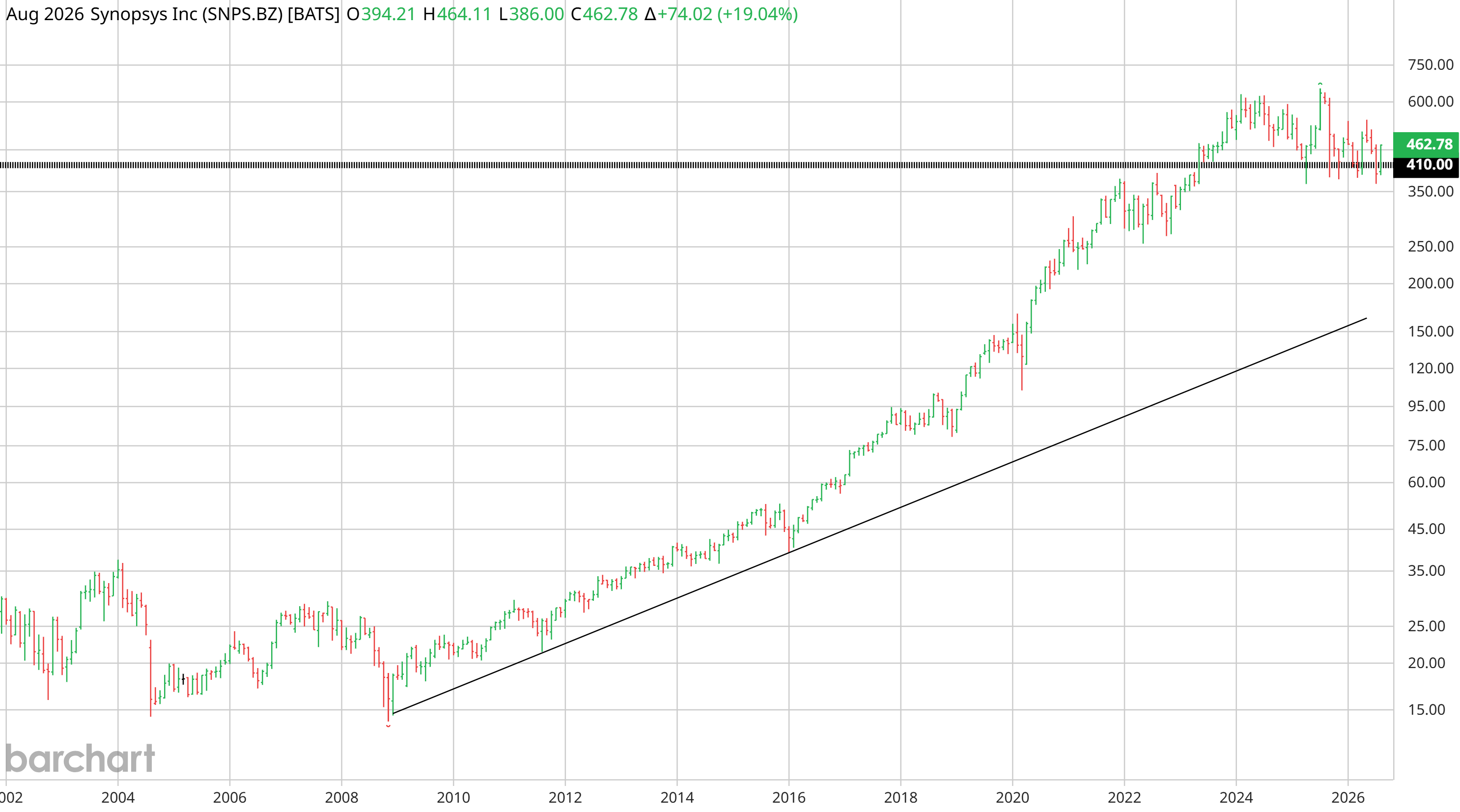
- The secular frame: a long-term uptrend from the 2008 low that price has never returned to — then, from early 2024, a two-and-a-half-year sideways box roughly between the 380 area and the mid-2025 record high. Long trend up, then sideways — and the sideways phase may now be over.
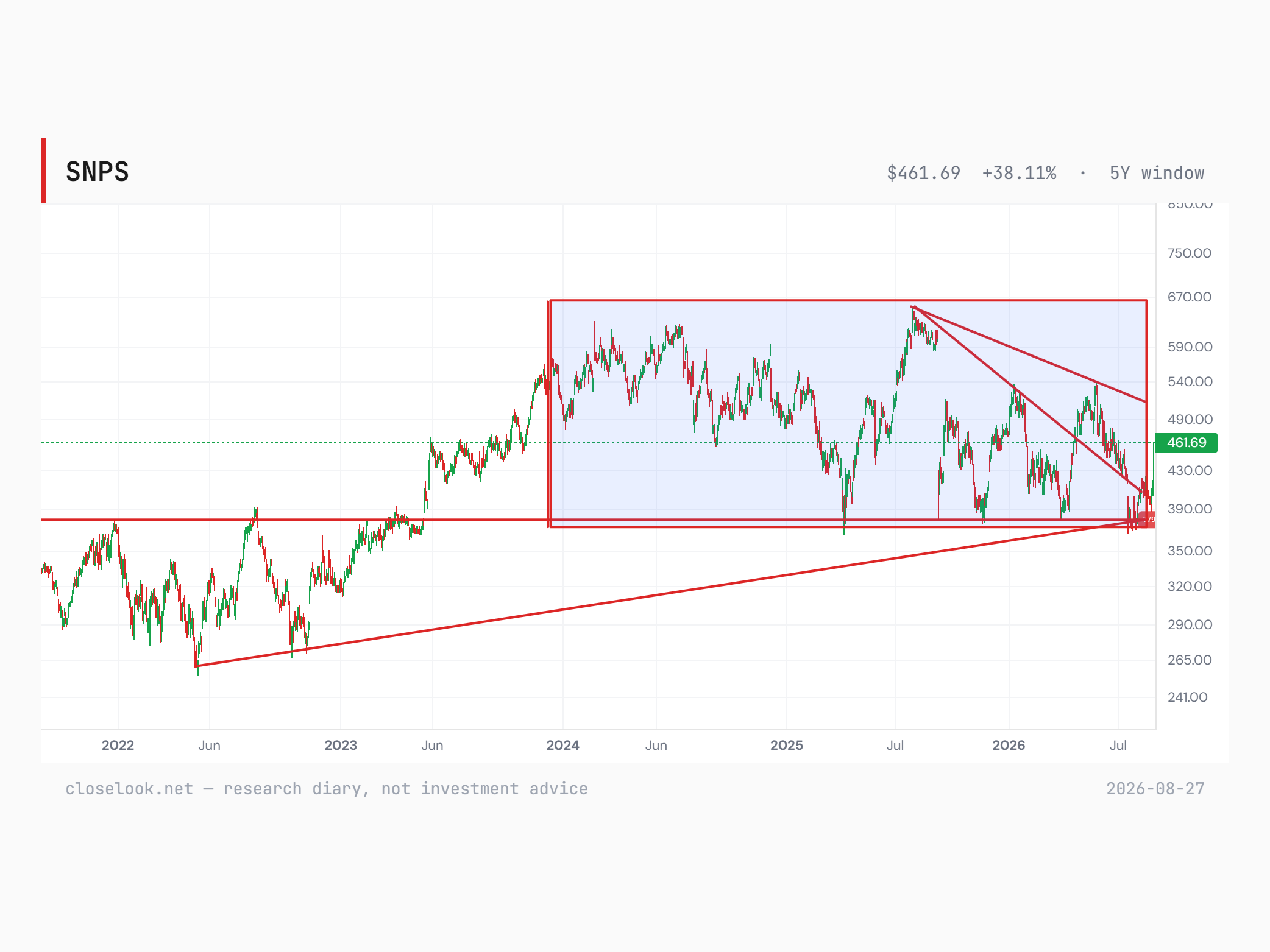
- Inside the box, a falling wedge: descending trendlines from the mid-2025 high converging near the summer 2026 lows at the box floor, where they meet a rising line carried up from the 2022 low. Thursday's verdict flip broke price up and out of that descending structure.
- The fear that built the box has a name: QiMeng, the Chinese Academy of Sciences' fully AI-driven chip-design system, unveiled in mid-2025 explicitly to cut reliance on US design tools — the wedge dates from the same summer.
- The print answered the fear with monetization: an agentic AI platform running in 30+ customer projects that increases usage of the underlying EDA tools, and the first joint product with the simulation company it acquired showing up to 10x faster design completion in early customer validations.
- The engine's honest read: Directional Flow still printed −12.1, flow accelerating-down, at the last pre-print scan. The payment front-ran the engine; tonight's rescan is the first confirmation check.
SNPS Synopsys last close 464.89 (2026-08-27)
The Setup
Wednesday evening put five earnings verdicts on the tape at once — Nvidia, Salesforce, CrowdStrike, HP and this name. Four were settled within hours: three payments, one punishment. This one was different. The after-hours tape read the quarter as a mild fade, and then Thursday's daylight session repriced the same information up more than twelve percent, through the 200-day average — the only one of the five prints to flip its own verdict overnight.
The chart explains why the bar was set so low. The long-term trend is a secular advance from the 2008 low that price has never revisited. But from early 2024 the stock went sideways — a two-and-a-half-year box near the top of that advance — while the compute layer it designs for carried the entire AI leg. The box had a specific fear inside it: that AI would disrupt chip design itself. That fear stopped being abstract in mid-2025, when the Chinese Academy of Sciences unveiled QiMeng, a fully AI-driven processor-design system built explicitly to cut reliance on US design tools. The falling wedge on this page's chart — descending trendlines from the mid-2025 record high, converging at the box floor — dates from that same summer.
Wednesday's quarter is the counter-argument, in numbers. The company is not being disrupted by AI chip design — it is selling it: an agentic AI platform that automates chip engineers' workflows now runs in more than 30 customer projects, and management's telling detail is that it increases usage of the underlying design tools. One layer down, Nvidia guided fiscal 2028 to roughly 70% growth and called the number supply-constrained — and every accelerator in that guide, and every custom chip designed to compete with it, passes through design software this company splits with exactly one major rival. A supply-constrained chip cycle is, one layer up, a design-demand cycle.
The sharpest way to say what happened: all three disputed parts of the thesis improved at once. EDA accelerating, Design IP recovering, Ansys creating incremental products — each had been a separate reason to sit the name out, and Wednesday removed all three in a single print. That reads, in our view, less like an earnings-beat rally than a risk-removal and multiple-restoration rally: the market moved from “Ansys integration risk plus structurally impaired IP plus possible AI disruption” toward “a broader AI-design toll booth whose content per chip is rising.” And the print opened an option the old thesis never carried — customized IP migrating from licence-and-NRE revenue toward licence plus royalties, with possible consumption pricing for agentic design work on top. Management says it will quantify more of that at its 30 September Investor Day.
In the Closelooknet readings
In-universe on this one: Synopsys is a Rubin 100 constituent, so the Directional Flow reading comes straight from the nightly engine rather than a hand calculation. The honest part: at the last pre-print scan (August 26) the engine still read −12.1 on the raw scale, flow tagged accelerating-down, deltas −1.3 over five days and −5.0 over 21 — only the three-month delta (+1.0) had turned. Thursday's repricing front-ran the engine by a full session — and the first post-flip rescan (August 27, Thursday's bar included) still prints −12.2, flow unchanged at accelerating-down, deltas −1.2 over five days and −4.7 over 21. One +11.7% session does not move a 63-day construction. The divergence stands, and we publish it as a divergence rather than smoothing it over. What the reversal has going for it structurally: price reclaimed the 200-day (446.06) and sits about 11% over the 50-day (417.06), and the slow stochastic turned up from mid-range rather than overbought. What it lacks: a positive Directional Flow print.
52-week range (closes): 372.33 – 612.17
The latest print
The third quarter of fiscal 2026 printed Wednesday, 26 August, above the high end of the company's own guidance. Revenue came in at $2.477 billion against a $2.44 billion consensus, up 42.4% from $1.740 billion a year earlier — a growth rate carried by the Ansys acquisition now inside the base. Non-GAAP EPS of $3.91 beat the $3.67 consensus by roughly 6.5% and stands 15.3% above the year-ago $3.39. The segment detail: Design Automation — the EDA tools plus Ansys — reached $2.00 billion, up 52.7%, about 81% of revenue, with Ansys contributing roughly $711 million; Design IP returned to growth at $473.8 million, up 10.8%, after a weak first half. Non-GAAP operating margin of 41.6% came in above management's own forecast on cost discipline and Ansys synergies running ahead of plan. Backlog stands at $10.9 billion.
The full year was raised: revenue to $9.69–9.74 billion (Ansys contributing roughly $2.98 billion), non-GAAP EPS to $15.04–15.10 — up $0.31 at the midpoint — and operating margin near 41.5%; the fourth-quarter guide is $2.53–2.58 billion and $4.10–4.16, with core EDA growth guided to reach double digits.
What changed investors’ minds runs deeper than the beat. Design IP — the division that had been the principal disappointment, with the worry that weakness around a major foundry customer was structural — returned to growth on broad AI-infrastructure demand, with management citing more than 100 cumulative die-to-die wins and 25 LPDDR6 wins. Core EDA grew 8.5% against a hard 16% comparison from a year earlier — accelerating into a double-digit organic guide rather than slowing, directly against the fear that the AI design cycle had peaked. And the Ansys bet started looking strategically right rather than merely accretive: the full-year contribution raised to roughly $2.98 billion, cost synergies running ahead of schedule, and the first combined product — Multiphysics Fusion, thermal and physical simulation integrated into the chip-design flow — expected to contribute revenue from 2027.
Three quieter details carry the thesis further. Management said its earlier expectation that multi-die designs could drive roughly 30% of EDA software demand has accelerated — advanced packaging, custom silicon, HBM and 3D integration all add die-to-die IP, verification, thermal analysis and system-level simulation, exactly where the combined portfolio sits. Non-AI chip-design starts have stabilized over the past two quarters while AI-related starts keep accelerating — removing the offset that had been draining the AI strength out of the aggregate. And full-year free-cash-flow guidance now stands near $2.6 billion. The market's first read of all this was a fade of one to two percent after hours. Its second read, twelve hours later with Nvidia's supply-constrained 70% guide in hand, was a double-digit payment, with analyst reiterations following the same morning. The print-record card logs both reactions.
The fundamentals
The business is a toll booth on chip design. Electronic design automation is an effective duopoly — this company and Cadence — with switching costs measured in engineering careers: chips are designed, verified and taped out inside these tools, and no advanced semiconductor ships without passing through them. The moat is not the license price; it is that the world's chip designers are trained on the platform.
Three engines, and two of them just changed character. Core EDA grew 8.5% this quarter with record hardware-assisted verification demand and double digits guided for the fourth quarter — and the agentic AI platform layered on top of it turns the AI-disruption threat into a consumption flywheel: agents designing chips still run the company's tools, only more of them, across 30-plus customer projects already. Ansys — the largest acquisition in the company's history — is delivering synergies ahead of plan, contributed roughly $711 million this quarter, and produced its first jointly built product: Multiphysics Fusion, showing up to 10x faster design completion in early customer validations, with management pointing to accelerated growth from fiscal 2027. Design IP ($473.8 million, up 10.8%) is the quiet third engine — a seat at the table of every custom-silicon program at every hyperscaler.
At roughly $88 billion of market value against $9.7 billion of guided revenue and a 41.5% operating margin, this is priced as what it is: infrastructure software with a monopoly-adjacent position — which is why the setup here is the reversion in the chart, not a discovery story in the multiple.
The chart, read by hand
Trend: Two charts, one read. The monthly: a secular uptrend from the 2008 low — a rising line price has never come back to — that carried the stock from the mid-teens to the mid-2025 record high; from early 2024 the advance went sideways, a two-and-a-half-year box near the top of the trend, floor in the 380 area. Long trend up, then sideways — and the sideways phase may now be over. The five-year chart shows why: inside the box, descending trendlines from the mid-2025 high converge at the summer 2026 lows, right where a rising line from the 2022 low arrives — a falling wedge compressing onto support. Thursday's verdict flip broke price up and out of that descending structure, back through the 200-day, in one session.
Oscillators: Slow stochastic 69.9 / 47.1 — K over D, rising out of mid-range, not yet overbought. Directional Flow −12.1 at the last pre-print scan, flow accelerating-down, delta63 +1.0 the only positive window — the engine lags the tape by construction on a gap day; tonight's rescan is the first true post-print reading.
Elliott Wave count: No formal count on this one — the frame is the secular trend plus the 2024–2026 consolidation: long trend up, then sideways, possibly over. The wedge break is the trigger; the box top near the mid-2025 record high is the confirmation zone.
Key levels: 366 — 52-week and spring low, the box floor's undercut · 380 — the box floor zone (early-2024 support shelf) · 410 — pre-print close, the unwind line · 417.06 — 50-day average · 446.06 — 200-day average, reclaimed on the print day · 480 — January anchor, the YTD flat line · 615.79 — 52-week high; the mid-2025 record high above it is the box top and confirmation zone
What the machines say
Technical snapshot (as of 2026-08-28) — vs 20d +13.8% · vs 50d +11.4% · vs 200d +4.1% · off 52w-high -28.7% · stochastic K 71 / D 47.4 · Up 13.4% at the close
Pattern engine (scan 2026-08-27) — directional-flow -12/100, neutral, accelerating down (5d -1.2%, 21d -4.7%)
Machine blocks render only where our engines actually cover the name — nothing is padded.
The risks, equal billing
One session does not repair two and a half years. The stock remains roughly 25% under its 52-week high after the repricing, and the box since early 2024 is broken only if the breakout holds on closes — a fall back under the pre-print close of 410 would unwind the verdict flip and put price back inside the wedge.
The disruption fear is not imaginary. QiMeng's published processors sit at the trailing edge (its second version is comparable to an Arm Cortex-A53-class core, far from leading-edge design), but the direction of travel is the point of the fear — and China's push to design around US tools is also a revenue question, since export controls already touch the EDA layer directly and have moved this stock hard before.
The engine disagrees, for now. Directional Flow read −12.1, accelerating-down, into the print — Thursday's payment front-ran the engine, and if the nightly rescans stay negative while price holds, that divergence resolves one way or the other. And the 42.4% headline growth is acquisition-carried: the organic EDA line is single-digit until the guided fourth-quarter acceleration actually prints; the Ansys margin story is the largest integration the company has attempted.
The restored multiple now has a date attached. If Thursday was primarily risk-removal and multiple-restoration rather than an earnings-beat rally, the burden shifts to the 30 September Investor Day: the long-term targets have to justify a valuation the market handed back in one session. A restored multiple with no quantified royalty-and-consumption story behind it is a gap the tape can re-open.
Our forecasts
12 months from now: Higher, in our view — the reversion case: a year of underperformance against the layer it designs for, organic EDA guided to double-digit growth, and a supply-constrained chip cycle that is, one layer up, a design-demand cycle. Conditional on the 200-day reclaim holding and the Directional Flow print turning.
5 years from now: The duopoly position compounds, in our view — every custom-silicon program at every hyperscaler is a new seat at the toll booth, AI-assisted design increases the compute spent inside these tools rather than replacing them, and Ansys extends the platform from chip design into full-system simulation. Meaningfully higher, if the design layer's moat survives AI-native entrants — the risk we would re-examine annually.
Diary views, not advice — held publicly alongside the scored record.
Why publish this name? Because our Directional Flow readings are what let us say it: stocks with this or a similar setup have often — historically — done well over the following twelve months. That is the engine's backtested observation about the past, not a forecast; past performance may not be an indication of future performance. Which is exactly why every pick is scored publicly against the tape from today, at one week, one month, three, six and twelve.
Closelooknet publishes an investment research diary, not investment advice. Every pick is scored publicly against the tape at 1w/1m/3m/6m/12m from publication — the record, not the single call, is the product.
Open the live SNPS terminal → All picks & the running record →
A note from the editor: the Weekly Chart Pick is free. Its price is one click — add Closelooknet as a preferred source on Google, and you support this work in Google Discover and Search every time you read.
Google opened in a new tab. Add Closelooknet there, then come back to this tab — the Chart Pick unlocks the moment you return.
The preferred-source setting lives in your Google account — if Google asks you to sign in first, you will land on the selection page right after. Google does not tell us whether you saved the selection. Clicking “Done” unlocks the Weekly Chart Pick on this device for 12 months.