C+

Weekly Signal · · 17 min read

The National-Security Discount

Weekly Signal · Special Edition
Sunday, June 14, 2026 · Special / Thematic

The National-Security Discount

When “Made in America” stops being a moat and starts being a liability.
Regime Health31 / 100 · Compromised
ConvictionHigh
CoverageWhole US stack
Time-to-priceBegins now
The national-security perimeter goes up around US technology
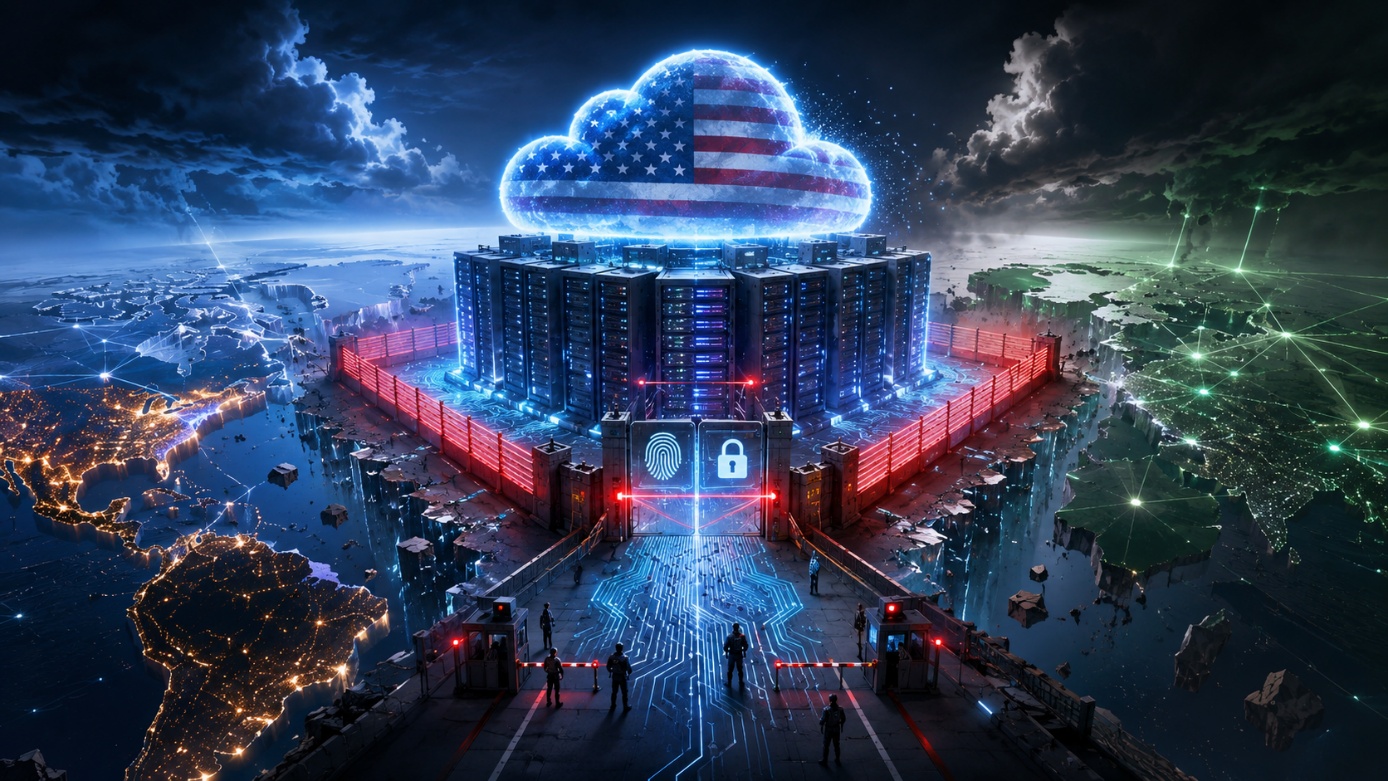
Editorial illustration: a glowing US-flag cloud hovering over a fortified, red-walled data-centre fortress with a fingerprint-and-padlock security gate and armed guard silhouettes, the world map lit around it — US technology walled behind a national-security perimeter.
US technology, walled behind a national-security perimeter: a flag-stamped cloud, a fortress of compute, identity gates at the door, and the rest of the world lit up on the other side of the wall. Illustration: Closelooknet.

⚡ The Signal — in one line

For two years the market priced US technology on the assumption that anything built in America could be sold to everyone.

Three developments now say that assumption may be dead — and a frictionless-global premium may be repriced into a permissioned-access discount across the entire US commercial stack, not just AI.

🚦 Headline Gauge

Regime under watch: the global-scale premium on US commercial output.

ReadingScoreVerdict
“Build once, sell everywhere” premium — Regime Health31 / 100🔴 Compromised
Thesis conviction (the discount is real, broad, and durable)High
Time-to-priceBegins now; one pillar is already legislated

Polarity note for this special: the gauge scores the health of the valuation regime, not a price target. 🟢 = the frictionless-global assumption holds; 🔴 = it no longer holds and multiples must adjust. A low reading is the warning, not the trade.

This is a regime call, not a stock call. In this house, regime selection has always mattered more than any single model, name, or quarter — it is the larger source of both risk and edge. What changed is not a company. It is the regime the entire US technology complex operates inside.

The thesis in three pillars

The mistake is to read last week as an AI story. It is a US-commercial-output story with three reinforcing legs:

1

Supply side — universality of designation. It is no longer just chips and GPUs. Any US product, service, platform, API, workflow, model, software feature, or commercial capability can be moved into the restricted bucket the moment Washington deems it strategic. The category is not “AI.” The category is “anything the United States controls and chooses to control further.”

2

Identity — the firewall is gone. The new restriction reaches not only foreign countries but foreign nationals working inside the United States, for US companies — including a company’s own non-citizen employees. A “domestic transfer” now needs a license. That converts an export-control question into an identity-based access-control regime, and it means even the domestic market and a firm’s own workforce are now permissioned, not open.

3

Demand side — trust is already walking. And here is the part that does not require Washington to ever act again: even if the US never reclassifies another product, the rest of the world no longer trusts that it won’t. That single realization is enough. Governments, enterprises, and buyers are already legislating, budgeting, and migrating away from US dependency — Microsoft, US cloud, US SaaS, US infrastructure. The demonstrated possibility of restriction is itself the catalyst for diversification.

Stack all three filters — lost foreign markets, lost foreign-national access, lost trust — and the conclusion is mechanical:

If the realistically serviceable market is only ~25% of the global market the multiples were built on, the multiples must come down. Not cyclically. Structurally.

Level 1 — Regime · What rules are we playing under?

The old regime for US technology was the most benign in the history of capitalism: build once, deploy globally, sell everywhere, add users at near-zero marginal cost, expand margins as usage scales, and let the whole world treat US infrastructure as neutral plumbing. That regime is the foundation of every premium multiple on every US technology balance sheet.

The hardware layer left that regime years ago — chips, equipment, compute caps, geo-tracking. Investors learned to discount silicon for control risk. The working assumption was that the control stopped at the wafer.

It did not. Control has now jumped the wafer and can attach to any layer of any US commercial product, and the gating variable is no longer geography alone — it is identity and government permission. When access can be suspended by nationality, including inside the US, and when foreign buyers can pre-emptively walk to avoid the risk, US technology has left the open-distribution regime entirely.

A regime change is precisely the event that invalidates a model built for the prior regime. Every premium multiple on US tech is a model fit to the old regime. It is now mis-specified.

Regime read: 🔴 broken — open distribution has given way to permissioned access plus a trust exodus.

Level 2 — Trend · One-off or direction?

The direction is the whole point.

2022–2024: controls concentrated on silicon — advanced ICs, manufacturing equipment, compute thresholds.

Through 2025–early 2026: Europe’s “digital sovereignty” talk hardened into procurement and law — GDPR enforcement, the CLOUD Act problem, sovereign-cloud budgets.

Jan–Jun 2026: the European Parliament passed a tech-sovereignty resolution by a wide margin; France’s digital directorate ordered every ministry to plan the elimination of non-European digital dependency by autumn 2026 and began migrating its own workstations off Windows; multiple German states mandated migration off Microsoft 365; the EU proposed a Cloud and AI Development Act that would bar US hyperscalers from the most sensitive government contracts purely on jurisdictional grounds; sovereign-cloud spend is running sharply higher year-over-year.

2 Jun 2026: a US executive order pulled frontier-model release inside a national-security review frame.

12 Jun 2026: the frame produced its first concrete software-side action — a Commerce export-control directive on two specific models, gated by nationality, requiring a license even for domestic transfer.

Two vectors are converging: the US pushing control up the stack, and the rest of the world pulling away from US dependency. Neither points back toward the old regime. They compound.

Trend read: 🔴 escalating, two-sided, and structural — not episodic.

Level 3 — Health · How sound is the thing being repriced?

The businesses are mostly excellent. That is not the question. The question is the quality of the multiple, not the quality of the company.

A premium multiple is a capitalized claim on unrestricted future scale. It assumes the serviceable market equals the global market. The three pillars each carve into that assumption:

The supply-side pillar says the product can be restricted from selling into part of the world. The identity pillar says part of the domestic market and the firm’s own workforce are now permissioned. The demand-side pillar says the world will voluntarily leave even where it is not pushed.

Each filter shrinks the reachable market. Together they do not trim it — they collapse it.

The question every premium US business now inherits is no longer “Can we sell this globally?” It is: “Who is allowed to access this, from where, under which passport, for which use case, in which sector, under whose permission — and who is choosing to walk away regardless?”

Health read: 🟡 businesses sound; valuation architecture fragile.

Level 4 — Context · The catalysts

The supply + identity proof-of-concept. On 12 June 2026, the US Commerce Department, citing national-security authorities, ordered Anthropic to suspend access to its two most advanced models — Fable 5 and Mythos 5 — by any foreign national, whether inside or outside the United States, including the company’s own foreign-national employees. Per the letter, a license was required even for the domestic transfer of those models. To comply with a directive of that scope, Anthropic disabled both models for all customers; the firm called it a misunderstanding and is working to restore access. Read it not as an AI footnote but as a template: a software capability, reclassified overnight, gated by nationality, reaching inside the United States.

The demand-side reality, already in motion. This did not land in a calm world. A widely-circulated June 2026 timeline documented more than 200 European governments, corporations, universities, and institutions that have already moved or begun moving off US providers — Microsoft, Google, Amazon, GitHub — since 2024. France’s interministerial digital directorate has ordered every ministry to plan elimination of non-European digital dependency by autumn 2026, starting with its own migration off Windows. The EU has proposed legislation that would exclude US hyperscalers from the most sensitive government workloads on jurisdictional grounds alone — explicitly “not because of anything those companies have done wrong,” but because of US law. Sovereign-cloud spending is compounding at a high double-digit rate. Microsoft has conceded under oath that it cannot guarantee data sovereignty against a US legal injunction.

The two combine into the point of this special: the US just demonstrated that it will reach into software and into its own borders by nationality — at exactly the moment the rest of the world had already decided it could no longer assume US neutrality. One side supplies the precedent; the other supplies the exit.

Context read: live, named, legislated, and self-reinforcing.

Level 5 — Timing · Is it priced? When does it bite?

It is barely priced. Most of the US technology complex is still carried on a global-TAM assumption — global enterprise rollout, global consumer scale, global developer usage, global cloud distribution. The repricing to a serviceable, permissioned, trusted-jurisdiction TAM has not happened.

The arithmetic is the uncomfortable part, and it is the heart of the call. Stack the filters — foreign-market restriction, foreign-national restriction (including inside the US), use-case and sector gating, plus voluntary buyer flight — and the realistic serviceable market may be on the order of a quarter of the global market the multiples were priced on. A premium multiple is the price of expected reachable scale. Cut reachable scale toward 25% and the scale-dependent portion of that multiple has to be marked down with it. That is not a cyclical wobble. It is a structural re-rating.

Timing runs on two clocks:

The event clock is fast and reversible. The specific Anthropic suspension may be restored within weeks; a single restriction lifting buys a relief bounce.

The trust clock is slow and one-way. Once governments and enterprises have seen that US access can be suspended overnight — and have started legislating and budgeting around it — the migration does not reverse when one order is lifted. The European sovereignty programs are multi-year and now have political and legal momentum independent of any single US decision.

The trade is the gap between a market still pricing the event clock and a world now governed by the trust clock.
Timing read: 🟡 early — the world has begun repricing; the multiples have not.

Level 6 — Decision · Posture

This is not advice. It is the positioning logic applied to our own reference portfolios, where we keep skin in the game.

Posture: demand a discount for the global-scale premium on US commercial output — broadly, not just in AI

  • Separate the premium from the business. Own the cash flows; question the portion of the multiple that is a pure frictionless-global assumption. That portion is what now carries the discount, and it sits in far more names than the obvious AI ones.
  • Re-underwrite on serviceable, permissioned, trusted-jurisdiction TAM. Any thesis that reads “global adoption, rising ARPU, margin expansion, new upgrade cycle” must be re-checked against a world that can restrict access and one that is choosing to leave. Where the growth story leans on access that can be restricted or trust that can be withdrawn, the multiple is too high.
  • The most exposed names are not the most commoditized — they are the ones whose entire premium rests on unrestricted, globally-trusted distribution of US-controlled technology. That includes the embedded-dependency incumbents (US hyperscale cloud, US productivity and enterprise software) precisely because they are the targets of the sovereignty migration.
  • Watch for the mirror-image beneficiary. A trust exodus is a reallocation, not pure destruction. Non-US and sovereignty-aligned providers, ex-US infrastructure, and “trusted-jurisdiction” alternatives sit on the other side of the same flow. The barbell’s ex-US leg is doing real work here.
  • Hold the hardware/software distinction we already drew, and extend it. The silicon was discounted for control risk long ago; that is why semis and software have been diverging rather than trading as one “tech” block. This special extends the same logic across the whole US commercial stack: the discount the chips already wear is now being fitted to software, cloud, and services.
Decision read: trim the US global-scale premium, keep the cycle, fund the trusted-jurisdiction other side.

Level 7 — Risk · What invalidates this signal?

Conviction without the counter-case is just narrative. The thesis is wrong, or early, if:

The counter-case

  • The 25% is too aggressive. A 75% cut to reachable TAM does not mechanically equal a 75% cut to the multiple — surviving permissioned markets may carry higher margins, much value sits in the installed base rather than future TAM, and switching costs are real. The direction (multiples down) is robust; the magnitude is the live debate.
  • The migration is slower than the headlines. US hyperscalers still hold roughly 70% of the European cloud market, and untangling embedded workloads is a multi-year effort. Plans for autumn 2026 are plans, not completed migrations; full deployment may not arrive before the end of the decade.
  • The trust damage is not US-specific. The CLOUD Act reaches any company with US operations — including some European providers — so “sovereign” alternatives may be less clean than advertised, blunting the exodus.
  • Capability commoditization defangs the supply-side control. If restricted capabilities are widely available elsewhere, designations become unenforceable and distribution stays effectively global.
  • The premium was never truly global. For names already concentrated in the US and trusted allies, there is less global TAM to discount.
Risk read: the event is reversible and the migration is slow; the variable to watch is the trust clock, not the news cycle.

📊 The Instrument — National-Security Discount Exposure Matrix

Purpose-built for this special, and broadened beyond AI. Each layer scored 0–100 on insulation from the combined discount (supply-side designation + identity reach + demand-side trust flight). 🟢 high score = insulated; 🔴 low score = exposed. Editorial judgment under the framework, not a data series.

Insulation score (0–100) · lower = more exposed
National-Security Discount Exposure Matrix — horizontal bar chart of insulation scores (0-100) across the US commercial stack: Frontier AI 18, Hyperscale cloud 22, AI-native apps 28, Enterprise software 30, Cybersecurity 34 (all EXPOSED); Developer tooling 40, Dual-use industrial 44, Consumer software 46, Financial & data infra 50, Life sciences 52, Semiconductors 58 (MODERATE). Lower score = more exposed.
The deepest exposure is not in the most commoditized layers — it is the ones whose premium assumes unrestricted, globally-trusted distribution. Closelooknet Exposure Matrix.
Layer of the US commercial stackDesignation surface (supply)Identity reachDemand-side trust flightGlobal-TAM dependenceInsulationVerdict
Frontier AI / strategic capabilityHighestHighestHighHighest18🔴 Exposed
Hyperscale cloud (US-controlled)HighHighHighest — being legislated awayHighest22🔴 Exposed
AI-native apps (thin wrappers over US models)HighHighHighHigh28🔴 Exposed
Enterprise software / productivity (the “Microsoft” case)Medium-HighMedium-HighHigh — sovereignty migration targetHigh30🔴 Exposed
Cybersecurity / capability-adjacentHighHighMediumMedium34🔴 Exposed
Developer tooling (e.g. code hosting)Medium-HighMediumHighHigh40🟡 Moderate
Dual-use / advanced industrial & instrumentationHighMediumMediumHigh44🟡 Moderate
Consumer software & platformsMediumMedium-HighMediumHigh46🟡 Moderate
Financial & data infrastructureMediumMediumMediumHigh50🟡 Moderate
Life sciences / strategically-designated pharmaMediumLow-MedMediumHigh52🟡 Moderate
Semiconductors / hardwareHigh — but already discountedMediumMediumHigh58🟡 Moderate

Reading the matrix: the deepest exposure is not in the most commoditized layers — it is in the ones whose entire premium assumes unrestricted, globally-trusted distribution of US-controlled technology. Hyperscale cloud and embedded enterprise software score badly not because of any product flaw but because they are the literal targets of the sovereignty migration. The silicon scores higher only because the market already did this work in 2022–2024. The point of the special is that the rest of the stack has not.

🧭 Read-across to the standard tape

How it maps to the names you watch

  • US mega-cap software / cloud / NDX: carries the largest unpriced gap between global-TAM pricing and permissioned-and-contested reality. Most room for the discount to land.
  • Semis / SMH: already wear a control discount; the marginal new national-security surprise is smaller here — relative insulation, not an all-clear.
  • Ex-US / sovereignty-aligned exposure: the other side of the same flow. A trust exodus reallocates spend; it does not vaporize it.

The divergence thesis generalizes. “Hardware vs software” was cut one. “US frictionless-global premium vs permissioned-and-contested reality” is cut two — same engine, applied across the whole stack.

🎯 Bottom Line

US commercial technology has acquired a national-security discount — and it now applies to the whole stack, not just AI. Three forces drive it: anything American can be reclassified and restricted; the restriction reaches foreign nationals even inside the United States; and even if Washington never acts again, the world has already stopped trusting that it won’t, and has begun to leave.

The question now attached to every premium US technology business is brutally simple: how much of the growth story depends on access that can be restricted, or trust that can be withdrawn? Where the answer is “a lot,” the multiple is too high — because permissioned TAM is not global TAM, a contested vendor is not a trusted one, and political dependency is not product-market fit.

If the reachable market is a quarter of what the multiples assumed, the multiples must decline. The event will be argued in the news cycle. The discount will be priced in the multiple. Watch the second one.
For all Weekly Signals, turn to closelook.net/weekly.
The Weekly Signal reads the regime a move is occurring in, not a price target. Closelooknet Weekly Signal — analytical framework, skin in the game, reference portfolios. Not investment advice.

Weekly Signal — Special Edition. This is market intelligence and reflects the positioning logic applied to Closelook reference portfolios, where we maintain skin in the game. It is not investment advice and not a recommendation to buy or sell any security. Frameworks, scores, and the ~25% TAM estimate are editorial judgments under the Weekly Signal methodology; do your own work.