Options
Covered Calls — Rolling Up and Out: Raise the Cap Without Closing the Trade
You sold the call, the stock ran, and now it's about to be called away. You don't have to let it go — and you don't have to pay to keep it. Done right, the roll is cash-neutral: it lifts your cap, buys you time, and leaves the premium you already banked in your pocket.


Every call seller meets this moment. You wrote a call against a position — for income, or as the overlay from When You Think the Rally Pauses, Sell Calls — Not Your ETF — the underlying climbed, and the call is now in the money, days from assignment. Let it get called and you sell shares you may have wanted to keep, possibly into a tax bill and the hardest problem in investing: deciding when to buy back. The alternative is the roll, and it's the single most useful piece of management in the seller's toolkit.
The mechanic, in numbers
Say you sold a February 100 call for $5. The stock has since run, and that call is now in the money — buying it back today costs $8. To roll up and out, you do two things at once: buy back the February 100 for $8, and sell an October 125 for $8. The new sale pays for the buyback, so the net cash on the roll is zero — it's cash-neutral. The original $5 you collected is still yours. Your cap rises from 100 to 125, giving the position $25 more room to appreciate before it's capped again, and your obligation now runs to October instead of February. Crucially, you never sold the shares.
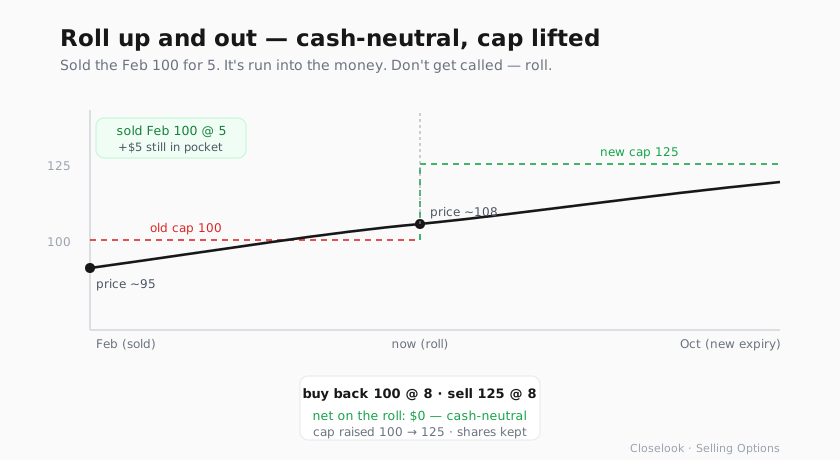
Run the whole sequence and the cash is clean: plus five on the original sale, minus eight to close, plus eight on the new strike — a net plus five still banked, now sitting against a higher strike and a later date. You've converted "about to be called away at 100" into "still holding, capped at 125, paid through October."
Credit, even, or debit — and when each is worth it
The quality of a roll is just the new sale measured against the buyback. When the new strike pays at least as much as it costs to close the old one — a credit or even roll, as above — the roll is clean: you defer assignment, lift the cap, and bank premium on the way. This is usually available when implied volatility is still high, and a stock that has just run often carries rich vol on the higher strike, which is what funds the roll. When the new strike pays less than the buyback — a debit roll — you're paying out of pocket to defer, and that's usually the market telling you the move was real. If a roll can only be done for a meaningful debit, taking assignment is often the cleaner answer than spending to postpone it.
What you actually traded
The roll is not a free lunch, and it helps to say plainly what you gave for what you got. You stayed capped — now at 125 rather than 100 — and you extended the obligation out to October, tying the position up longer and keeping you short the call through more of the future. In exchange you kept the shares, kept the premium, and bought $25 of additional upside room plus the time for the position to grow into it, all financed by the call you re-sold. That's a good trade when the position is one you want to keep and the thesis still has room. It's a poor one when you're only deferring an exit you should take.
The other direction, and the put side
The same move runs in reverse. If the underlying had fallen instead and your call decayed toward worthless, you can roll down and out — close the cheap call and sell a lower strike nearer the new price, harvesting fresh premium while the position recovers. The identical logic applies on the put side: a cash-secured put that's gone against you can be rolled down and out for more premium and a lower eventual entry, rather than taken at assignment immediately. Rolling isn't only a winner's tool — it's how you keep a position earning in either direction.
When not to roll — and the wheel
Rolling is for positions you want to keep. If you were genuinely happy to sell at the strike — the income covered call did its job, or you wanted out anyway — take the assignment and don't roll reflexively. Watch the calendar, too: an in-the-money call can be exercised early in the day or two before an ex-dividend date, as the holder reaches for the payout, forcing assignment ahead of expiry. And if you do let the shares get called, you're not stuck — you're in cash at the top of the wheel, free to sell a put and begin the cycle again, which loops straight back to Sell to Own, or Sell to Never Own.
One question worth sitting with
The roll is how you keep a winner working — but it can quietly become how you refuse to admit the move beat you. Every roll defers the cap and extends the obligation; do it indefinitely and you've turned a position you own into a short-volatility bet you can no longer close on your own terms. So each time, the question is whether you're rolling because the thesis still has room to run, or only because you can't stand to be called away. The first is management. The second is a habit dressed up as one. The Money Temperature monitor helps frame whether the move that put you in the money is likely to keep going — in which case roll up and ride — or to mean-revert, in which case the cap you're fighting may be doing you a favour.
Closelooknet publishes a market diary, not investment advice. The strategies described here are educational. Tax, suitability, and risk depend on personal circumstances — consult a licensed advisor before acting.