Daily Pulse · · 11:30 CET · framework · NVDA
Nvidia has pushed above its trading range — but a breakout you have to confirm is not the same as a breakout you can trust. The real question is whether Vera Rubin restarts a Nvidia-specific leadership leg, or whether AI leadership stays downstream in the derivatives.
Nvidia is back at an important technical and narrative inflection point. The stock has pushed above its recent trading range, but the move still needs confirmation. This is not the moment for Nvidia to drift: it needs to hold above the former consolidation zone and begin showing strength again. A slide back into the range would raise the risk of a failed breakout — a sign that investors are not yet ready to price a fresh Nvidia leadership leg.
That matters because Nvidia is not just another AI stock. It is the core architecture company behind the AI-infrastructure cycle. But even its leadership tends to move in waves — and the question now is whether Vera Rubin marks the beginning of the next phase.
How the architecture cycle leads — then broadens
My working thesis: Nvidia tends to lead early in a new chip-architecture cycle. At the start, the market focuses on Nvidia itself — the new chip, the performance jump, the scarcity value, the pricing power, the earnings acceleration.
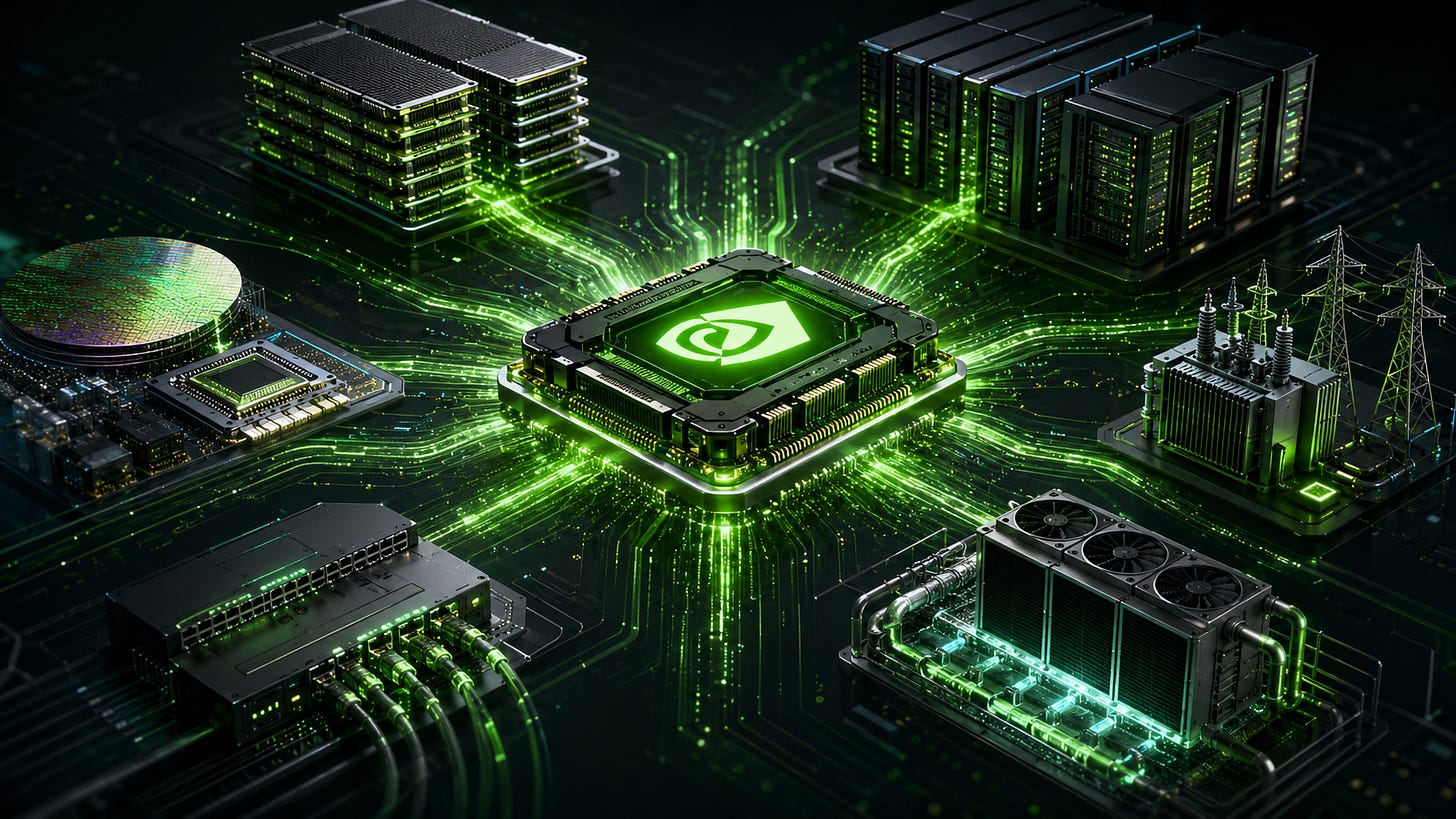
Then, as the cycle matures, the trade broadens. Leadership moves into the derivatives: HBM memory, advanced packaging, networking, power equipment, cooling, server makers, cloud-capex beneficiaries. Nvidia may still perform, but it can start to lag the broader AI supply chain.
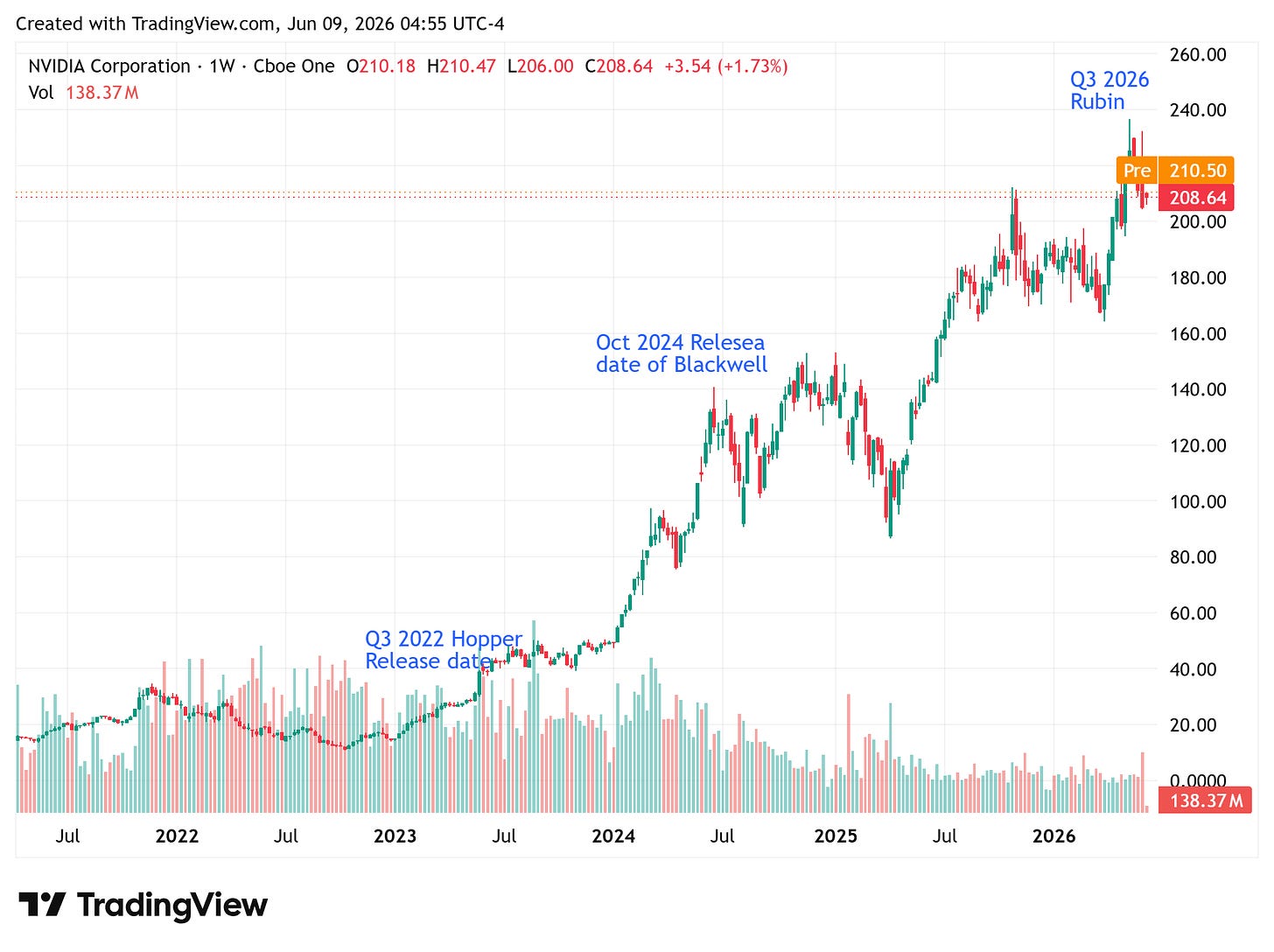
We saw this with Hopper: Nvidia led because it was the purest expression of AI-compute scarcity. We saw it again with Blackwell — but by then the market was more sophisticated, buying not just the GPU but the ecosystem needed to deploy the platform at scale. Now comes the next test: Vera Rubin, and further out, Feynman.
Why the chart matters
The grey trading range is the market’s digestion phase — investors paused, reassessed, and waited for the next catalyst. The breakout above that range suggests the market may be starting to price a new product-cycle leadership phase. But it is not enough to break out once: Nvidia must now stay out of the box.

If the stock falls back into the prior range, the message is clear: the market is not yet convinced Rubin is enough to restart Nvidia-specific leadership. The AI trade may continue, but leadership would stay with the derivatives rather than Nvidia itself. If Nvidia holds above the range and accelerates, the signal is far more constructive — support for the idea that a new architecture cycle is beginning, with Nvidia again the first-order beneficiary.
The cycle-leadership model
The Nvidia cycle splits into three phases.

Phase 1 — Architecture anticipation. Nvidia usually leads. The market prices the new platform before the full revenue impact is visible; scarcity, performance and future demand dominate the narrative.
Phase 2 — Deployment and derivative rotation. As the platform moves into production, investors look beyond Nvidia. The trade spreads into the supply chain: memory, packaging, networking, cooling, power, servers, cloud infrastructure.
Phase 3 — Digestion and transition. Once expectations are high, Nvidia needs the next architecture to re-accelerate the story. If the next chip cycle is credible, close enough and large enough, Nvidia can regain leadership. If not, the stock consolidates while the market hunts for second-order winners. This is where we are now — and Rubin is the test of moving from the Blackwell deployment phase into a fresh leadership phase.
What I’m watching: relative leadership, not just price
For the bull case, the key is not absolute performance but relative leadership. Nvidia needs to outperform the AI-derivative basket again — NVDA against the semiconductor ETFs, the Nasdaq-100, TSMC, the HBM suppliers, networking names, server makers, power-infrastructure and cooling plays.
If Nvidia leads that group, the market is saying the next architecture cycle belongs to Nvidia again. If the derivatives lead while Nvidia stalls, the message is different: the AI buildout continues, but the better risk/reward has moved downstream. That distinction is what matters for positioning.
Positioning: hold-and-watch
In my own book this is a hold-and-watch moment, not a reason to ignore risk. The breakout is encouraging, but it needs confirmation, and the line is the former trading range — Nvidia should not fall back into it. Chasing an unconfirmed breakout is the riskier path; the cleaner setup would be Nvidia holding above the range, digesting calmly, then pushing higher with renewed relative strength. Put simply, the stock now needs to behave like a leader — and a leader should not break out and immediately retreat.
Closelooknet Lens: the rotation map

That means watching HBM memory, advanced packaging, networking and optical connectivity, server OEMs, liquid cooling, power equipment, data-center infrastructure, semiconductor equipment and cloud-capex beneficiaries. The strongest version of the Rubin cycle has Nvidia leading first and the ecosystem confirming. The weaker version has the ecosystem leading while Nvidia struggles — the market still likes AI infrastructure, but no longer sees Nvidia as the highest-upside expression of the theme.
Reality check: what can go wrong
The biggest risk is that Rubin is already partly priced in. Nvidia is not an undiscovered story; expectations are high and the roadmap is known, so the company needs to deliver more than excitement — order strength, margin resilience, supply-chain execution, and management language confirming Rubin is incremental rather than merely a replacement cycle.
A second risk is that the broader AI trade turns more selective. If investors start questioning cloud-capex returns, AI monetisation or data-center economics, Nvidia could struggle even with strong products. A third is technical: the stochastic has cooled, and price now has to carry the move on its own.
The bottom line
Nvidia is at crunch time. A clean hold above the range would support the view that Rubin can restart Nvidia’s leadership cycle; a fall back into it would weaken that view and suggest AI leadership stays with the downstream beneficiaries. NVDA must stay above the old range, show renewed strength, and begin outperforming the derivative basket again. That is the signal I am watching.