Options
Options — From Apple to Nebius: Matching the Strategy to the Stock and the Vol
Six pieces, one decision. Here's how to route from a name and a view to the right structure — and let the volatility regime, not your mood, set how aggressive the strike. The map for the whole series.


As of late May 2026 the toolkit is complete, and the tape is doing something specific: the VIX sits near its 52-week lows around 16–17, while semis and AI names trade at or near highs with rich single-name volatility. That split — a calm index over hot thematics — is exactly the condition in which matching the trade to the name matters most. The same instinct ("sell some premium") routes to opposite trades depending on what you're selling it against. This is the map: which structure, on which kind of stock, in which vol regime.
It all rests on one fact
Everything in this series is a way of selling options, and selling wins for one structural reason: the buyer needs direction, magnitude, and timing all to land, while the seller only needs the move to stay contained — and implied volatility tends to run above the volatility that actually shows up. That's the edge from The Buyer Needs Three Things to Go Right. The Seller Needs One. The rest is knowing how to point it.
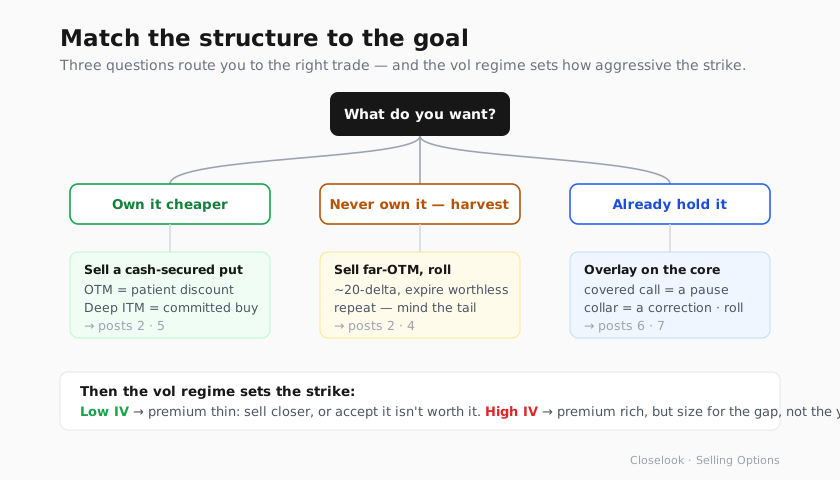
The first question: do you want the stock? A sold put does two opposite jobs, and the strike — read as delta — is the dial between them. If assignment is the win, you're selling to own cheaper: an out-of-the-money put as a patient discount, a deep-in-the-money put as a committed buy. If expiry-worthless is the win, you're selling to never own: a far-OTM put you collect and roll. That's the whole argument of Sell to Own, or Sell to Never Own. The decision tree below is the short version.
The second question: what is the name's character? This is where Apple and Nebius part ways. A quality, low-IV name — Apple at low-20s vol — has calm Greeks and a thin but dependable premium; the edge is real and modest, and you size it normally. A high-beta, high-IV name — Nebius in the 80s — pays four to five times the premium for the same delta, but its Greeks are violent and its tail is real, so you size for the gap, not the yield. The mechanics of that divergence are in Why the Same Greeks Are Calm on Apple and Lethal on Nebius, and what the tail does to a seller is in Win Small, Often. Lose Big, Once. The rule that ties them together: the richer the premium, the larger the risk it's quoting — never the free lunch it looks like.
The third question: do you already hold it? If the position is one you intend to keep, you're not opening a trade — you're shaping risk around a core. That's the overlay: a covered call to monetise an expected pause, a collar to brace for a genuine correction, a deep-ITM call when you want real protection without selling, a lone put when you'll pay to keep unbounded upside. The full spectrum is in When You Think the Rally Pauses, Sell Calls — Not Your ETF. And when a sold call runs into the money, you don't have to be called away — you roll, the subject of Rolling Up and Out.
Let the vol regime set the strike
The last dial isn't yours, it's the market's. In a low-IV tape the premium is thin: you either sell closer to the money to get paid, or accept that the trade isn't worth the cap and sit out. In a high-IV tape the premium is rich, but that's the market pricing a bigger move, so you size off the downside and not the headline yield. Right now the regime is split — index calm, semis blistering — which is why the overlay on a liquid semis vehicle like SMH or SOXX is the live setup: extended underlying, fat call premium, deep chain.
The ETF canvas, in one line
For the overlay, option liquidity decides what's usable, not what the fund holds. The broad-index ETFs (SPY, QQQ, IWM) are overlay-grade; the SPDR sectors plus SMH, SOXX, IBB, VNQ and ARKK are workable; most niche thematics are map-only — read the theme there, trade it through a liquid proxy. The full tiering and the current thematic heat map are in the ETF overlay reference.
One question worth sitting with
The toolkit doesn't make money — matching it to the name and the regime does. The most common and most expensive mistake isn't choosing the wrong structure; it's running the high-IV name's strategy at the low-IV name's position size, lulled by a premium that looked like Apple's risk and was really Nebius's. So before any trade, the question is simple: have I sized this for the stock I'm actually selling against, in the regime that's actually here — or for the one I wish I were in? The Money Temperature monitor is built to keep that second question honest.
Go deeper: the detailed strategy pieces — covered calls (income and harvest) and cash-secured puts (accumulation and trading) — sit beneath this hub, along with the full ETF overlay reference.
Closelooknet publishes a market diary, not investment advice. The strategies described here are educational. Tax, suitability, and risk depend on personal circumstances — consult a licensed advisor before acting.