Daily Pulse · · 11:30 CET · market · DELL
A strange thing is happening in the market. A new class of value stocks is developing — but many traditional value investors have deliberately overlooked them.
What's the buzz?
We are not talking about banks, energy, utilities, or consumer staples. We are talking about old tech: traditional semiconductor companies, analog-chip makers, PC vendors, server manufacturers, and enterprise hardware names.
Think Intel, Texas Instruments, Dell, HP, and Lenovo.
For years, these companies were treated as yesterday's technology: cyclical, low-growth, hardware-heavy, and vulnerable to margin pressure. In other words, the kind of stocks that growth investors ignored, and many value investors distrusted.
But AI may be changing the equation.
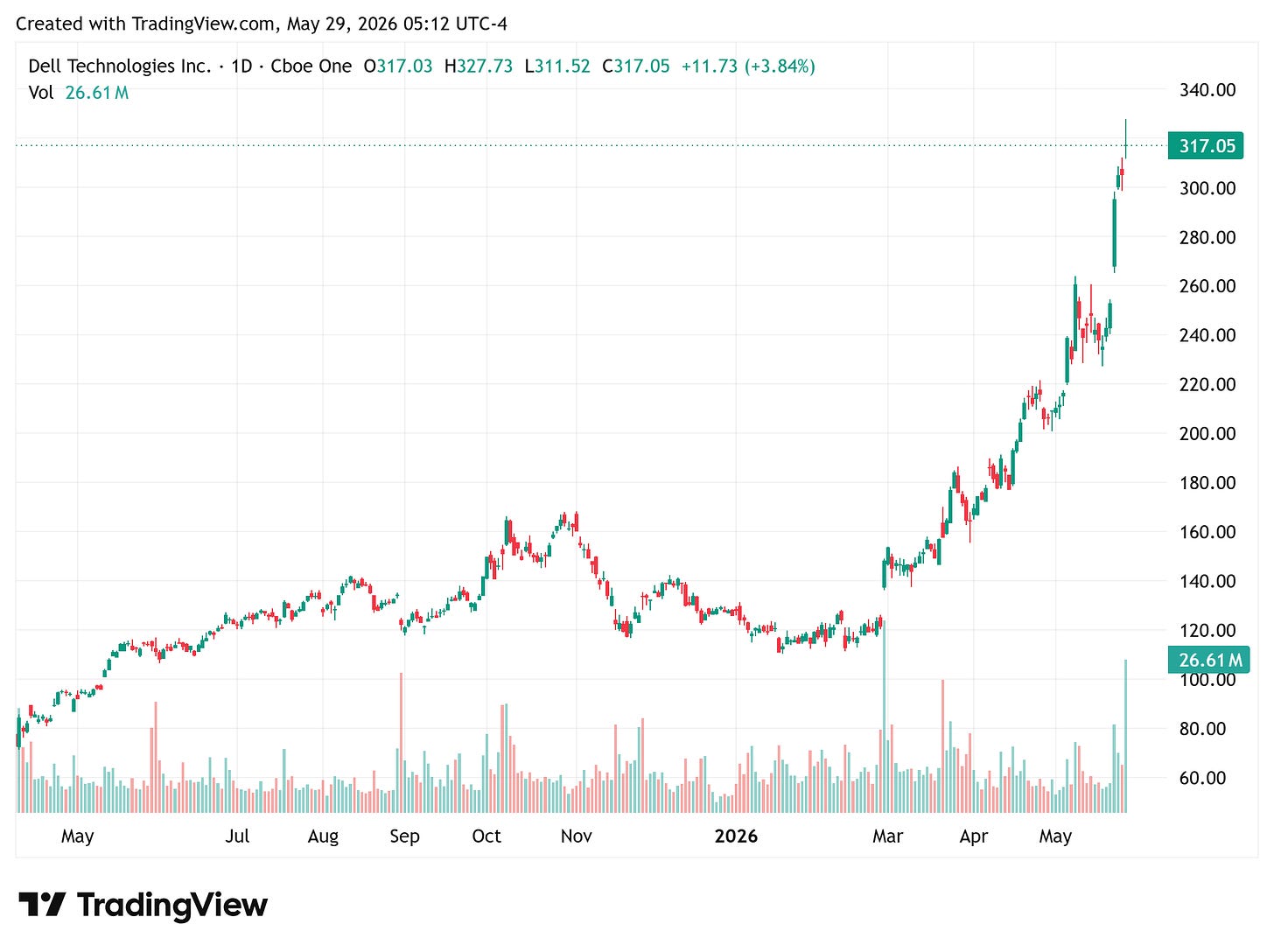
Dell's latest results show how dramatic the shift has become. The company reported a surge in AI-optimized server demand, with AI server orders rising sharply and management lifting guidance amid infrastructure demand. Lenovo is also benefiting from the same wave, with its infrastructure business returning to profitable growth and management pointing to AI infrastructure and hybrid AI as key drivers.
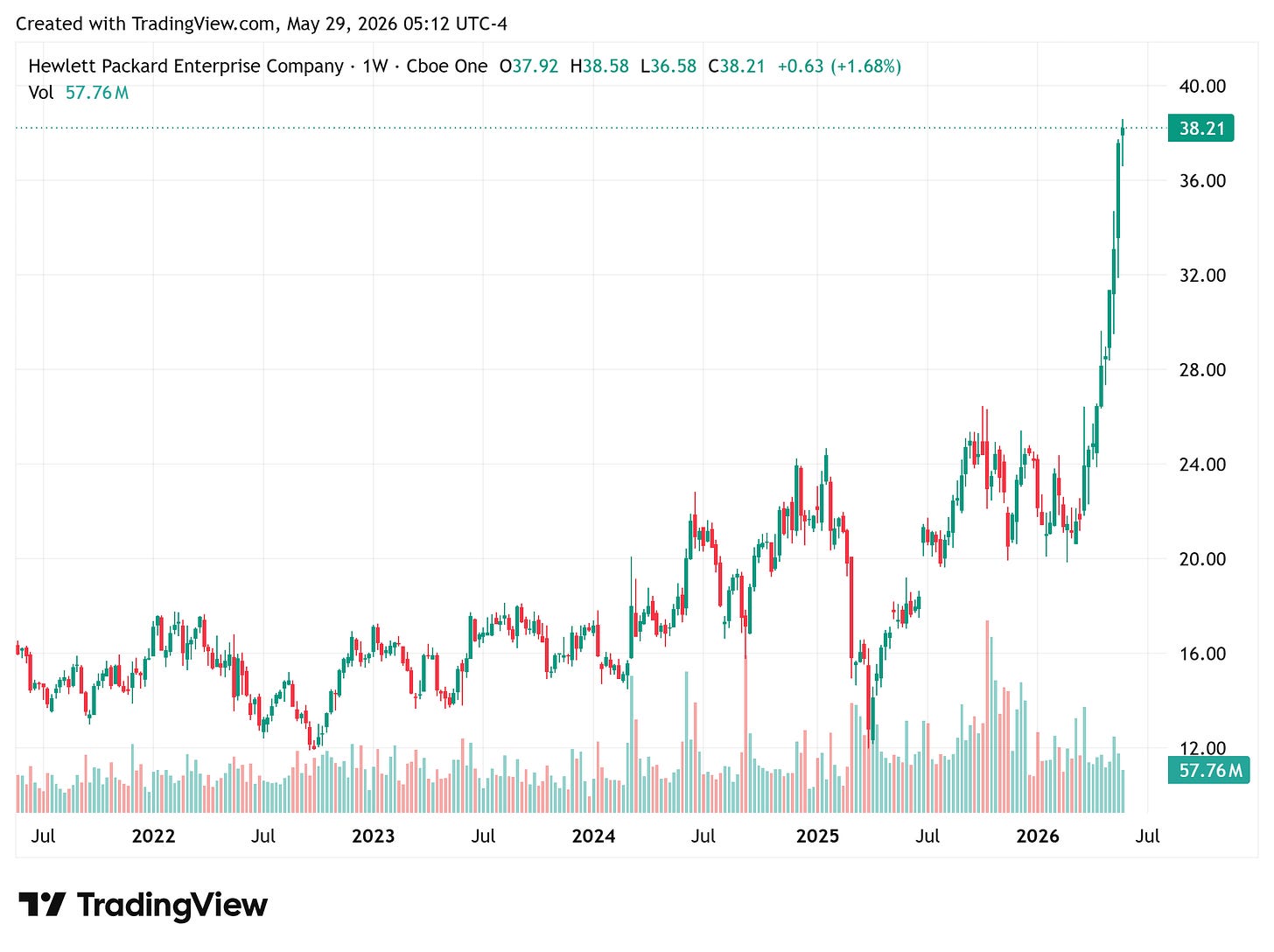
Hewlett Packard Enterprise (HPE) sits in the same current. After folding in Juniper Networks, its networking revenue stepped up sharply, and it is seeing demand for AI-optimized servers, switches, and direct-liquid-cooling systems. Its joint work with Nvidia gives enterprises a ready-to-deploy private-cloud-AI foundation, while the GreenLake platform pushes the business toward a more predictable, higher-margin as-a-service subscription model.
So what?
The market has spent the past two years rewarding the obvious AI winners: Nvidia, Microsoft, Broadcom, AMD, and the hyperscalers.
But AI does not run on software alone.
It needs servers. It needs racks. It needs storage. It needs power management. It needs cooling. It needs networking. It needs PCs and edge devices. It needs analog chips. And it needs the boring infrastructure layer that many investors dismissed as “old economy tech.”
That is where the new value opportunity may be forming.
These companies are not pure AI growth stories. They are AI infrastructure value stocks.
The paradox is that many value investors still see them through an old lens. They remember Intel's execution issues, HP's printer dependence, Dell's low-margin hardware model, and Lenovo's China discount. They see cyclicality and conclude it's a value trap. Or even worse. Tech! Do not touch it.
But the market is starting to ask a different question:
What if some of these old-tech companies are no longer just cyclical hardware names — but essential suppliers to the AI buildout?
Backing it up: the stocks.
Dell is the clearest example. It has moved from being a PC/server assembler to a direct beneficiary of AI infrastructure spending. The valuation is no longer deep-value cheap, with current market data showing a P/E above 40, but the earnings momentum is real.
Texas Instruments is a subtler case. TXN is not “cheap” on trailing earnings, with a P/E above 50. Still, it owns a powerful position in analog and power-management chips — exactly the kind of components needed as data centers become more power-intensive.
HP Inc. looks more like a traditional value. It trades at a much lower multiple, around 9x earnings, but the growth case is weaker, and management has warned that trade-related costs could pressure fiscal 2026 guidance.
Intel is the most controversial name. It may be cheap on strategic assets, but not on earnings. Current market data show negative EPS and a negative P/E, making Intel more of a turnaround option than a clean value stock.
Lenovo remains interesting because it sits at the intersection of PCs, AI PCs, servers, and global enterprise hardware. Its discount partly reflects geopolitics and margins, but the AI infrastructure angle is becoming harder to ignore.
Now what?
This does not mean all old-tech hardware stocks are automatic buys. The better conclusion is this:
A new category is emerging: cyclical technology infrastructure value.
These are companies that still carry old-economy multiples, old-economy skepticism, and old-economy labels — but some of their demand drivers now come from one of the market's most powerful growth themes: AI infrastructure.
That combination can be powerful. But it is also dangerous. Investors must separate the three groups:
- Real AI infrastructure beneficiaries — Dell, HPE, and selected server/networking suppliers.
- Durable component suppliers — Texas Instruments and other analog/power-management names.
- Turnaround or value-trap candidates — Intel, HP Inc., and others, where the story depends heavily on execution.
Actionable advice: buying and selling
For investors, this is not a “buy the whole basket blindly” moment. A better approach is to build a watchlist and rank these companies by three factors:
- First: AI revenue visibility. Is AI already showing up in orders, backlog, or guidance?
- Second: margin quality. Are they simply shipping more low-margin hardware, or can they capture real profits?
- Third: balance-sheet and execution risk. Cheap stocks can stay cheap if management cannot convert the opportunity into cash flow.
Dell currently has the strongest near-term momentum. HP Inc. has the cleaner traditional value multiple. Texas Instruments has a higher-quality business model but less obvious cheapness. Intel has the biggest optionality, but also the highest execution risk.
Closelooknet Lens: spotting the ripple effects
We have added Lenovo to a few of our portfolios.
The key ripple effect is this: AI may be reclassifying parts of the technology sector.
Yesterday's boring hardware names could become tomorrow's infrastructure toll collectors.
That does not make them the new Nvidia. But it does mean the AI trade may broaden beyond the obvious winners. The next leg may be about more than just chips that train models. It may increasingly be about the companies that supply the servers, power architecture, PCs, and hardware backbone needed to deploy AI everywhere.
This is where value investors should pay attention.
The irony is clear: the next value opportunity may be hiding in the sector many value investors still refuse to touch — technology.
Reality Check: What can go wrong?
A lot.
AI server demand could prove cyclical. Margins could disappoint. Hardware competition could intensify. Tariffs and geopolitics could hurt supply chains. PC demand could remain weak. Intel's turnaround could take longer than expected. And some of these stocks, especially Dell and Texas Instruments, may already reflect considerable optimism.
So the theme is not “old tech is cheap.”
The better theme is:
Some old-tech stocks are becoming AI infrastructure value plays — but investors must be selective.
That is the opportunity, also for those value investors that have learned how to adapt.