C+

Daily Pulse · · macro · TLT

The Federal Reserve building under a split sky: on the left, storm clouds and a red, falling candlestick chart with a downward arrow (the hawkish front end repricing higher); on the right, a calm sunset with a green line anchored by a large ship's anchor in still water (the long end staying anchored) — a hawkish Fed the long end refuses to follow.

Warsh Goes Hawkish. The Long End Isn't Listening.

Yesterday was Kevin Warsh’s first FOMC as chair, and he planted a hawkish flag — a unanimous hold, the easing bias quietly dropped, half the dots now pencilling in a hike this year. The front page read it as hawkish. The bond market read it differently — and the bond market is the one with your money in it.

Rates stayed put at 3.50–3.75% (the fourth straight hold), but the message hardened: a unanimous vote, the easing bias gone, and a statement stripped back to a single line — the Committee will deliver price stability. That’s the front-page read. The more interesting read is in the curve — and the curve isn’t agreeing.

The curve is splitting

Put four ETFs across the maturity spectrum side by side and the disagreement is visible:

  • BSV — short-term — ~77.6
  • IEI — 3–7y Treasuries — ~117
  • IEF — 7–10y Treasuries — ~94
  • TLT — 20+y Treasuries — ~86, sitting just above its multi-year ~79 floor
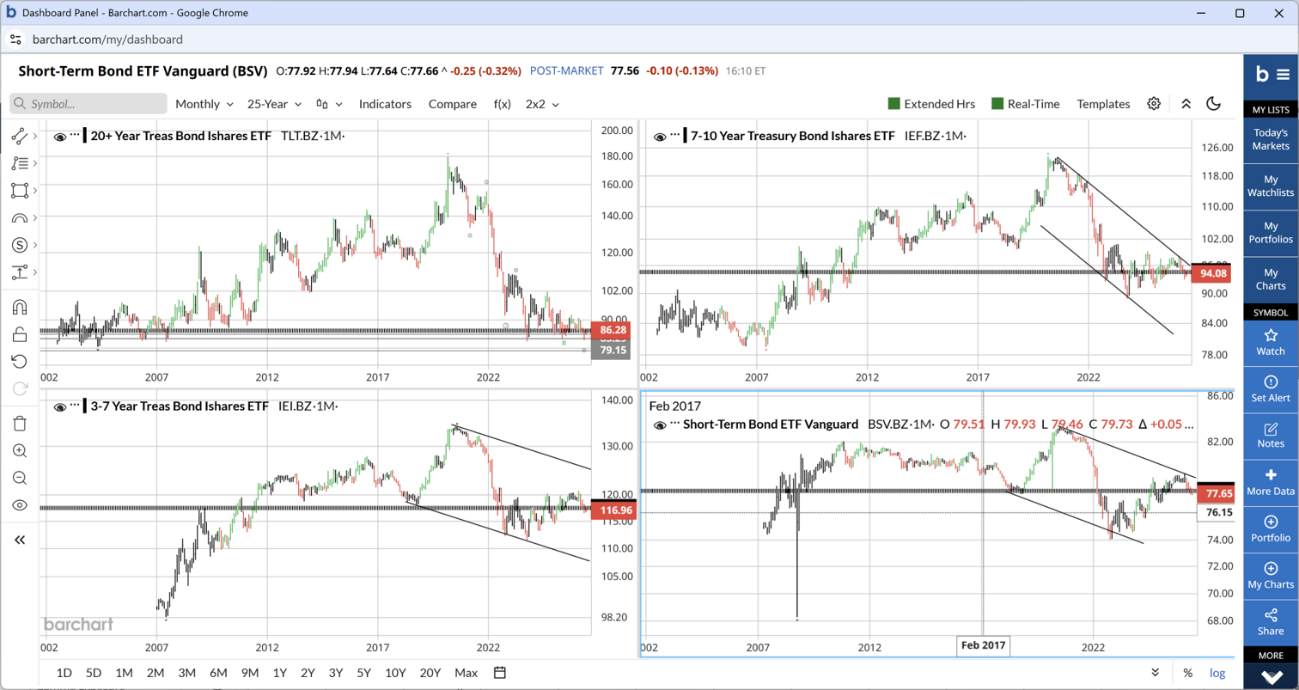
Four Barchart panels across the Treasury maturity ladder — Vanguard BSV short-term, iShares IEI 3-7y, IEF 7-10y and TLT 20+y — the front and belly rolling over against descending trendlines while TLT bases near its multi-year low
Figure 1. The maturity ladder, split: BSV / IEI / IEF roll over (front and belly repricing higher in yield) while TLT (20+y) bases near its ~79 floor. Source: Barchart.

The short end and the belly — BSV, IEI, IEF — are rolling over against descending trendlines. In price terms that’s a top; in yield terms it means the market is letting the front and middle of the curve reprice higher — exactly where a hawkish Fed has leverage.

TLT is doing the opposite. After a three-year bear market from ~180 to the mid-80s, it’s trying to base near the lows. A price bottom at the long end is a top in long-term rates. The 20-year part of the curve is telling you it does not believe it needs to go meaningfully higher.

So: front and belly up in yield, long end capped. A bear flattening led by the front — not a parallel shift, not a long-end blow-out.

Why this is a “transitory” signature

Here’s the tell most people will skip past: Warsh’s own statement gave the game away. Even while turning hawkish, the FOMC flagged that elevated inflation is “in part reflecting supply shocks that have driven price increases in certain sectors.” Translation: the Fed is treating a chunk of this as a supply-side, sector-specific shock — not a broad, self-sustaining wage-price spiral.

That is the exact distinction the long end cares about. A front-loaded Fed fighting a supply shock pushes short rates up now and is expected to be done later. Long-run inflation expectations stay anchored, so the long end stays anchored. TLT bases. That’s the curve you’re looking at.

What our monitor says — and why it matters here

This is where we lean on our own read rather than the headline. Our Structural Inflation monitor is built for precisely this question. It isn’t a CPI mirror — it’s a leading regime read across 26 FRED series in seven buckets, and it answers three questions: Level (how hot is pressure right now?), Direction (heating or cooling over the next 3–6 months?) and Character (structural or transitory?).

The Closelooknet Structural Inflation monitor — Level, Direction and Character gauges, a Character Read panel reading Mixed with a Shock Spreading? gauge showing No, above the seven weighted buckets (cost, labor, shelter, breadth, expectations, supply, margins)
Figure 2. The Structural Inflation monitor: three gauges (Level / Direction / Character) over seven weighted buckets. The Character read — and its “spreading?” gauge — is the one the long end cares about. Source: Closelooknet, FRED.

The third question is the whole ballgame for the long end. The monitor builds Character as the persistence core — wages, the rent pipeline, median/trimmed breadth, long-run expectations — minus the part of the supply shock that has not yet shown up in breadth and expectations. In plain English: a supply shock only matters for the long end if it spreads — if it leaks into wages, into the trimmed-mean measures, into 5y5y expectations. Until it does, it’s noise the long end can look through.

That is the read that fits the tape: a hot Level, a hawkish Fed on the front end — but a Character that hasn’t tipped structural. Which is exactly why TLT can base while BSV, IEI and IEF roll over.

The monitor’s 26 underlying FRED series listed by bucket — cost, labor, shelter, breadth, expectations, supply and margins — each with a level-z and momentum-z column
Figure 3. Under the gauges: the 26 FRED series across seven buckets. The “spreading?” gauge watches whether the supply shock is leaking into breadth and expectations — the monitor’s built-in kill-switch. Source: Closelooknet, FRED.

The monitor also carries its own kill-switch. There’s a “spreading?” gauge — is the supply shock leaking into breadth and expectations? The day that flips, the thesis flips: the long end stops being anchored, TLT breaks its base, and the bear flattening becomes a bear steepening. That is the single thing to watch.

What it means for the book

If the front end leads and the long end holds:

  • Gold, Bitcoin, EM — directionally a headwind. Higher front-end real rates and a firm dollar are exactly what these dislike.
  • US equities — mixed, and sector is everything. Front-end-sensitive, rate-levered plays feel the squeeze; long-duration growth keeps its footing as long as the long end stays anchored and the Character read stays benign.
  • Duration — the long end is the contrarian position here, not the front. TLT basing is the market’s vote on transitory.

The headline is “Warsh went hawkish.” The tape’s reply is “on the front end, fine — but we still think this is transitory.” We’ll keep scoring that disagreement on the monitor — cross-read it with the Money Temperature regime and the Growth & Recession monitor before sizing anything.