Worth a Read
Korea's Memory-vs-Equipment Split, Read From the Seoul Close
LoRosha's Investment Desk reads Wednesday's KOSPI/KOSDAQ divergence as an AI supply-chain split. The cut, and where it meets the Closelooknet frameworks.
Source: LoRosha's Investment Desk (Substack) Read the original →
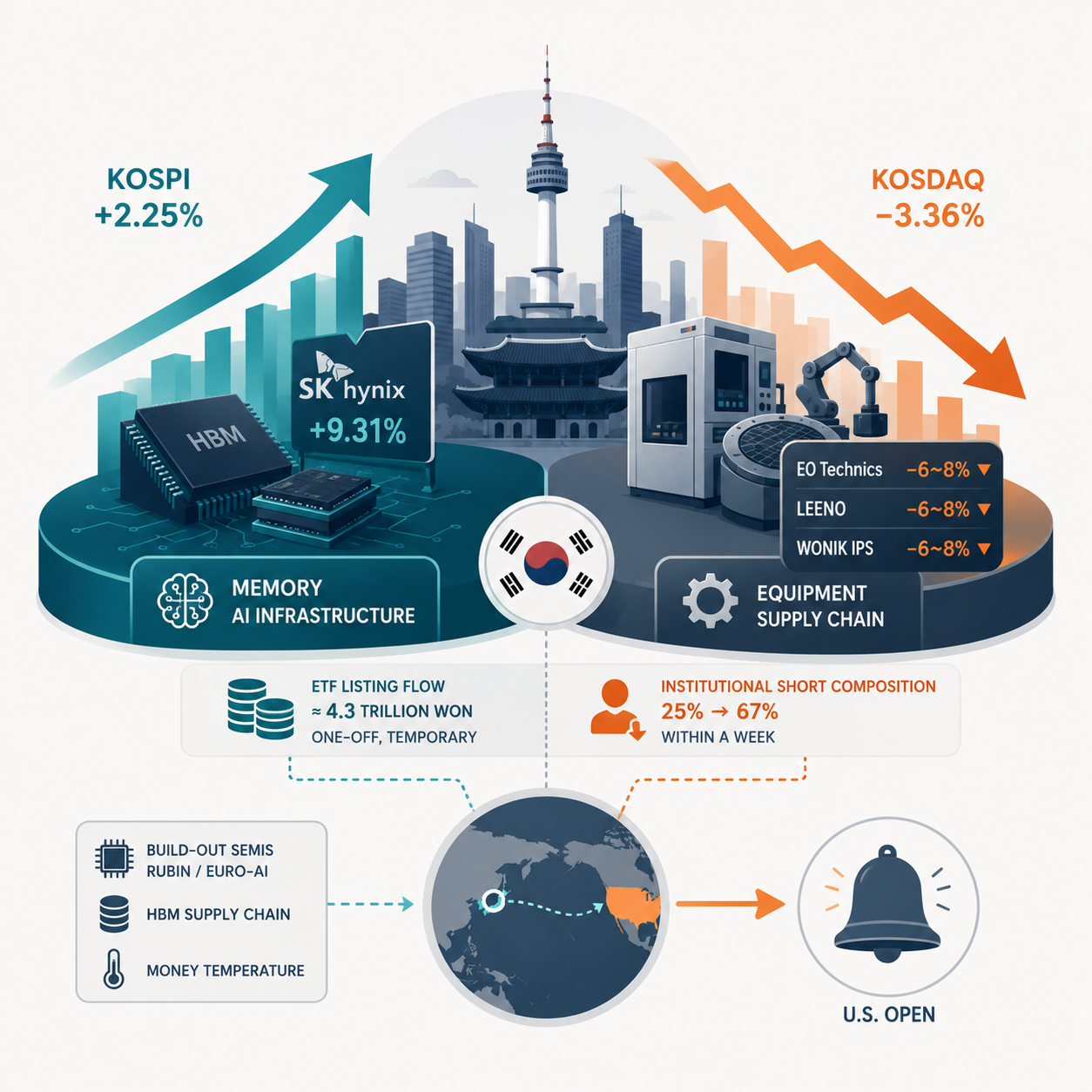
Korea's market closed Wednesday with a divergence that rarely shows up inside a single index print: the KOSPI rose 2.25% while the KOSDAQ fell 3.36% on the same session. LoRosha's Investment Desk, which tracks the Seoul close as an early read on the US open, treats that gap not as a broad rally but as an AI supply-chain split.
SK Hynix led the large-cap memory names higher, up 9.31%, as the market kept reclassifying memory as AI infrastructure — the same re-rating that has carried Micron toward Nvidia-style multiples. The semiconductor-equipment long tail moved the other way: EO Technics, LEENO and WONIK IPS fell 6 to 8% even with foreign buyers present. Underneath the headline, roughly 4.3 trillion won of one-time leveraged-ETF inflow flattered the KOSPI number, while institutional short composition on the KOSDAQ climbed from about 25% to 67% inside a week.
The core idea The desk separates two forces that look like one: the mechanical, one-off flow from the ETF listing, and the standing institutional short positioning underneath it. Only the first is temporary — the short structure pressuring the equipment names does not lapse when the listing flow does.
That is the read worth carrying into the US session. The +2.25% tape was thinner than it looked — carried by a handful of re-rated memory names rather than the whole complex — and the positioning that sold the equipment long tail does not clear when the mechanical ETF flow does.
Where it meets the Closelooknet frameworks
The memory-as-AI-infrastructure thesis is one Closelooknet already tracks from the other side of the trade — through the Build-Out semis read in Rubin and Euro-AI, and through the HBM supply chain that sits under it. Korea's close is an early tape on both: when Seoul re-rates SK Hynix on memory-cycle conviction, the same signal often surfaces hours later in the US-listed names, and the foreign-flow and short-composition shifts feed the kind of regime read Closelooknet keeps in Money Temperature.
Closelooknet keeps this as a market-diary observation, not a recommendation — the value is the cross-read between the Seoul close and the US open, not a call on any single name.
Update — July 10, 2026 Six weeks on, the split resolved — upward, and at record scale. SK Hynix sold $26.5 billion of Nasdaq ADRs in the largest US listing by a foreign company, priced at a 2.9% premium to Seoul and opened around fourteen percent above the offer on July 10; the Kospi rose 4.6% into the pricing. The memory side of this piece’s split has been fully re-rated — the open question is now the Korea discount itself, and we took the whole trio apart in Three Ways to Own the Memory Supercycle.
Worth a Read points you to another writer's published work; the synthesis above, and any errors in it, are Closelooknet's, not the source's. Closelooknet publishes a market diary, not investment advice — circumstances differ; consult a licensed advisor before acting.