Daily Pulse · · 08:30 CET · 1 min read · framework
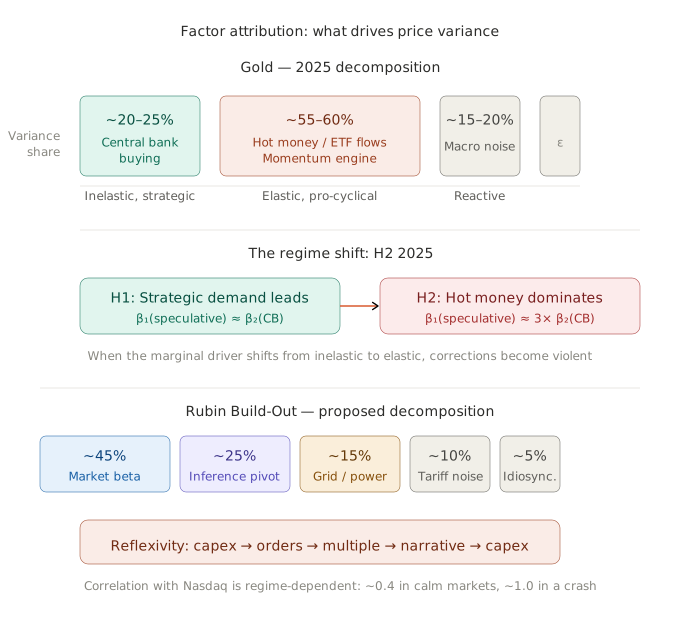

Standard market commentary identifies what drove returns. Factor analysis identifies how much each driver contributed — and more importantly, whether those drivers are changing.
Applied to Gold (2025): three components explain most of the variance. Central bank buying (~20–25%) providing the structural floor. Hot money and ETF flows (~55–60%) providing the momentum. Macro noise (~15–20%).
The key finding: the β for speculative flows grew roughly 3x larger than the β for central bank buying during H2 2025. The marginal price driver shifted from inelastic strategic demand to elastic momentum flows. That structural shift explains why the correction was violent.
Applied to the Rubin Build-Out: five components proposed. Market beta (~45%), inference pivot (~25%), grid/power (~15%), tariff noise (~10%), idiosyncratic (~5%).
The most important observation is reflexivity: hyperscaler capex announcements feed into NVIDIA's order book, which feeds into NVIDIA's multiple, which feeds into the AI narrative that justifies the capex. That feedback loop is exactly the non-linearity that standard PCA misses.
Correlations between Rubin infrastructure stocks and the broader Nasdaq are regime-dependent — approximately 0.4 in calm markets, approaching 1.0 in a crash. Watching the derivatives of factor participation is where static attribution becomes a dynamic regime detection system.
C — free account
The free C account unlocks the full Daily Pulse — every section of this read.
One tap with Google or one email — no password, no card. You are signed in until you sign out, on this browser, from then on.
Join the Look — freeAlready joined on this browser? The full edition shows automatically — if it doesn't, sign in again here. Looking for the archive, portfolios and realtime? That is C+.