Daily Pulse · · 08:30 NY · 2 min read · market

In this edition
Risk-on but late-run
Index moves
| Index | 1D | 1W |
|---|---|---|
| Rubin 100 | +0.50% | +2.93% |
| HALO 100 | +0.01% | -0.79% |
| Euro-AI 50 | +1.33% | -4.03% |
| AW25 | — | +0.57% |
Pattern alerts
- NOC support-confluence WARNING
- MCD support-confluence WARNING
- PFE support-confluence WARNING
- JNJ support-confluence WARNING
- MA support-confluence WARNING
Cointegration
0 active pairs, 7 breaks.
Closelook Temperature sits at 59 🟡, still risk-on but the dispersion underneath is widening. The Rubin Build-Out 100 added +0.50% on the day and is now +25.1% over the trailing month — a continuation of the capital rotation into infrastructure build-out names that has driven the index since late March. Euro-AI 50 gained +1.33% on the day but remains negative on the week at −4.0%, suggesting intra-week turbulence today's bounce has not fully resolved. HALO 100 was essentially flat at +0.01%, marginally negative on the week and month — a divergence between defensive/healthcare-adjacent positioning and the more aggressive infrastructure and AI-exposed baskets. AW25 shows no daily print but its one-month return of +18.6% places it firmly in the risk-on cohort.
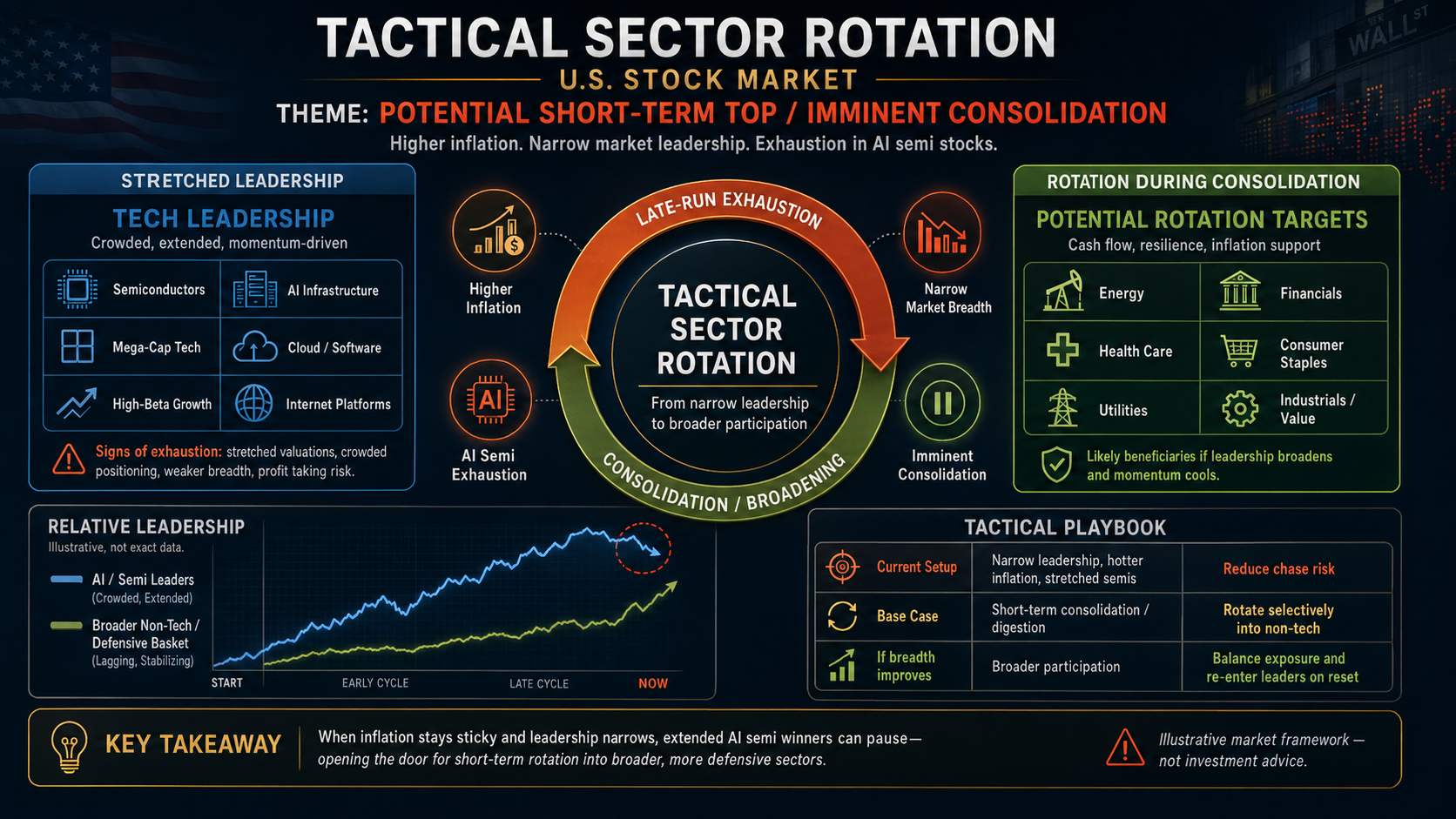
The cover frames the read. Three conditions for late-run exhaustion — narrow market leadership, stretched valuations in AI semis, sticky inflation — sit on top of a tactical playbook that points away from the late-cycle leaders and toward cash-flow / inflation-supported defensives if breadth fails to broaden. Rubin's +25% month is exactly the kind of crowded, extended, momentum-driven move the framework flags as exhaustion-prone. Tuesday's session showed the first real crack: Rubin printed −2.95% in a single day before today's modest bounce — the cleanest tell yet that the buildout trade is meeting digestion.
The Pattern Scanner registered 28 active signals. The top five hits are all support-confluence reads — NOC, MCD, PFE, JNJ, and MA. The two highest-confidence names, NOC and MCD, carry red-regime labels. That combination — high-confidence support tests in red-regime names — warrants attention: it typically reflects oversold positioning rather than constructive accumulation. PFE, JNJ, and MA sit in yellow-regime territory with moderate confidence, more ambiguous reads. The scanner is finding technical floors in defensive names — defense, restaurants, pharma, payments — not in names riding momentum. That maps cleanly onto the tactical-rotation framework's "rotation during consolidation" panel.
Cointegration shows zero active pairs against seven breaks — an elevated break count with no new pair formation. When pair relationships dissolve in bunches like this, cross-asset correlations are shifting. That fits the rotation hypothesis: capital rebalancing across sectors rather than settling into a clean trending environment. We watch this spread carefully when Temperature is climbing — divergence between the pair-break count and the composite risk score sometimes precedes a regime re-rating.
Forward focus: whether Euro-AI can recover its weekly losses while Rubin sustains the monthly trend, and whether the cointegration break cluster resolves into new pairings or persists as a dispersion signal. The diary continues to size down the names that have done the most work since the March/April lift-off — not chasing.
C — free account
The free C account unlocks the full Daily Pulse — every section of this read.
One tap with Google or one email — no password, no card. You are signed in until you sign out, on this browser, from then on.
Join the Look — freeAlready joined on this browser? The full edition shows automatically — if it doesn't, sign in again here. Looking for the archive, portfolios and realtime? That is C+.