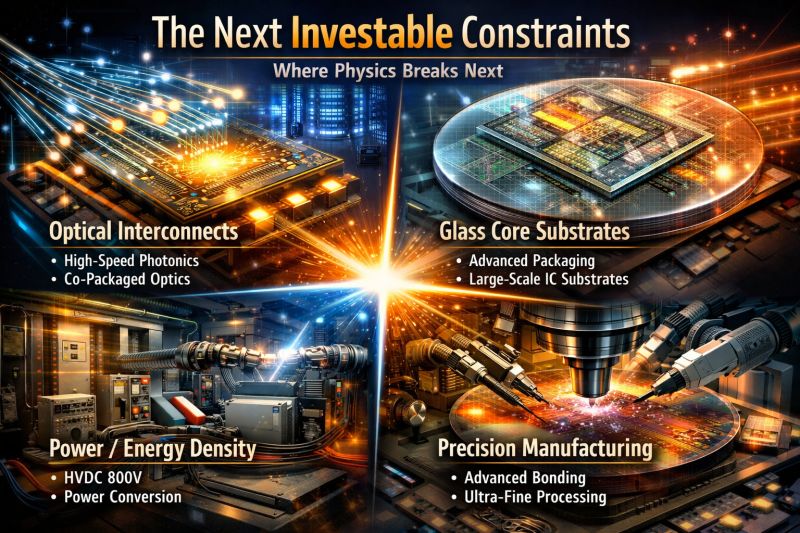
In a supply chain, the bottleneck determines the throughput of the entire system. If TSMC can fabricate 100,000 wafers per month but the packaging capacity only handles 60,000, the effective output is 60,000. The packaging provider has pricing power because expanding their capacity is the only way to increase total output.
This creates an asymmetric investment opportunity: constraint companies have disproportionate pricing power relative to their size. BESI (hybrid bonding, €5B market cap) can raise prices because no one else offers comparable hybrid bonding equipment. Vertiv and Modine (liquid cooling) can raise prices because every new GPU cluster needs cooling and deployment timelines are tight.
Advanced Packaging: CoWoS and hybrid bonding capacity. TSMC, BESI, Kulicke & Soffa. → Deep dive
Chip Testing: Advantest ATE equipment. → Deep dive
Thermal Management: Liquid cooling for AI clusters. Vertiv, Modine. → Deep dive
Glass Substrates: AGC, Corning, Intel. Next-generation packaging substrates replacing organic materials.
Precision Manufacturing: DISCO (wafer dicing), Tokyo Electron (deposition). Irreplaceable process steps.
Constraint sectors receive overweight allocation in the Functional Index's equal-weight variant precisely because their pricing power is structural, not cyclical. The thesis: in the AI build-out, invest where the bottlenecks are.
Functional Index →Packaging Bottleneck →Testing Bottleneck →