Legacy Exposure measures how much of a company's revenue comes from workflows that autonomous agents can replace. A company with 80% of revenue from manual data entry has high Legacy Exposure. A chip fabricator has near-zero.
Agent Benefit captures how much a company benefits from the rise of AI agents — either by providing infrastructure for them or by having products that agents enhance rather than replace.
Upside Unpriced identifies positive optionality the market hasn't recognized. A company quietly building an agent orchestration platform while the market values it on legacy revenue has high Upside Unpriced.
Downside Unpriced is the inverse: risk the market ignores. A SaaS company trading at 15x revenue while agents can replicate its core feature has high Downside Unpriced.
Confidence is a meta-dimension: how certain is our scoring? Early-stage disruption with limited data scores low confidence.
Natural Position: Companies that benefit from AI agents regardless of which agents win. Semiconductor companies, cloud providers, and infrastructure plays. They sell the picks and shovels.
Cannibalize or Die: Incumbents whose existing products are threatened, but who have the distribution, data, and resources to pivot — if they move fast enough. Microsoft, Salesforce, and Adobe sit here. Their stock price depends on execution speed.
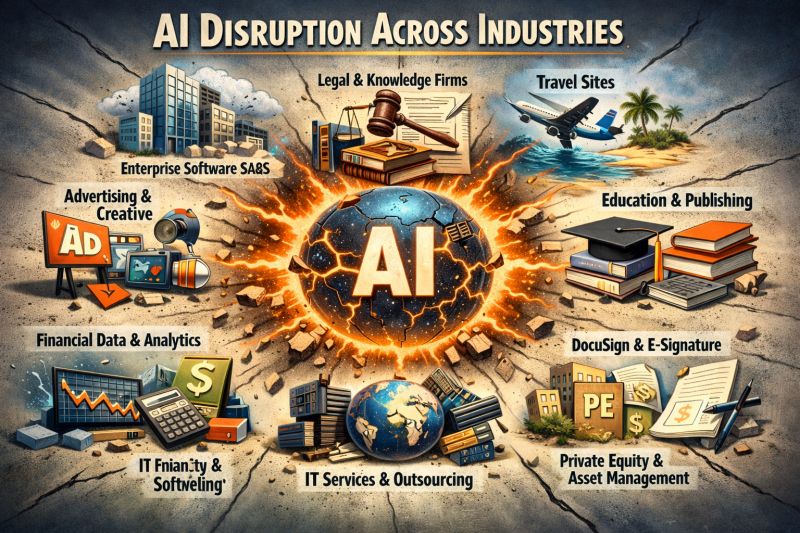
Terminal: Companies whose entire value proposition — the thing customers pay for — is something an agent does better, faster, and cheaper. The market hasn't priced this in because it seems futuristic. But agentic AI timelines are compressing.
The ABR Framework maps directly to the AI Barbell Strategy: go long Natural Position companies (infrastructure), short Terminal companies (disrupted SaaS), and manage Cannibalize or Die on a case-by-case basis based on execution signals.
The ABR Framework is applied across the Nasdaq 100 and extended to European tech. It feeds directly into portfolio construction — Natural Position stocks go into the AI Infrastructure portfolio, Terminal stocks become short candidates. The framework is updated quarterly as agentic AI capabilities evolve.
ABR Framework — Full Analysis →SaaSpocalypse Map (Dossier) →SaaSpocalypse — 101 Entry →