Part 1: The Economics of Asymmetric Warfare
Three active conflicts — Ukraine-Russia, the Middle East escalation including Iran's direct strikes on U.S. bases and Israel, and the Houthi campaign in the Red Sea — have delivered the same brutal lesson: the military doctrines and weapons systems that defined the Cold War era no longer work.
The core problem is economic, not tactical. A Patriot PAC-3 MSE interceptor costs between $3.9 and $7 million per shot. The U.S. Army's interceptor stockpiles had fallen to roughly 25% of required levels by mid-2025 — and Washington has since quadrupled planned PAC-3 procurement to nearly 14,000 missiles at a cost of $40 billion to replenish what combat has consumed.
Meanwhile, an Iranian Shahed drone costs as little as $20,000 to build. The math is devastating.
When an adversary can launch hundreds of low-cost drones per day, defending with missiles that cost 200 times more per engagement is not a strategy — it's a path to financial exhaustion. Ukraine demonstrated this in real time: Patriot intercept rates against modified Russian Iskander missiles dropped sharply as Russia adapted terminal-phase maneuver profiles. The Financial Times documented this deterioration. The system designed to protect a continent was being gamed by mid-flight evasion.
The conclusion is inescapable. Every military on the planet must now invest in two things simultaneously: cheap, expendable autonomous offensive systems (drones, loitering munitions, swarm technology) and entirely new defensive paradigms (directed energy, electronic warfare, AI-guided rapid-fire systems). This is not a one-year procurement cycle. This is a generational restructuring of how wars are fought.
Part 2: HALO's Strongest Sectors in 2026
The market has noticed. Within the Closelooknet HALO Functional Index — our 100-constituent "Smart Atoms" index tracking growth companies outside the classic AI stack of chips, cloud, and software — three sectors dominate the YTD leaderboard. All three share one characteristic: they benefit from geopolitical necessity, not LLM hype.
The common thread: physical infrastructure that cannot be digitised away by a chatbot, that requires real-world engineering and manufacturing, and is suddenly in urgent demand globally. These sectors use AI — embedded in drones, sensor fusion, autonomous navigation — but their moats are physical, not algorithmic. Defense leads because the demand shock is most acute — but Space (dual-use reconnaissance, communications) and Nuclear (energy security for military bases and grid resilience) are part of the same geopolitical rewiring.
Part 3: Inside the HALO Defense Sector
Our Autonomous Defense & Drones sector comprises ten companies across four countries, spanning the full spectrum from small-cap pure-play drone makers to large-cap defense platforms undergoing autonomous transformation.
| Ticker | Company | Country | Cap | Focus |
|---|---|---|---|---|
| AVAV | AeroVironment | US | Mid | Switchblade, Puma drones · directed energy (BlueHalo) |
| KTOS | Kratos Defense | US | Mid | Autonomous combat drones (Valkyrie, XQ-58A) |
| RCAT | Red Cat Holdings | US | Small | Teal 2 recon drone · U.S. Army SRR program |
| AXON | Axon Enterprise | US | Large | Taser, body cams, AI-driven public safety platform |
| TDY | Teledyne Technologies | US | Large | Sensors, imaging, defense electronics |
| SAAB-B.ST | Saab AB | Sweden | Large | Gripen, RBS 70, Carl-Gustaf · European sovereignty play |
| 012450.KS | Hanwha Aerospace | South Korea | Large | K9 howitzer, drone engines · Asia-Pacific rearmament |
| HAG.DE | Hensoldt | Germany | Mid | Radar, sensors · NATO surveillance electronics |
| KOG.OL | Kongsberg Gruppen | Norway | Mid | Naval Strike Missile, NASAMS, autonomous naval systems |
| DRO.AX | DroneShield | Australia | Small | Counter-drone detection · C-UAS specialist |
The geographic and cap-size diversity is intentional. This is not a bet on one contractor or one country — it's exposure to the global autonomous defense supply chain. Axon and Teledyne provide large-cap stability. AVAV, KTOS, and Kongsberg are the pure-play autonomous weapons and systems providers. Saab and Hanwha Aerospace are the European and Asian pillars of the NATO/allied rearmament cycle. The small-caps — Red Cat and DroneShield — carry the highest risk but also the highest torque if drone adoption accelerates.
Two names stand out for their positioning at the intersection of autonomous systems, geographic diversification, and multi-segment resilience.
Kongsberg is the rarest kind of defense company — one that doesn't need a single conflict to justify its business model, yet benefits enormously when conflicts expose the inadequacy of legacy systems. The Norwegian group operates across three distinct segments, each with its own growth engine and civilian-military crossover.
The NASAMS system — co-developed with Raytheon — has become one of the most sought-after medium-range air defense solutions globally, proven in Ukraine. The Naval Strike Missile is deployed by the U.S. Navy. And the F-35 supply chain contract provides long-duration revenue visibility. What makes Kongsberg compelling is the balance: roughly half of revenue comes from civilian maritime and discovery segments, providing a natural hedge that most pure-play defense names lack.
If Kongsberg represents the sophisticated European defense ecosystem, Hanwha Aerospace is its Asian counterpart — and arguably the single most important non-Western defense growth story of the decade. Backed by the Hanwha Group (one of South Korea's largest conglomerates), this is a company that has gone from regional contractor to global NATO supplier in under five years.
The K9 howitzer story encapsulates the entire European rearmament thesis in one product. Poland signed the largest-ever Korean arms export deal to acquire hundreds of K9 units — with a local production facility in Poland now under construction. This isn't just an arms sale; it's a technology transfer that positions Hanwha as a permanent fixture in European defense supply chains. Cooperation with Spain's Indra on next-generation artillery systems, and the Norwegian production agreement, signal a company that is embedding itself across NATO rather than merely selling to it. As Europe ramps from 2% to 3.5% of GDP on defense, Hanwha is uniquely positioned to capture spend that European industrial capacity alone cannot fulfil.
Part 4: The Multi-Year Tailwind — This Is Just the Beginning
The investment case goes far beyond 2026 returns. What has changed is the structural baseline of global defense spending — and the shift is unprecedented in peacetime.
Europe's Rearmament Cycle
At the NATO Summit in The Hague in June 2025, allied heads of state agreed to spend 3.5% of GDP on core defense by 2035 — nearly double the 2% target that most members struggled to meet for a decade. The EU's own numbers tell the story: defense investments across EU member states hit €106 billion in 2024 (up 42% year-over-year) and are projected to reach €130 billion in 2025. The European Commission's ReArm Europe plan aims to mobilise over €800 billion through national budgets, the €150 billion SAFE loan instrument, and EIB lending.
Germany alone has committed to reaching 3.05% of GDP by 2029, with its defense budget expected to roughly double to €162 billion. A constitutional fiscal reform unlocked approximately €500 billion in additional defense funds. Poland is already spending over 4% of GDP. The Baltics, Nordics, and Eastern European states are accelerating even faster.
Asia-Pacific: The Parallel Build-Up
Europe's rearmament is mirrored across the Indo-Pacific. Japan's record defense budgets, South Korea's expanding arms exports (Hanwha's K9 howitzer is now deployed by seven NATO armies), and Australia's AUKUS-driven naval and surveillance investments all create parallel demand for exactly the kind of autonomous systems and defense electronics our HALO Defense constituents produce.
The United States: Replenishment + Modernisation
The U.S. Army's decision to quadruple PAC-3 MSE procurement to nearly 14,000 missiles at $40 billion is just the replenishment bill. The real transformation is the Pentagon's Replicator initiative, which aims to field thousands of autonomous systems across all service branches — drones, unmanned undersea vehicles, and AI-enabled sensor networks. This is the market that AVAV, Kratos, and the next generation of defense contractors are built for.
The Structural Thesis
Three wars have proven that Cold War doctrine is dead. Global defense budgets are entering a multi-year structural expansion — not a cyclical spike. The demand is for autonomous systems, not legacy platforms.
Conclusion
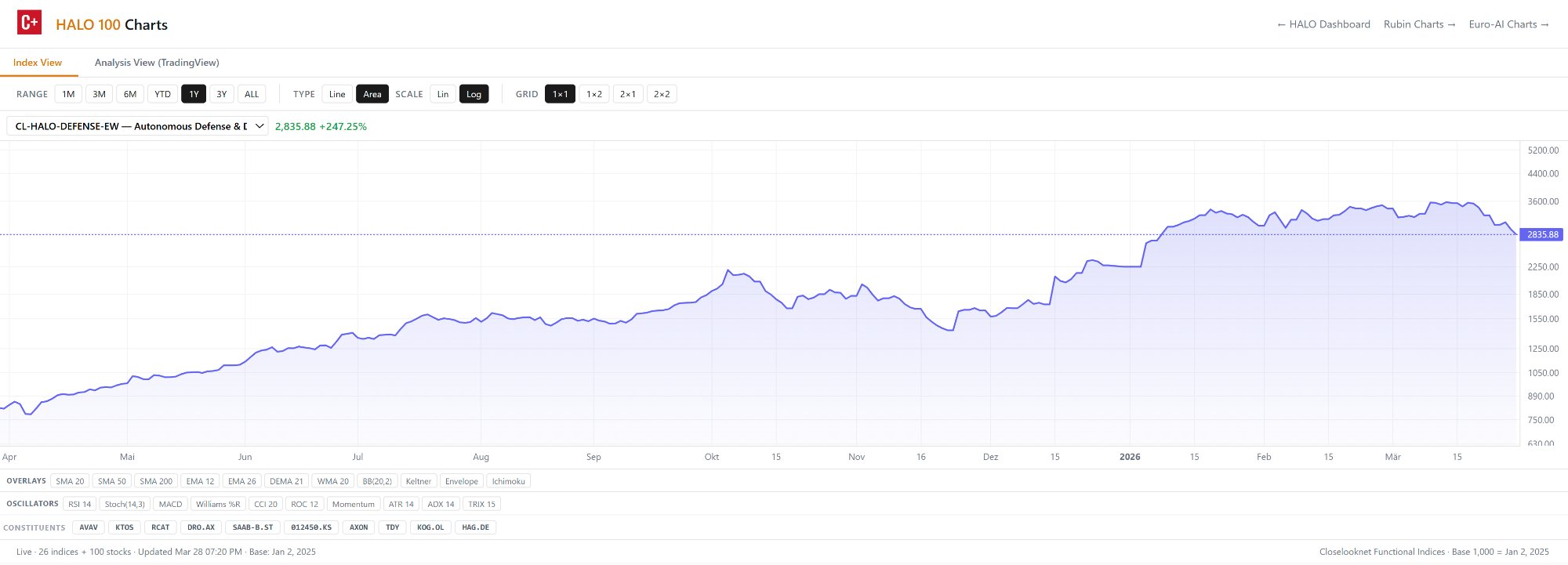
The HALO Defense & Drones sector at +25.98% YTD is not a momentum trade. It is the market pricing in a generational shift in how the world spends on security. Three active wars have compressed what would normally be a decade-long doctrinal evolution into two years of real-world validation: autonomous beats legacy, cheap beats expensive, mass beats precision.
The rearmament cycle is not over — by most measures, it is still in its early innings. European defense investments doubled in three years and are projected to double again by the end of the decade. U.S. replenishment orders alone run into the tens of billions. And the technology shift from manned platforms to autonomous systems creates a structural growth premium for the companies in this space that will persist long after the current conflicts end.
The recent pullback from mid-March highs is worth watching. If the thesis is right — and three wars suggest it is — this drawdown is not a warning. It is an opportunity.
Explore the full HALO Defense sector live:
Index Chart with Overlays & Oscillators →
HALO Functional Index — All 12 Sectors →